
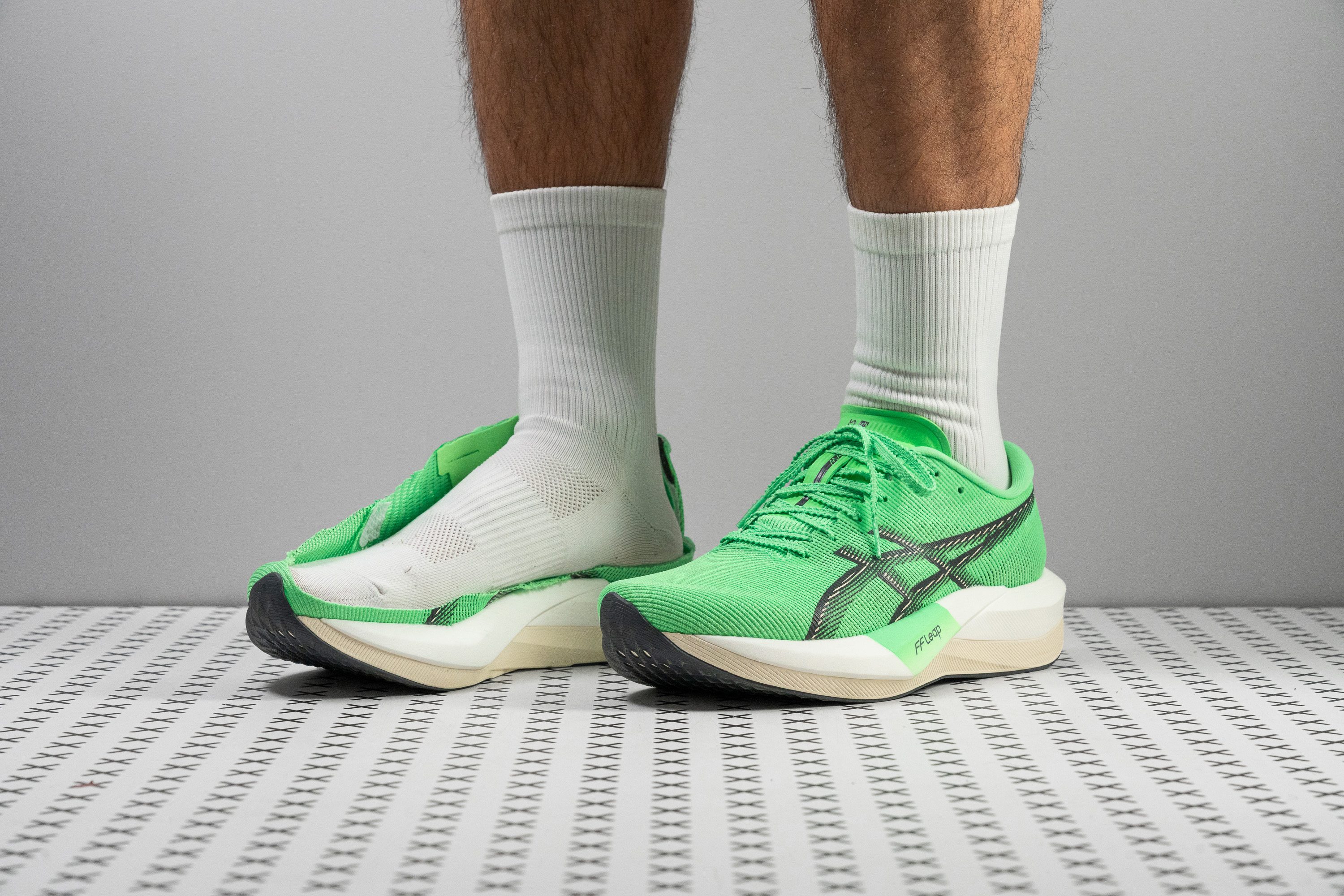





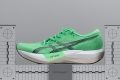



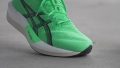
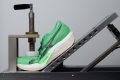
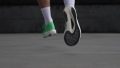
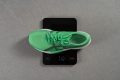


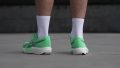


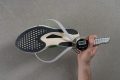
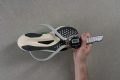








Nuestra conclusión
- Tiradas diarias / rodajes 68
- Tempo 89
- Competición 86
- Estabilidad 55
Pros
- ¡Se vuelven a sentir como las Magic Speed!
- Hechas totalmente de Espuma FF Leap
- Caucho ASICSGRIP con un agarre increíble
- Muy transpirables
- Geometría ágil e inspirada en la competición
- Precio razonable
- Buenas zapatillas de competición para principiantes
- Más flexibles que las superzapatillas
- Sistema de cordones excelente
Contras
- Retorno de energía limitado por la espuma FF Blast+
- Pueden ser demasiado extremas para los talonadores
- A la gente que se toma en serio el running no le gustan
Premios
- Entre mejores zapatillas ASICS de running
- Entre mejores zapatillas de running para medio maratón
- Top 25% entre Zapatillas de running para asfalto
- Top 23% entre zapatillas de running neutras
- Top 29% más vendidas zapatillas de running
Comparativa
Las zapatillas de running más parecidas
+ + Añadir unas zapatillas | |||||
|---|---|---|---|---|---|
| Nuestra puntuación | 86 Geniales | 88 Magníficas | 92 Magníficas | 92 Magníficas | |
| Precio | 190 € | 250 € | 270 € | 270 € | |
| Ritmo | Tempo / seriesCompetición | Competición | Competición | Competición | |
| Absorción de impactos | Alta | Alta | Alta | Alta | |
| Retorno de energía | Moderado | Alto | Alto | Alto | |
| Tracción | Alta | Alta | Alta | Alta | |
| Sujeción arco del pié | Neutral | Neutral | Neutral | Neutral | |
| Peso laboratorio Peso marca | 7.1 oz / 201g 6.9 oz / 196g | 7.8 oz / 220g 7.4 oz / 210g | 5.6 oz / 159g 6 oz / 170g | 5.7 oz / 163g 6 oz / 170g | |
| Ligero | ✓ | ✓ | ✓ | ✓ | |
| Drop laboratorio Drop marca | 8.7 mm 7.0 mm | 10.0 mm 7.0 mm | 6.9 mm 5.0 mm | 6.0 mm 5.0 mm | |
| Técnica de carrera | TalónMedio/antepié | TalónMedio/antepié | Medio/antepié | Medio/antepié | |
| Talla | Tallan bien | Tallan un poquito pequeño | Tallan bien | Tallan bien | |
| Rigidez de la mediasuela | Blanda | Equilibrada | Blanda | Blanda | |
| Diferencia de la rigidez de la mediasuela en frío | Pequeña | Pequeña | Pequeña | Pequeña | |
| Durabilidad de la parte delantera | Mala | Decente | Mala | Mala | |
| Durabilidad del acolchado del talón | Alta | Alta | Alta | Alta | |
| Durabilidad de la suela exterior | Buena | Buena | Buena | Decente | |
| Transpirabilidad | Alta | Alta | Alta | Alta | |
| Anchura / ajuste | Media | Estrecha | Estrecha | Estrecha | |
| Anchura de la parte delantera | Media | Estrecha | Media | Estrecha | |
| Flexibilidad | Moderada | Rígida | Moderada | Rígida | |
| Rigidez torsional | Moderadas | Moderadas | Moderadas | Rígidas | |
| Rigidez del contrafuerte del talón | Moderado | Flexible | Flexible | Flexible | |
| Placa | Placa de carbono | Placa de carbono | Placa de carbono | Placa de carbono | |
| Con rocker | ✓ | ✓ | ✓ | ✓ | |
| Talón laboratorio Talón marca | 35.3 mm 37.5 mm | 39.6 mm 40.0 mm | 38.9 mm 39.5 mm | 38.7 mm 39.5 mm | |
| Antepié laboratorio Antepié marca | 26.6 mm 30.5 mm | 29.6 mm 33.0 mm | 32.0 mm 34.5 mm | 32.7 mm 34.5 mm | |
| Anchuras disponibles | EstándarAncho | Estándar | EstándarAncho | Estándar | |
| Compatibles con plantillas personalizadas | ✓ | ✓ | ✓ | ✓ | |
| Estación | VeranoTodas las estaciones | VeranoTodas las estaciones | VeranoTodas las estaciones | VeranoTodas las estaciones | |
| Plantilla extraíble | ✓ | ✓ | ✓ | ✓ | |
| Clasificación | #89 Top 23% | #50 Top 13% | #16 Top 4% | #11 Top 3% | |
| Popularidad | #113 Top 29% | #98 Top 25% | #170 Top 43% | #15 Top 4% |



Quién debería comprárselas
Las ASICS Magic Speed 5 han vuelto totalmente renovadas para ser las compañeras perfectas de:
- Los principiantes que están buscando sus primeras zapatillas con placa de carbono con las que disfrutar de los entrenamientos por intervalos y de los ejercicios más rápidos.
- Los runners que quieren un modelo ligero, ágil y divertido que sea más asequible que la mayoría de las zapatillas de competición.
- Los fans de las Magic Speed 3 a los que les decepcionó la versión 4 y pedían "borrón y cuenta nueva" con un modelo más ligero y reactivo.
Quién NO debería comprárselas
Entendemos perfectamente que el precio más asequible de las Magic Speed 5 te llame la atención, pero no nos parecen la mejor opción para los deportistas que se toman más en serio el running. Si lo que marca el cronómetro es crucial para ti, lo mejor es que vayas a por todas, y ASICS tiene tres superzapatillas estupendas para eso: las Metaspeed Edge Tokyo, las Metaspeed Sky Tokyo y las Metaspeed Ray.
También creemos que los corredores a los que les gustan las suelas maximalistas no les va a encantar la de estas zapatillas. Como son más bajitas, la experiencia cambia; en nuestra opinión, los deportistas que estén buscando la máxima amortiguación deberían echarle un ojo a las ASICS Sonicblast, que nos parecen las sucesoras no oficiales de las Magic Speed 4.
Amortiguación
Shock absorption
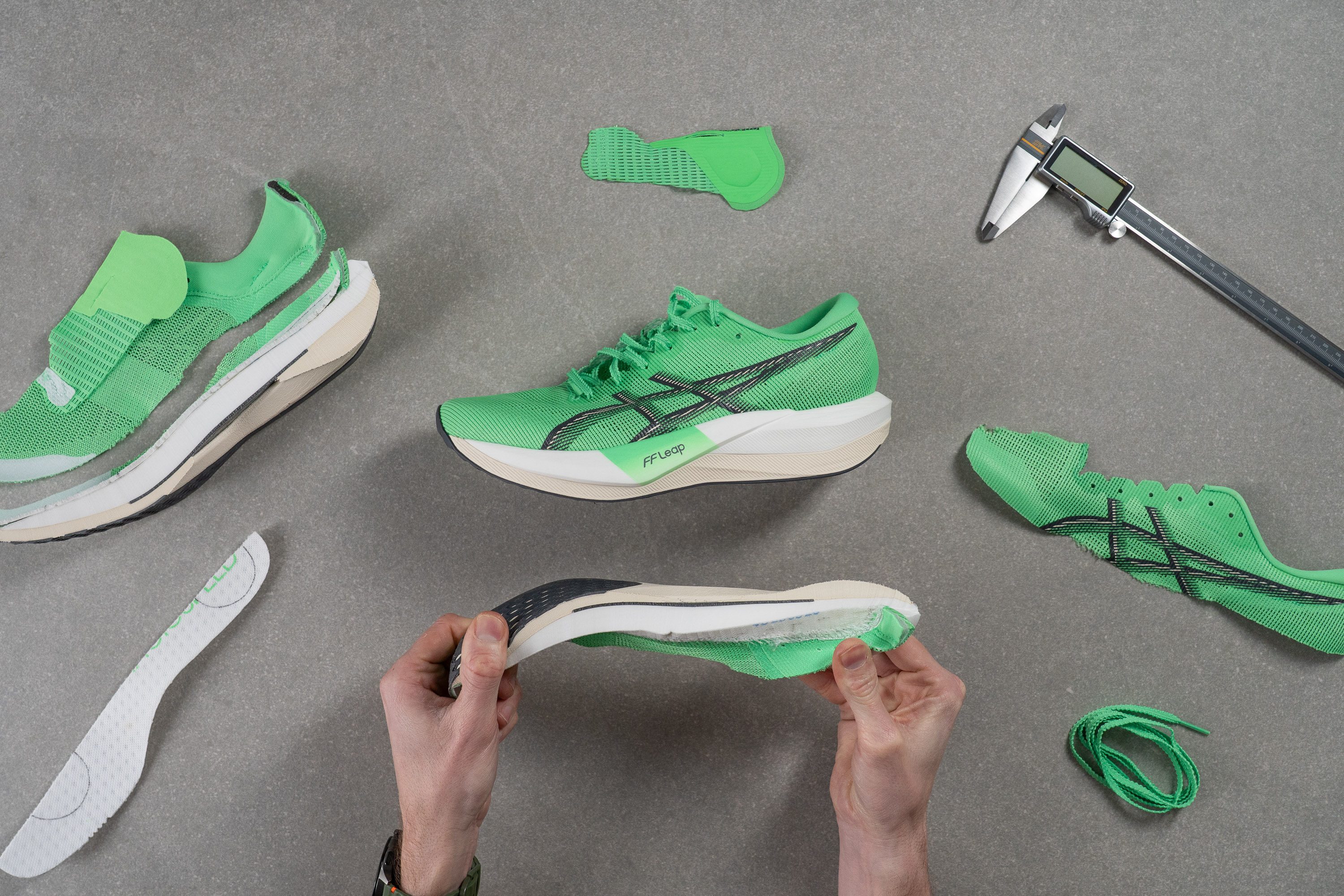
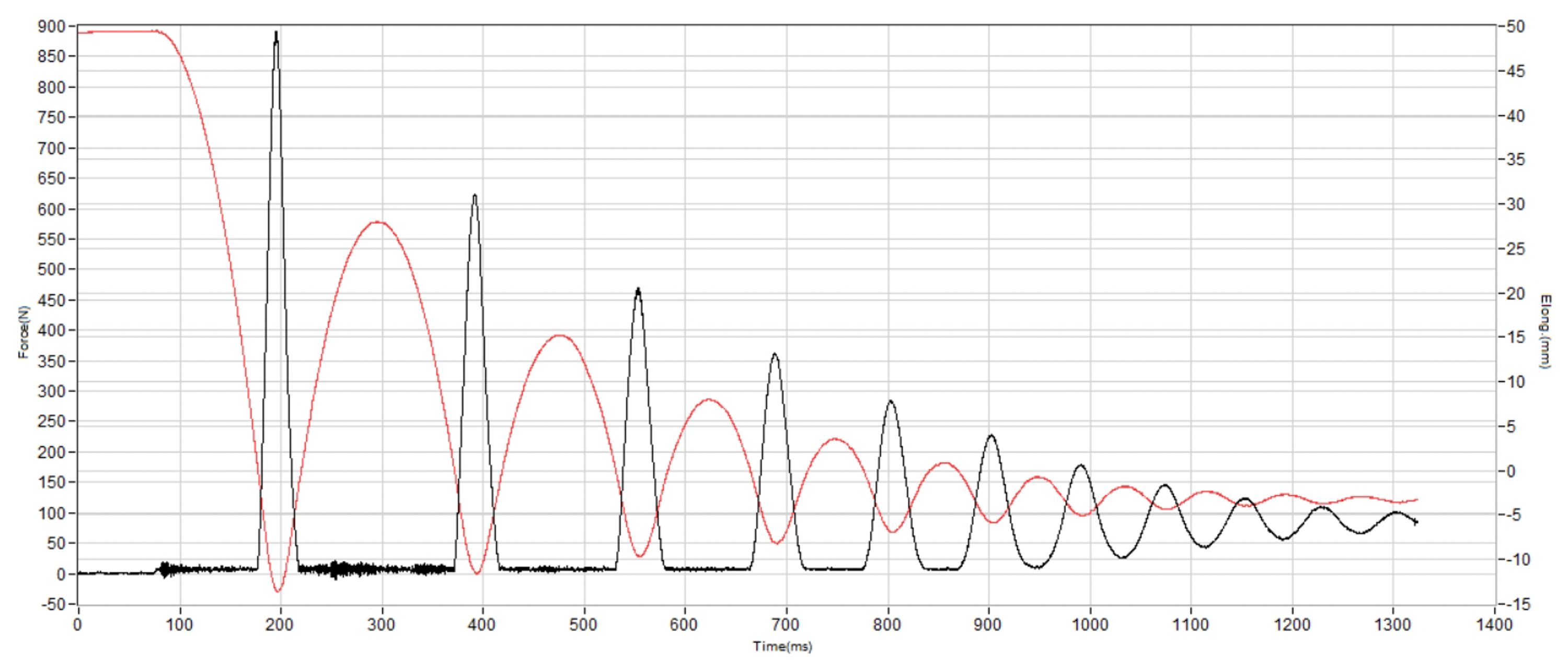
La absorción de impactos de las Magic Speed 5 es genial, con 149 SA en el talón y 112 SA en el antepié. A ver, tampoco es que sea un locurote, pero al final es lo que hay con su suela bajita. Incluso así, estas zapatillas proporcionan protección suficiente para las carreras largas, sobre todo para los talonadores.
| Magic Speed 5 | 149 SA |
| Media | 131 SA |
Energy return
Las ASICS Magic Speed 5 utilizan una mezcla de espumas interesante, combinando una capa superior de la maravillosa FF Leap con una capa inferior de la mucho menos energética FF Blast+. Es como mezclar oro con estaño, la verdad, y el resultado ha sido un retorno de energía decente del 64,6 % en el talón y del 62,6 % en el antepié.
No está mal (además supera a las decepcionantes Magic Speed 4) pero, incluso así, nos parece un poquito bajo para las competiciones serias. Personalmente, a nosotros nos parece que la marca ha perdido una oportunidad, ya que simplemente con haber utilizado FF Blast Max en lugar de FF Blast+ probablemente el rebote habría subido hasta cerca del 70 %.
| Magic Speed 5 | 62.6% |
| Media | 61.4% |
Altura de la suela en la zona del talón
Las Magic Speed 4 se alejaron mucho de la idea original detrás de la línea Magic Speed. A juzgar por la respuesta de ASICS, parece que ese enfoque no funcionó muy bien si nos centramos en las ventas.
Con las Magic Speed 5, la marca claramente se aleja de esa dirección maximalista. La altura del talón baja de los enormes 42,5 mm de la vesión anterior a 35,3 mm, y la verdad es que nos parece una corrección inteligente y muy acertada. Las Magic Speed vuelven a sentirse ágiles y ligeras.
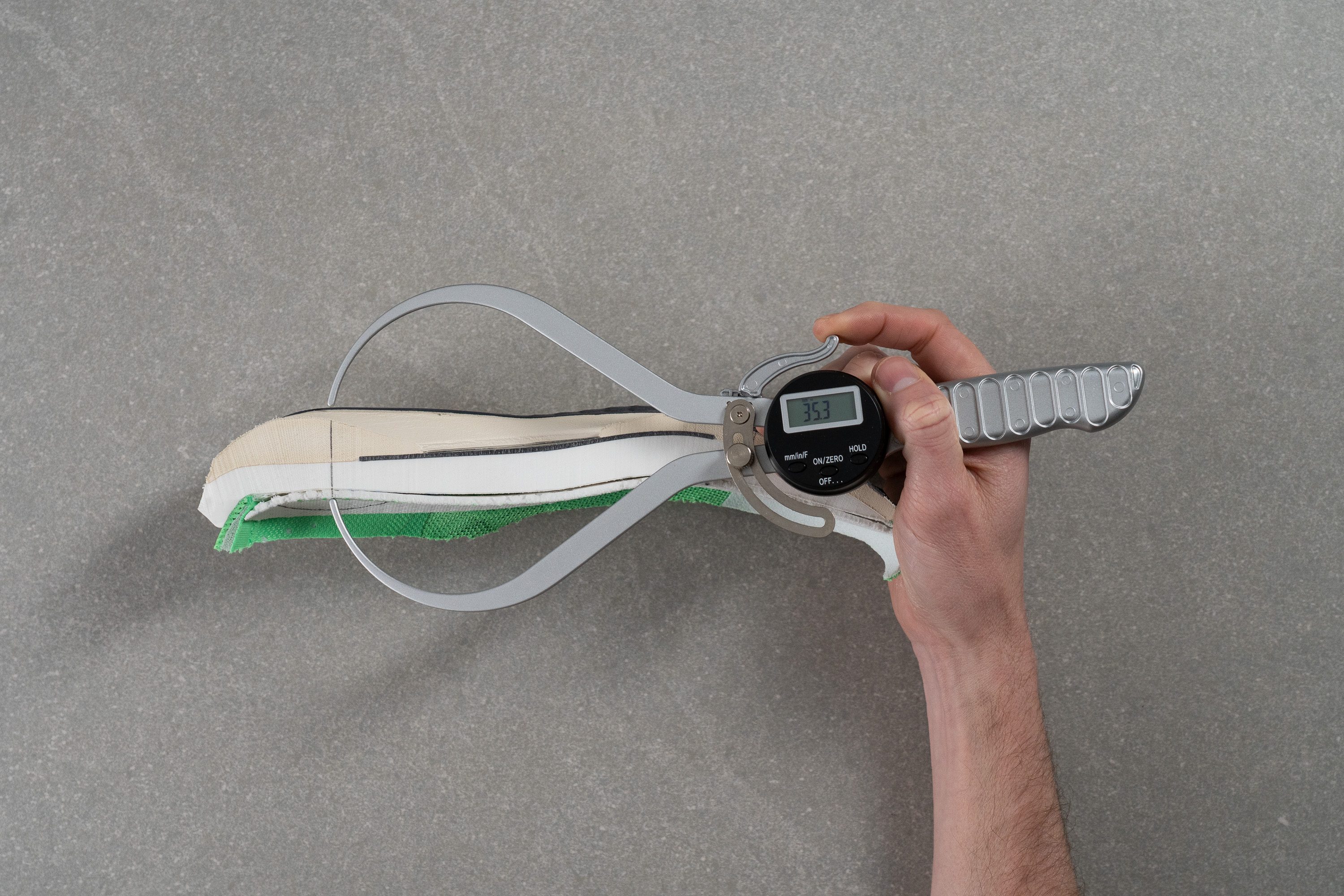
| Magic Speed 5 | 35.3 mm |
| Media | 35.5 mm |
Altura de la suela en el antepié
La suela también es bastante más finita, así que ahora está más cerca de la media con sus 26,6 mm. La pisada nos pareció más directa y conectada con el suelo en cada paso, lo que hace que estas zapatillas sean una mejor opción para correr a mayor velocidad.
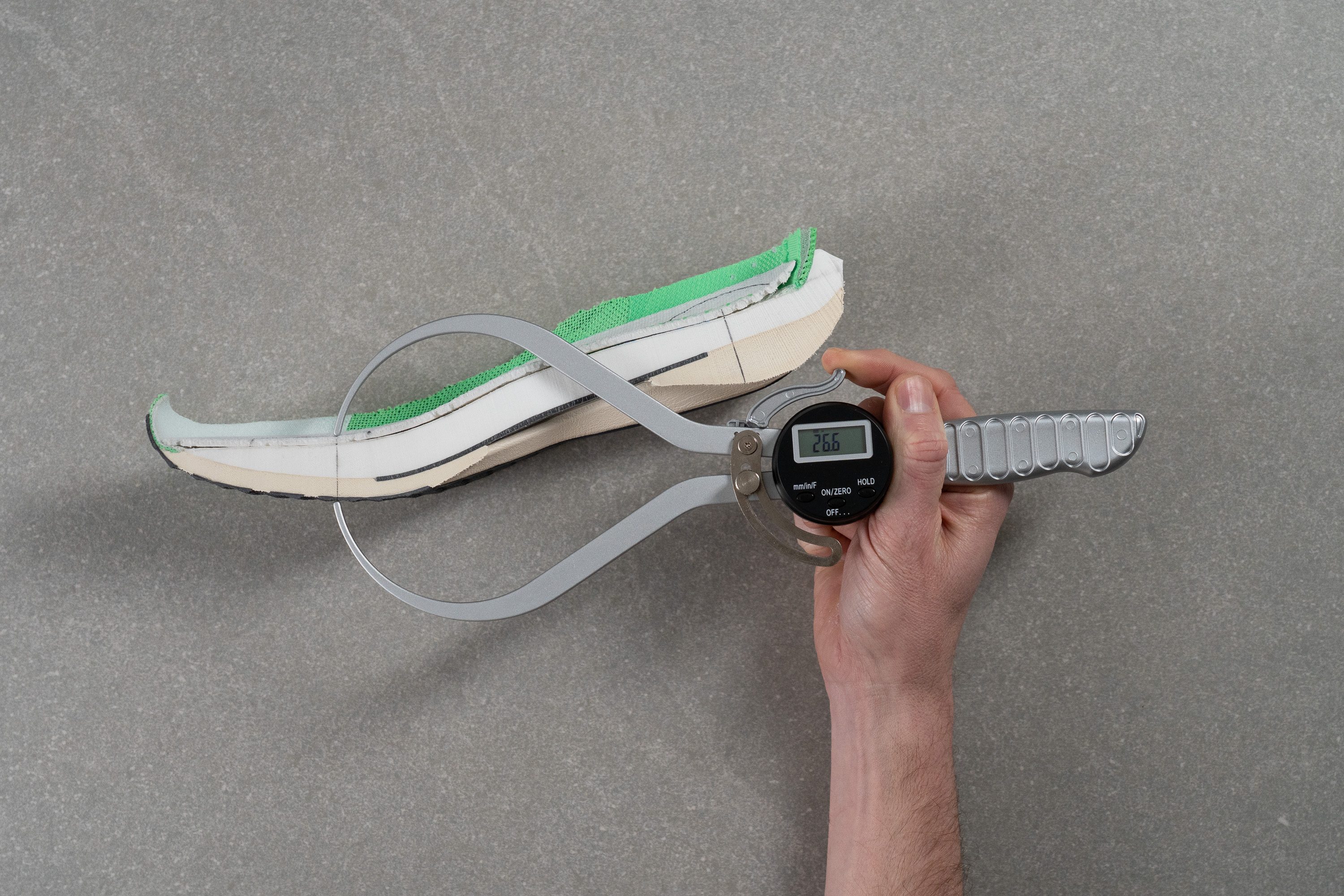
| Magic Speed 5 | 26.6 mm |
| Media | 27.1 mm |
Drop
ASICS nos dice que estas zapatillas tienen un drop 7 mm, pero a nosotros nos dio 8,7. Es un resultado parecido y, la verdad, coincide con la sensación que nos espérabamos. No es un resultado que nos sorprendiese, aunque por un momento pensamos que ASICS se iba a atrever con un drop más bajo inspirado en la línea Metaspeed.
Para unas zapatillas que están pensadas para ser una versión que se adapte mejor a los principiantes y derivada del concepto Metaspeed, su drop alto nos parece lógico, ya que se debería adaptar mejor a una gama más amplia de corredores.
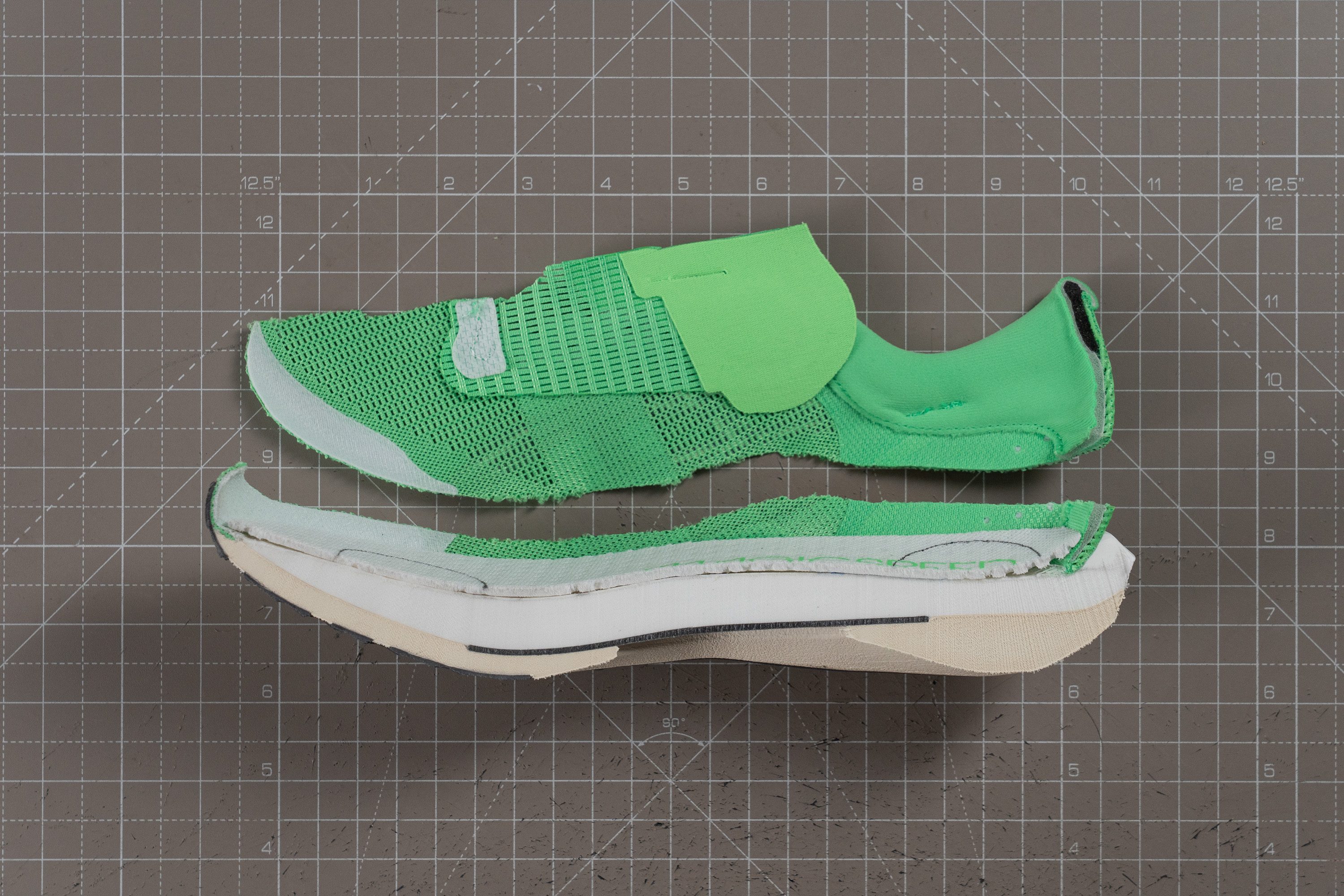
| Magic Speed 5 | 8.7 mm |
| Media | 8.4 mm |
Dureza de la mediasuela
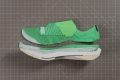
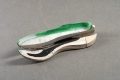
La industria de las zapatillas de running está avanzando rápidamente hacia las espumas A-TPU, y la FF Leap es uno de los mejores ejemplos de lo bueno que puede ser este material. Sus 27,0 AC la hacen divertida, blanda y además tiene rebote. La línea Magic Speed también incorpora esta espuma, que es un paso adelante muy positivo.
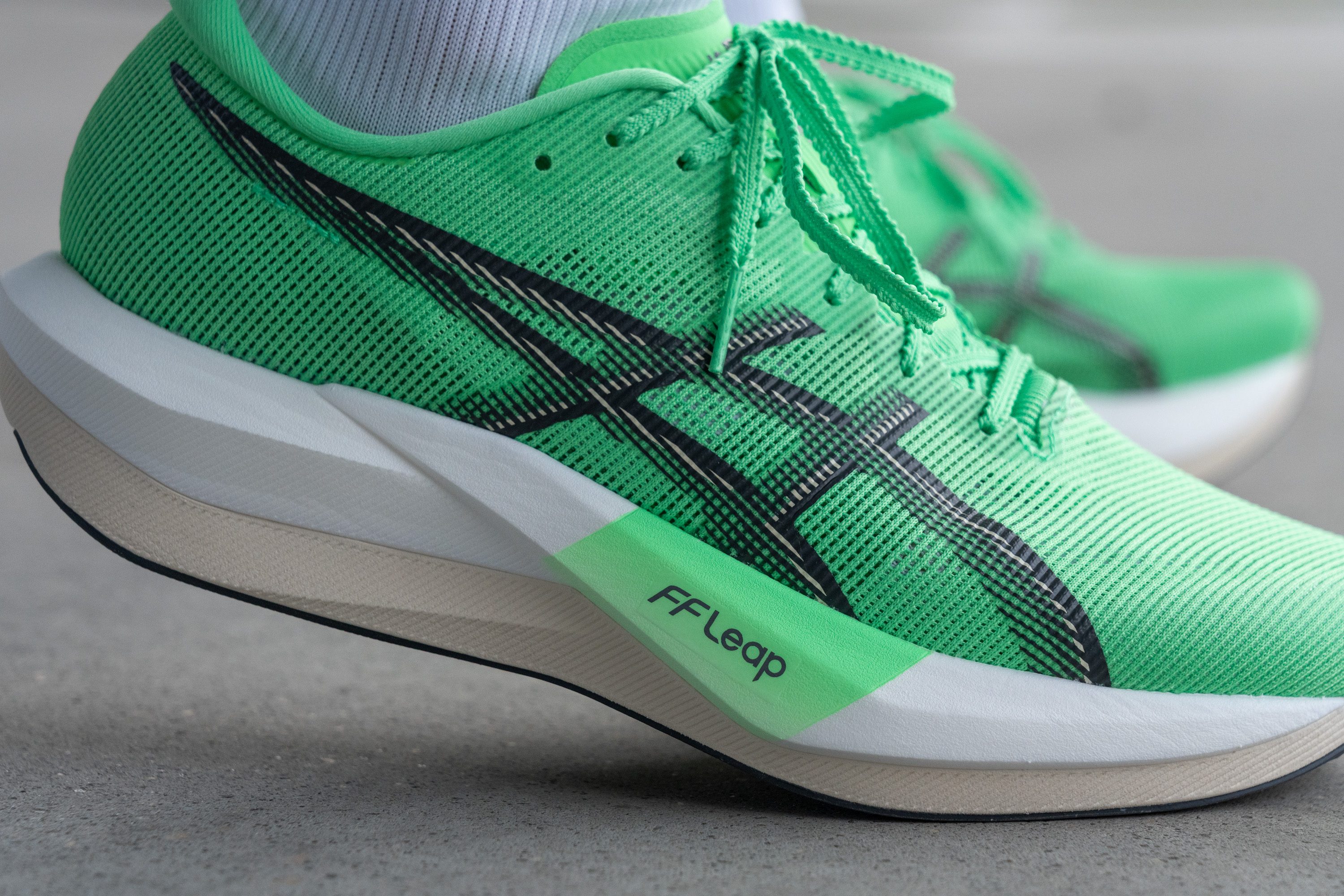
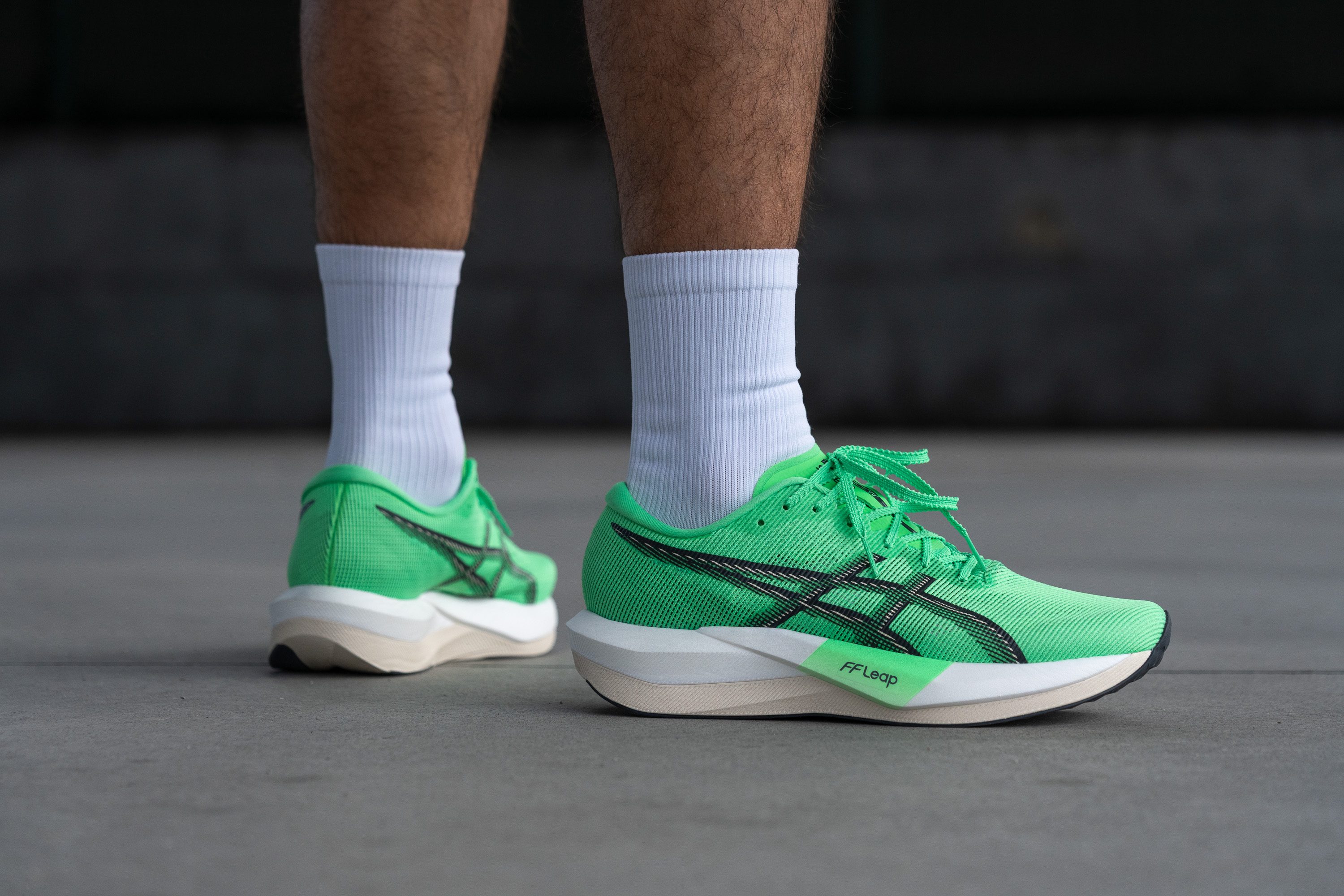
También es importante mencionar que, esta vez, la espuma FF Leap es una capa completa. Cuando cortamos las Magic Speed 4 por la mitad, la espuma FF Turbo era solo como un pequeño disco en el antepié, cosa que nos dejó un poco confundidos. En este modelo, ASICS utiliza correctamente la FF Leap, y ese cambio marca la diferencia.
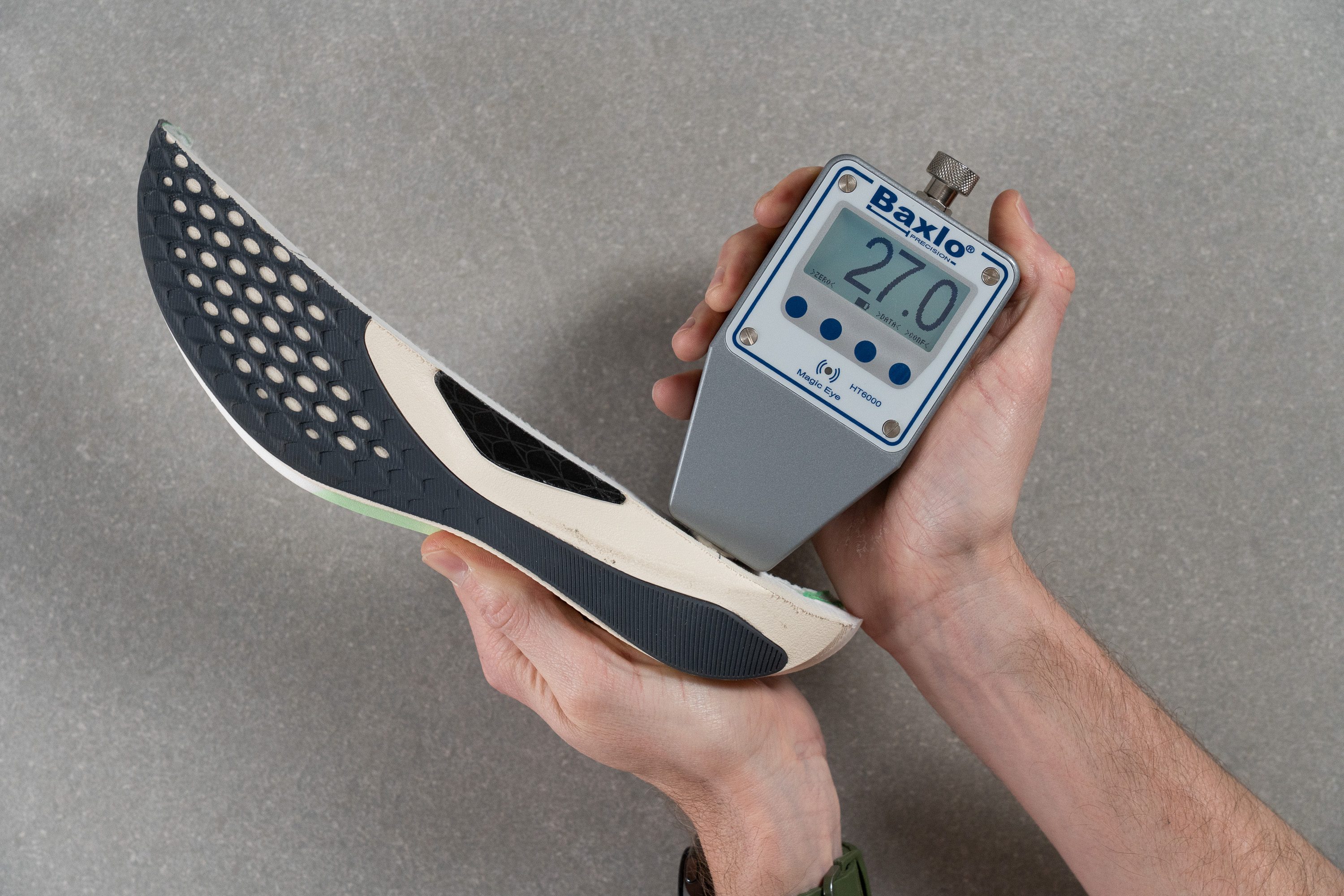
| Magic Speed 5 | 27.0 AC |
| Media | 35.5 AC |
Rocker
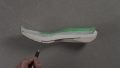
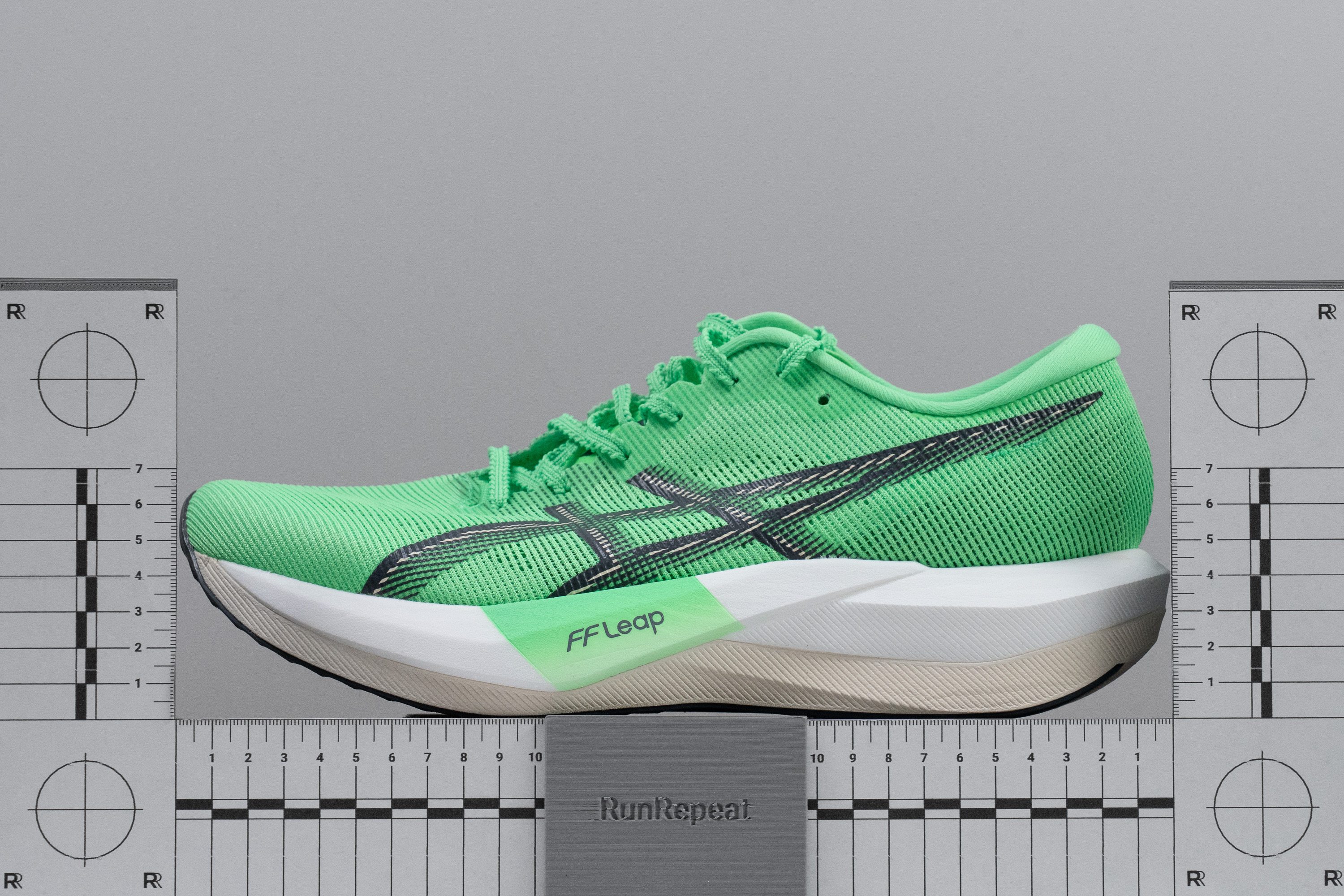
Al alejarse de esa suela gigantesca de la versión anterior, ASICS también suavizó el rocker. Incluso así, el antepié mantiene una curvatura agresiva inspirada en la serie Metaspeed.
Placa
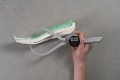
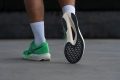
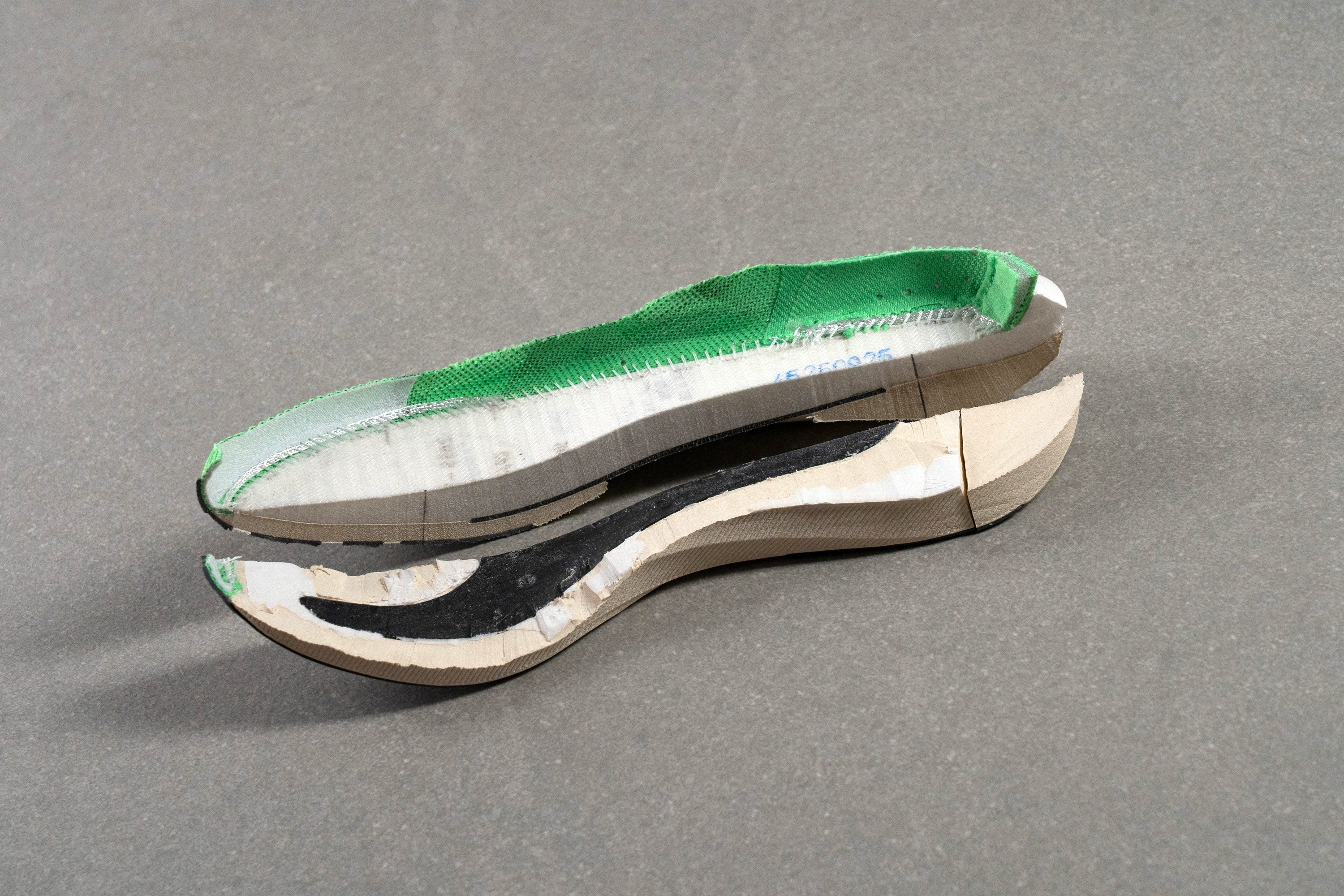
La placa de las Magic Speed 5 representa otro gran cambio con respecto a las versiones anteriores. Este modelo tiene una placa de carbono que se extiende desde el final del talón hasta el principio del antepié, cubriendo aproximadamente el 70 % de la mediasuela. O, al menos, esa sería la conclusión a la que llegaría cualquiera después de ver este video, ¿verdad?
Pero nosotros analizamos más en detalle estas zapatillas y descubrimos que las Magic Speed 5 utilizan una placa dividida en el antepié, parecida a la de otras que hemos visto en algunos modelos de trail running. Esto hace que estas ASICS sean más flexibles, evitando esa clásica rigidez extrema que proporciona una placa completa de carbono.
En cuanto a la geometría, la sentimos más parecida a la de las Edge que a la de las Sky, pero más flexible, ya que está diseñada para ser más tolerante y adecuada para los principiantes.
Tallaje y ajuste
Talla
Las ASICS Magic Speed 5 tallan bien (52 votos).
Longitud interna
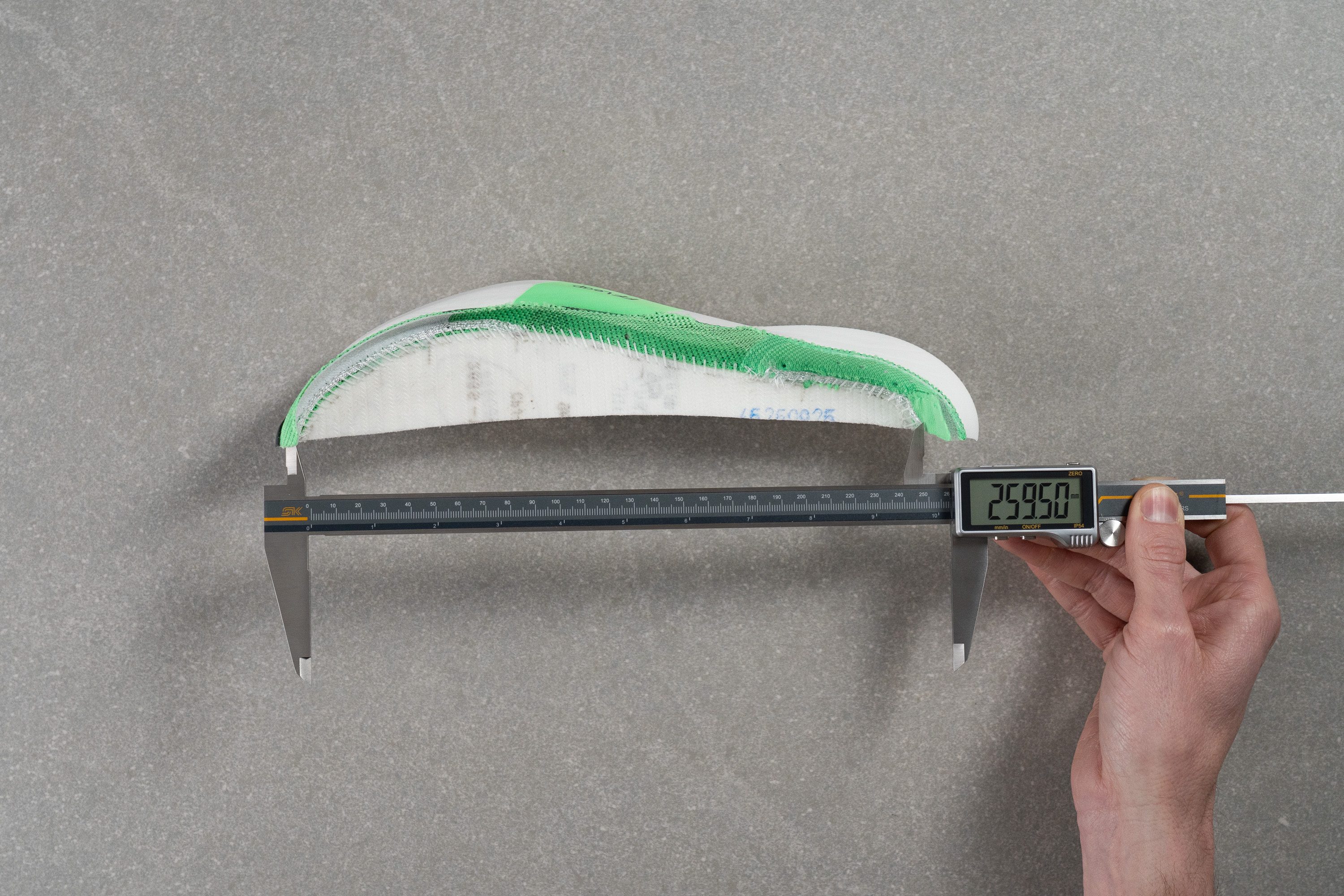
| Magic Speed 5 | 259.5 mm |
| Media | 269.4 mm |
Anchura / Ajuste
En nuestras pruebas de uso corriendo con ellas, el ajuste de las Magic Speed 5 cumple con lo que promete: es bastante cómodo, aunque claramente está diseñado pensando en la competición, así que se siente más ceñido cuanto más te acercas a los dedos.
Pero claro, el ajuste es algo muy subjetivo, así que preferimos basarnos en datos objetivos que obtenemos de nuestro laboratorio. Empezando con nuestra primera medida, vimos que la anchura es estándar, de 95,1 mm.
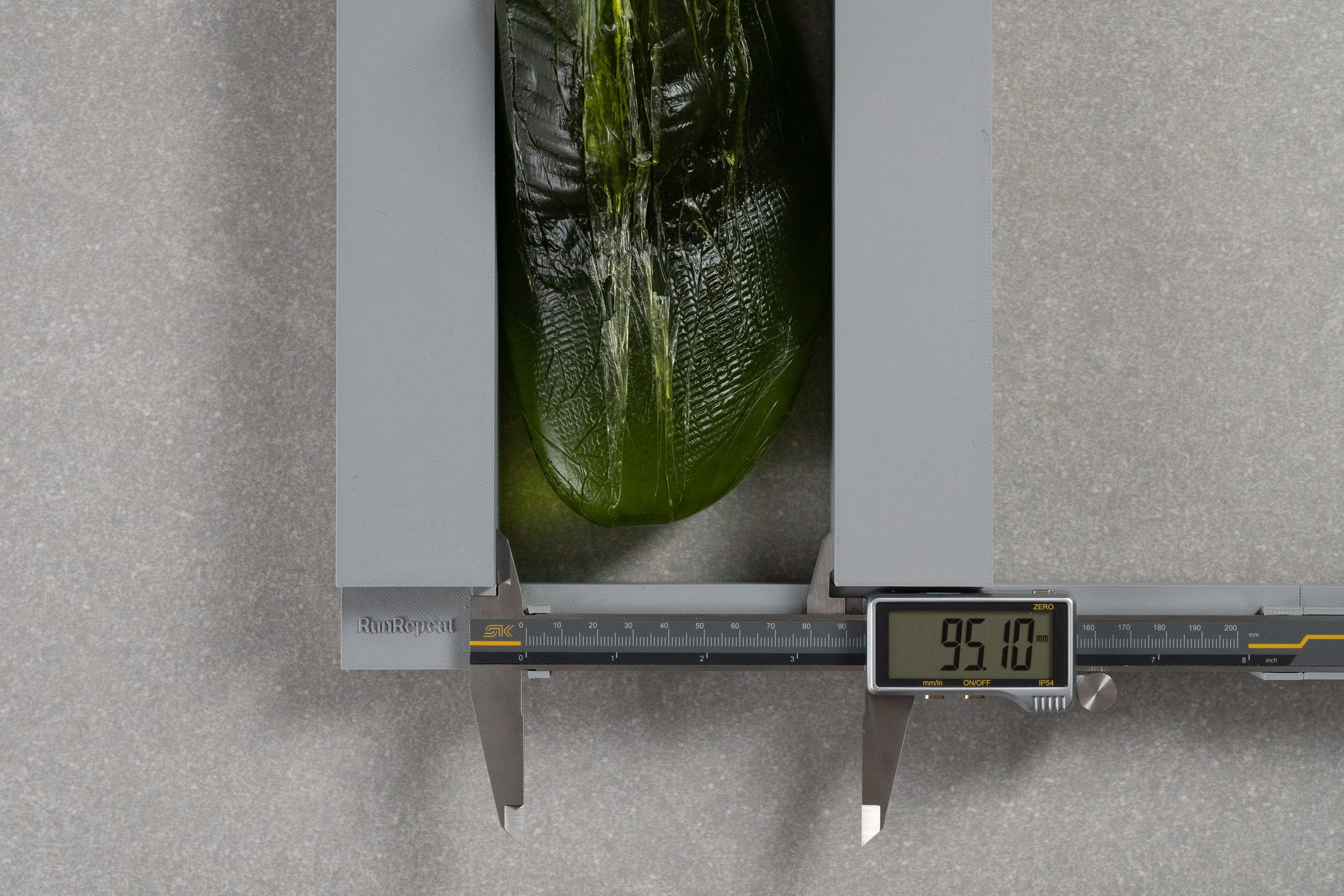
| Magic Speed 5 | 95.1 mm |
| Media | 95.2 mm |
Anchura de la parte delantera
La parte delantera se estrecha un poco, hasta 71,9 mm, lo que debería adaptarse bien a la mayoría de los corredores. Sin embargo, las personas que tienen los pies muy anchos a lo mejor sienten más presión, sobre todo si se enfrentan a distancias largas.
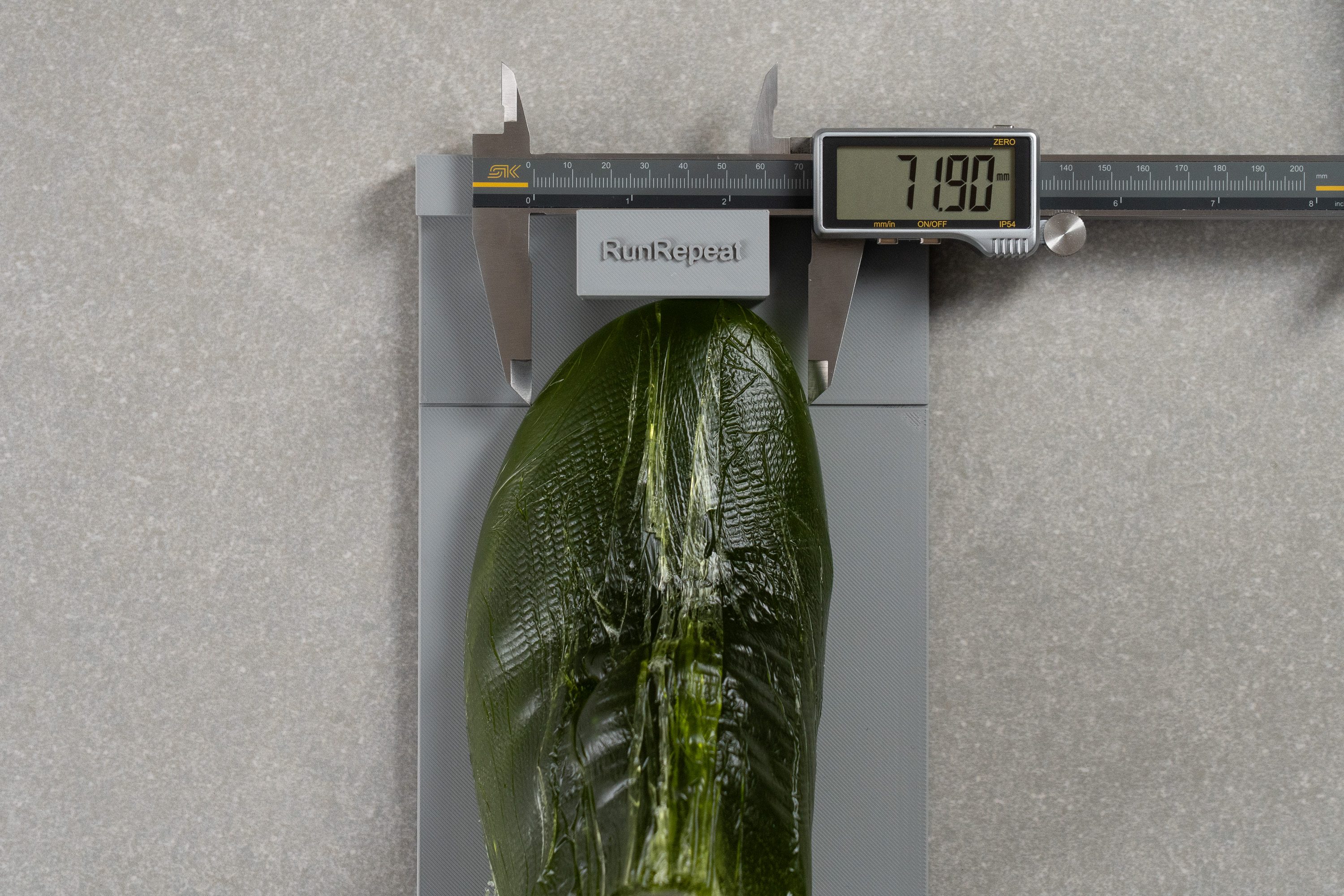
| Magic Speed 5 | 71.9 mm |
| Media | 73.2 mm |
Altura de la parte delantera
Después medimos la anchura de la zona de los dedos. Muchas veces la gente pasa por alto este detalle, pero..., ¡no en nuestro laboratorio!
Nuestro calibre marcó 25,7 mm, que es un resultado un poco más bajo de lo que vemos en la mayoría de las zapatillas. Lo bueno es que la malla de ingeniería es un poquito elástica, reforzando la posición de este modelo entre unas zapatillas de entrenamiento y unas de competición.
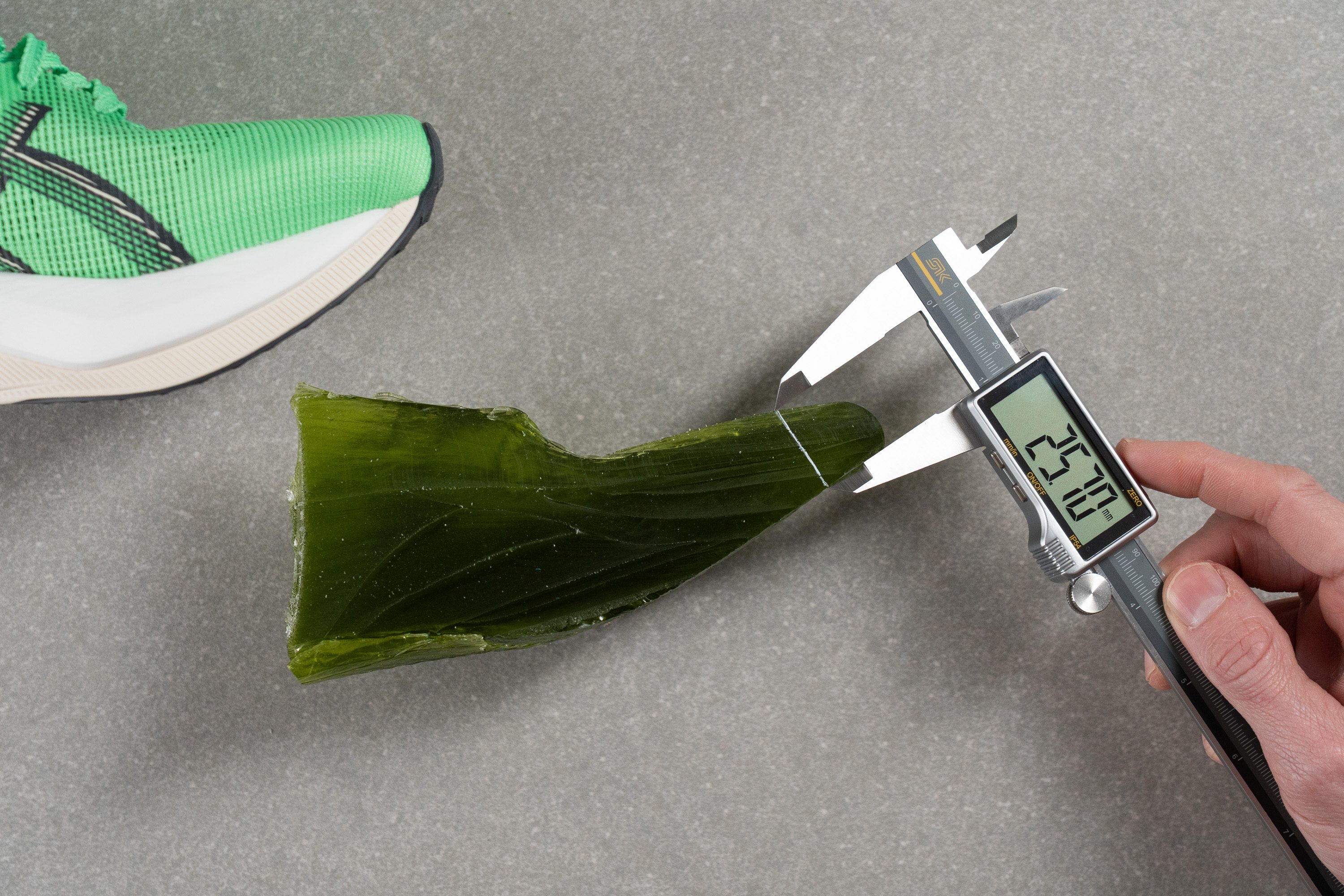
| Magic Speed 5 | 25.7 mm |
| Media | 27.0 mm |
Tracción / Agarre
Traction test
ASICS claramente dio en el clavo con el caucho ASICSGRIP, igualando o incluso superando algunas de las mejores suelas del mercado. Las Magic Speed 5 también presumen de este compuesto, ofreciéndonos una tracción excelente tanto en superficies secas como mojadas.
En nuestra prueba SATRA TM144, obtuvo un sólido 0,79, ¡los números hablan por sí solos!
| Magic Speed 5 | 0.79 |
| Media | 0.53 |
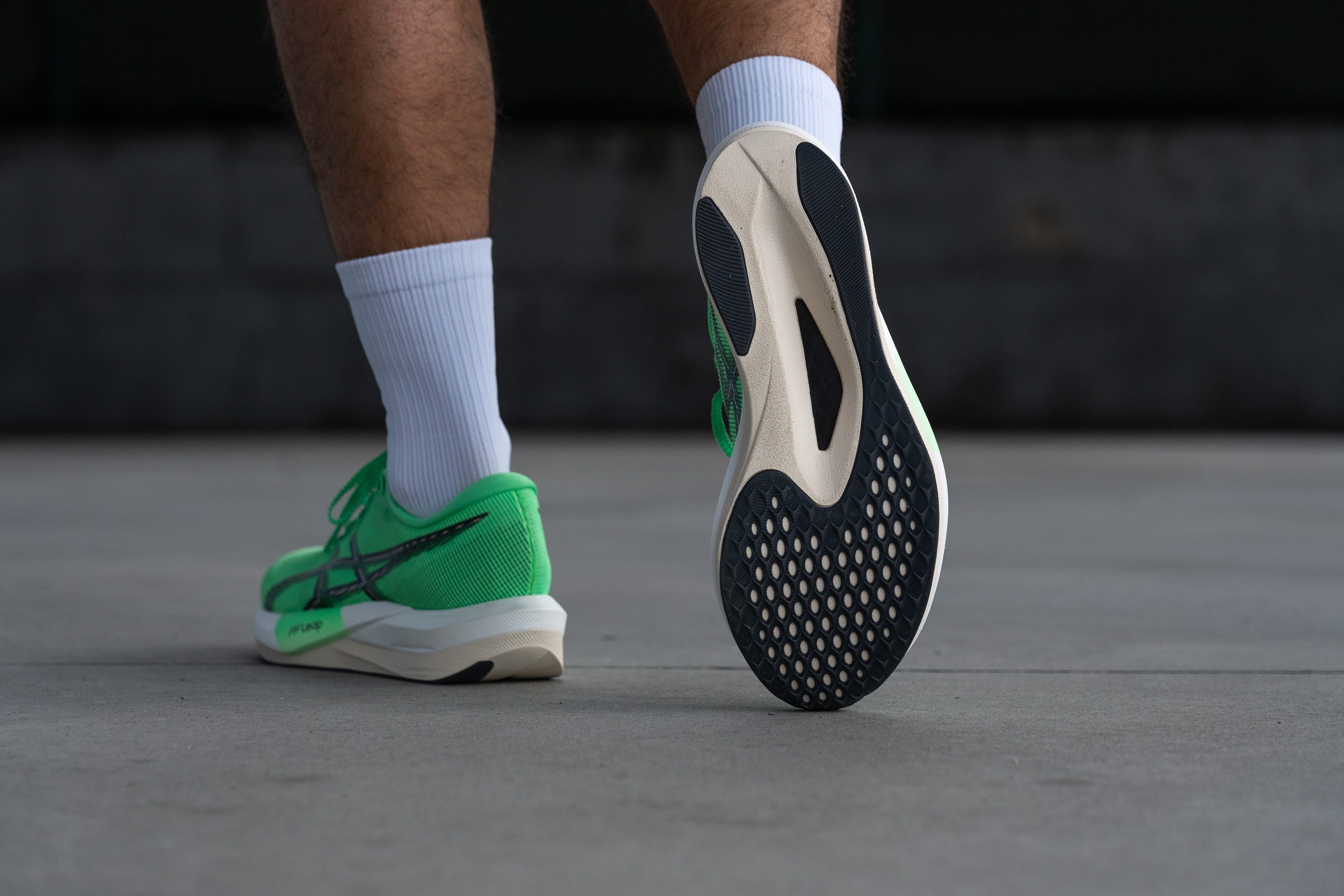
Diseño de la suela exterior
La suela exterior está inspirada en la serie Metaspeed, pero ASICS ha decidido añadir una cobertura y un grosor un poco mayores. Esta elección nos tiene todo el sentido del mundo, ya que este modelo está diseñado como unas superzapatillas de entrenamiento, y no como unas superzapatillas puras y duras.
Aunque tienen más caucho, estas zapatillas no se sienten nada voluminosas. Personalmente, creemos que ASICS tomó la decisión correcta al apostar por una mayor durabilidad sin sacrificar la ligerenza y eficiencia de la pisada.
Flexibilidad / Rigidez
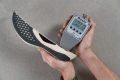
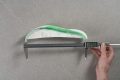
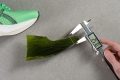
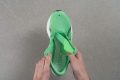
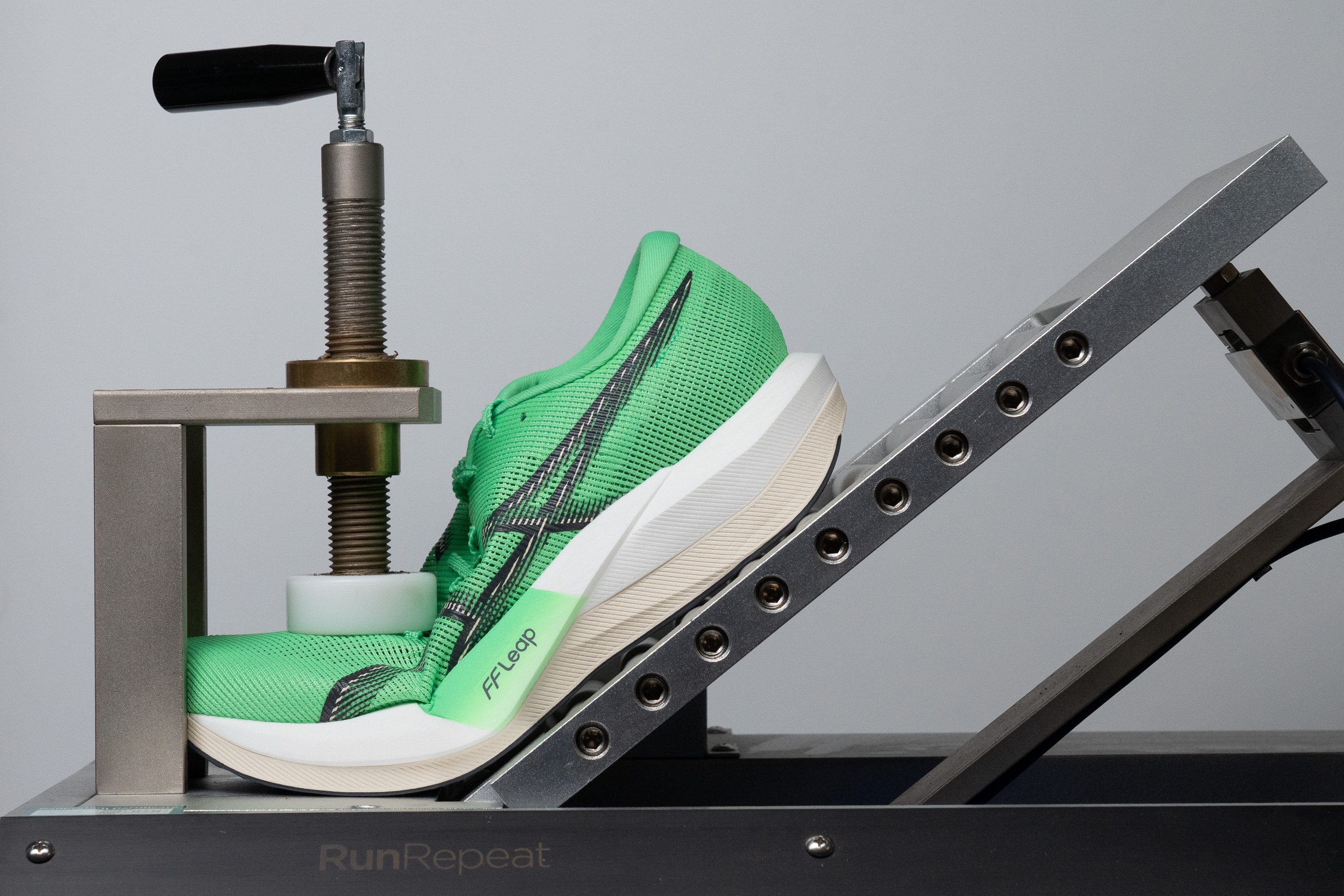
Otro resultado que demuestra claramente que las Magic Speed 5 tienen una rigidez más moderada es nuestra prueba de flexión, ya que solo necesitamos 13,1 N para doblarlas 30 grados. Para darte algo más de contexto, las Metaspeed Sky Tokyo necesitaron 21,1 N en la misma prueba, que es un 61 % más.
Esta es otra razón por la que este modelo puede ser un buen par de competición si acabas de empezar con este deporte. La sensación es parecida a la de unas superzapatillas, pero en una versión más flexible.
| Magic Speed 5 | 13.1N |
| Media | 15.5N |
Peso
El peso es otro de los detalles con los que las Magic Speed 5 han vuelto a sus raíces.
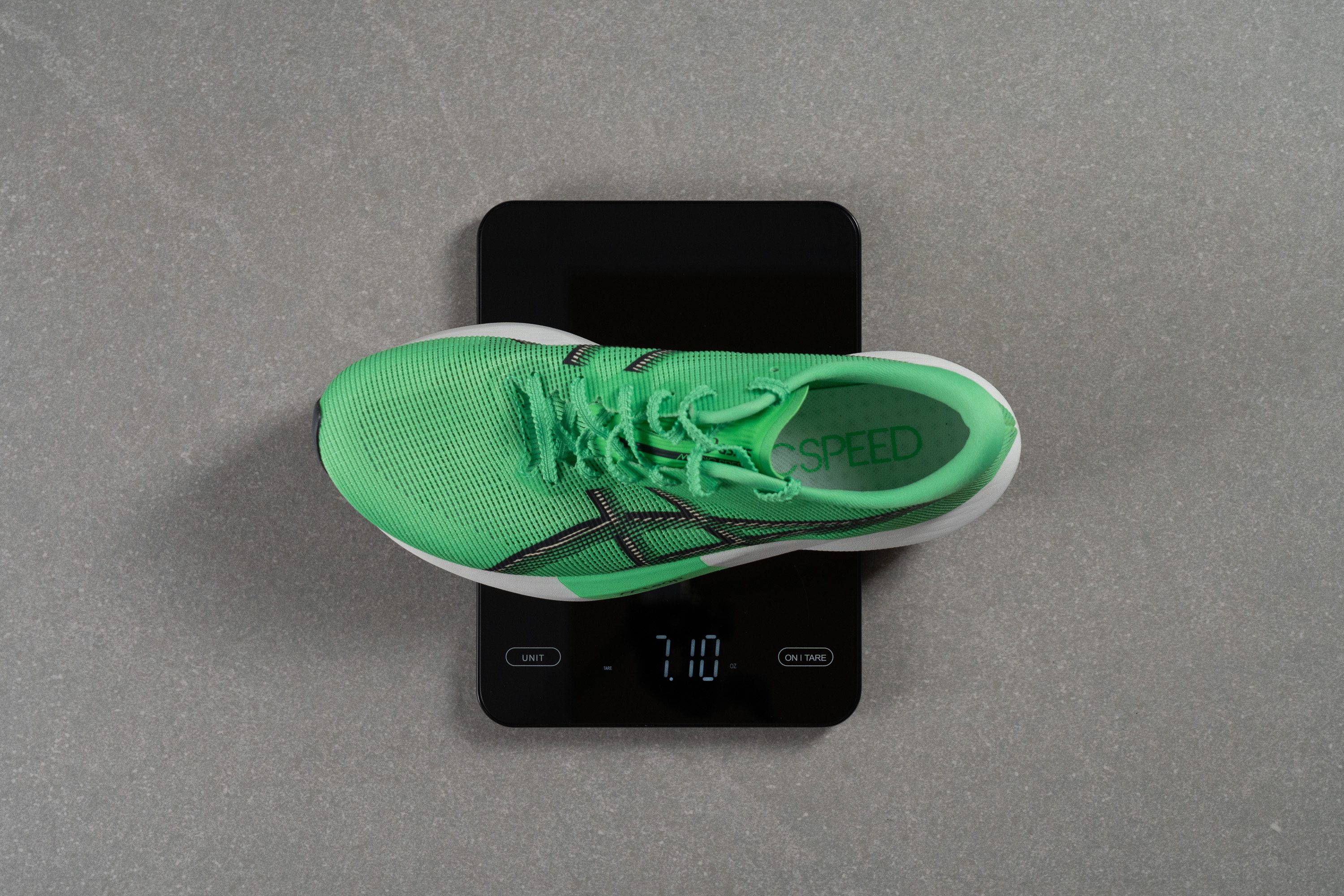
Estas zapatillas siempre han querido ser ágiles, y sus 201 g, que las hacen más ligeras que las versiones 3 y 4, nos demuestran que han vuelto. De hecho, este peso es incluso comparable con el de modelos de alto rendimiento como las Nike Alphafly 3.
| Magic Speed 5 | 7.1 oz (201g) |
| Media | 9.2 oz (261g) |
Transpirabilidad
Breathability test
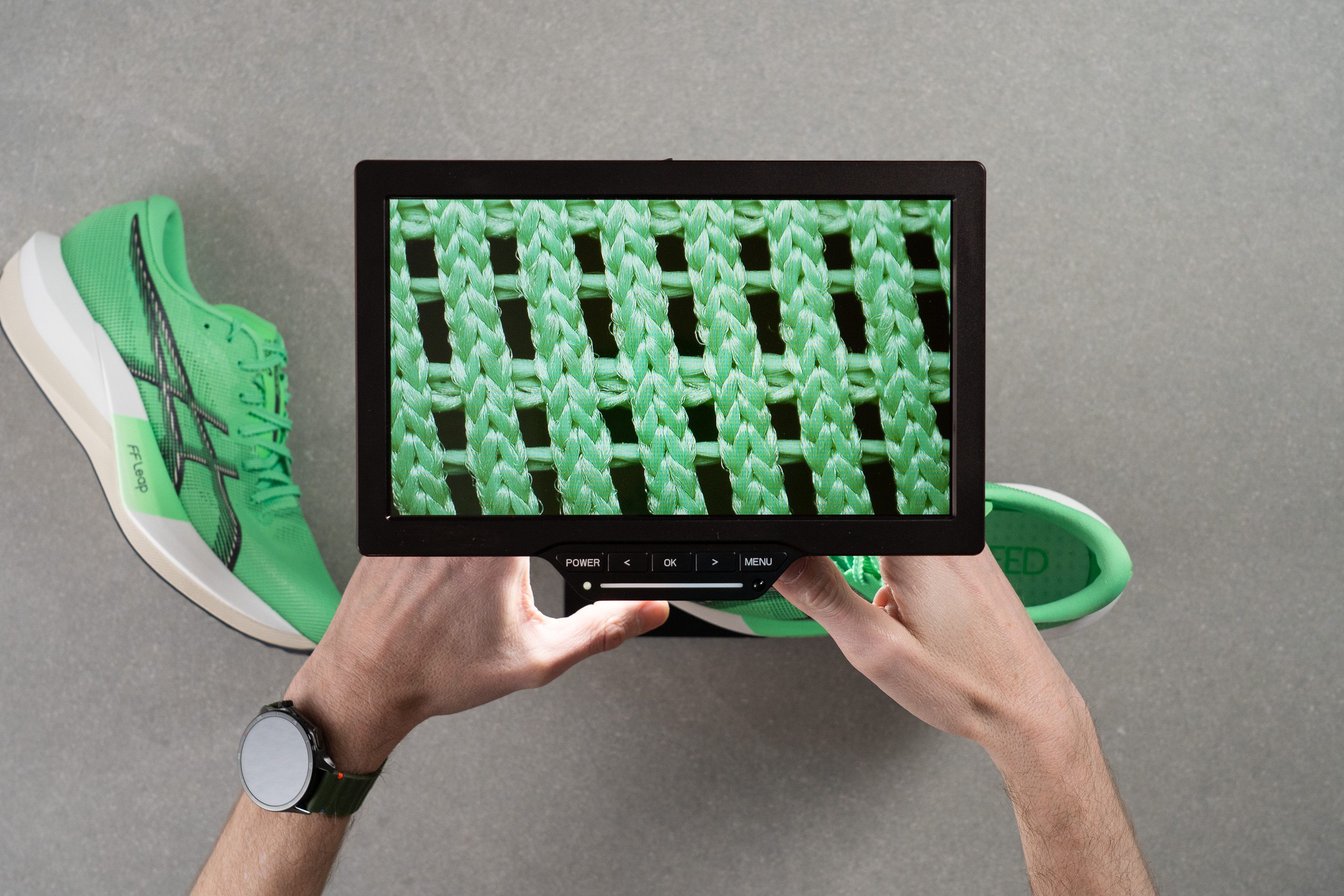
ActualizadoDurante nuestra evaluación manual de las ASICS Magic Speed 5, su upper nos dejó boquiabiertos con lo finito y transpirable que parecía. Pero como no nos fiamos ya ni de nuestra propia sombra, utilizamos nuestra máquina para analizar cómo de bien se les da a estas zapatillas (y sí, a todas ellas, no solo al upper) gestionar el sudor y la humedad.
Y consiguieron superar nuestra prueba sin problema. Presumiendo de un resultado excelente de 79 BR, a este modelo de tempo se le da muy bien quitarles el sudor a los pies.
| Magic Speed 5 | 79 BR |
| Media | 75 BR |
Potencial de secado
NuevoPero una buena transpirabilidad es solo el principio. Cuando el sudor se aleja del pie, las zapatillas tienen que saber qué hacer con esa humedad; si no, se acumula poco a poco dentro de ellas volviéndolas más pesadas y más húmedas, sobre todo en las distancias largas.
Por suerte, eso no fue un problema para las Magic Speed 5. Después de tenerlas 3 horas en nuestra máquina con una temperatura controlada, descubrimos que habían conseguido que se evaporase el 57 % de la humedad retenida. Aunque no es un resultado increíble, es más que suficiente para no tener que preocuparse por su capacidad de secado.
| Magic Speed 5 | 57% |
| Media | 53% |
Estabilidad
Prueba de estabilidad lateral
Como la mediasuela de este modelo es más bajita que la del diseño más maximalista de sus predecesoras, la estabilidad también ha mejorado. Incluso así, las Magic Speed 5 siguen siendo unas zapatillas completamente neutras al tener esa forma compacta inspirada en los modelos de competición y al no tener elementos específicos de estabilidad.
Rigidez torsional
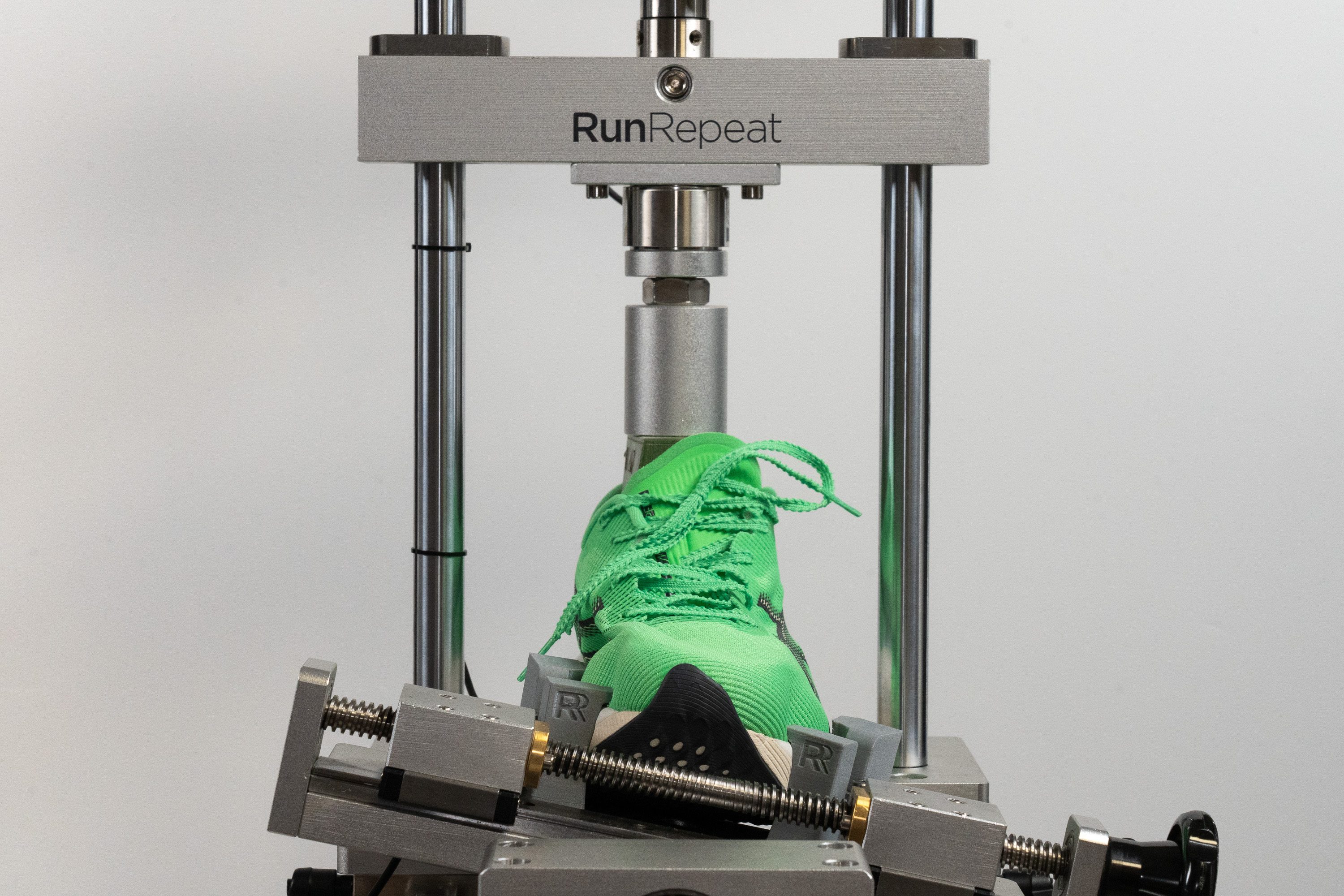
Cuando analizamos la rigidez torsional de las MS5, nuestra máquina marcó 15,9 Nm, así que no se dejan retorcer fácilmente incluso teniendo una placa bifurcada.
| Magic Speed 5 | 15.9 Nm |
| Media | 14.4 Nm |
Rigidez del contrafuerte del talón
ASICS también se olvidó del contrafuerte de talón ultraflexible de la línea Metaspeed y optó por un diseño más parecido al de las zapatillas de entrenamiento: cuando lo analizamos, le dimos un 3/5. Esto les da un poco más de sujeción a los talonadores y ayuda a que mantengan la forma incluso al final de las carreras más largas y exigentes de los domingos.
| Magic Speed 5 | 3 |
| Media | 3 |
Anchura de la mediasuela - antepié
Antes hablamos de la estructura compacta de las Magic Speed 5, pero queremos respaldarlo con cifras de nuestro calibre digital. Empezando por el antepié, marcó 110,1 mm, una cifra que está por debajo de la media actual del laboratorio.
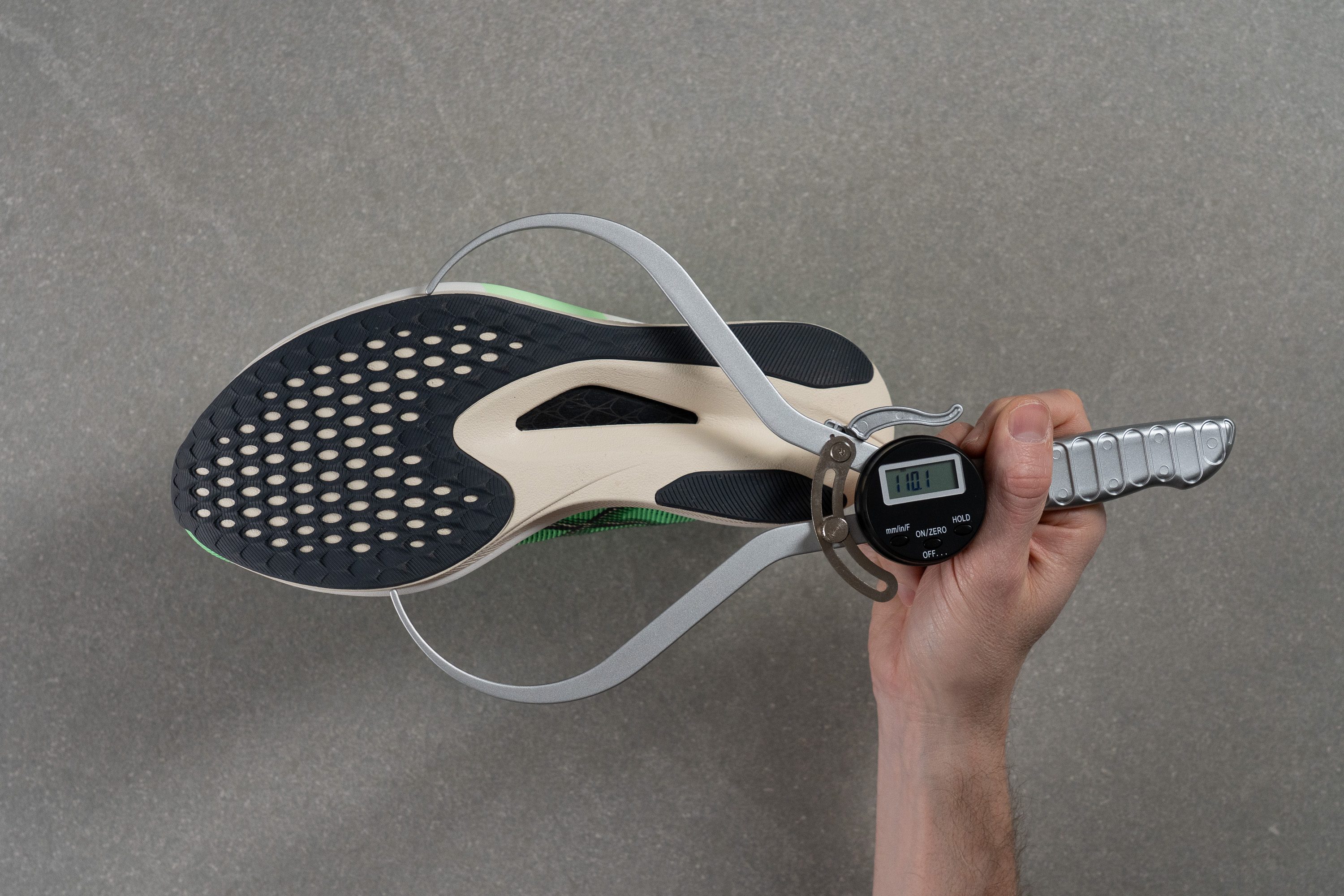
| Magic Speed 5 | 110.1 mm |
| Media | 115.1 mm |
Anchura de la mediasuela - talón
El talón donde ASICS realmente apuesta por un diseño agresivo.
Nuestro calibre marcó solo 78,1 mm. Ten esta cifra en cuenta si prefieres las superzapatillas de entrenamiento que tienen una zona de apoyo más amplia, como pueden ser las Superblast 2.
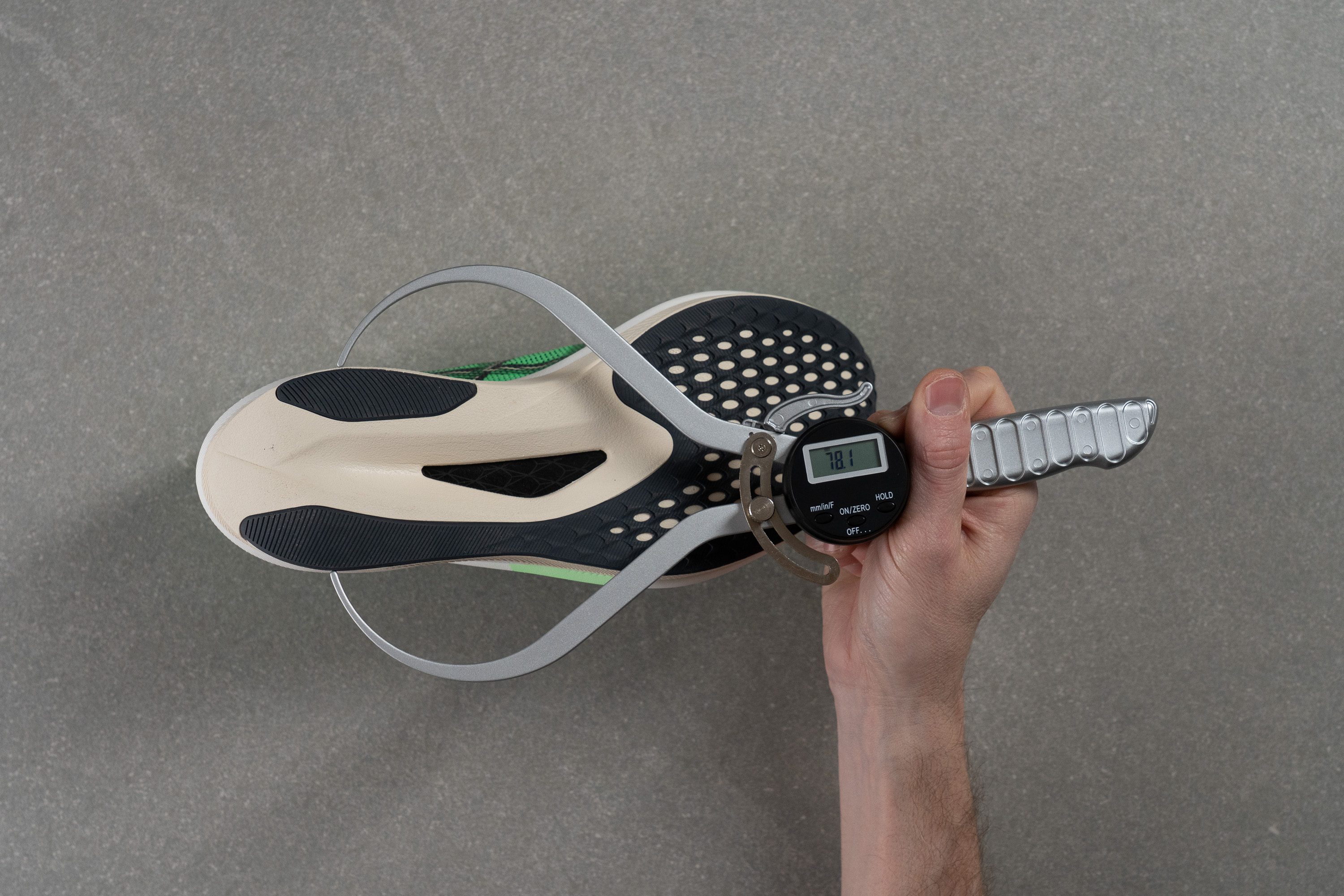
| Magic Speed 5 | 78.1 mm |
| Media | 91.1 mm |
Durabilidad
Durabilidad de la parte delantera
Es raro ver un upper que combine una transpirabilidad estupenda, un buen peso y una estructura duradera. Tan raro que ni las Magic Speed 5 lo consiguen. Vamos, que la malla terminó hecha un cuadro en un abrir y cerrar de ojos, así que se llevó un 1/5 en durabilidad.
| Magic Speed 5 | 1 |
| Media | 2.6 |
Durabilidad del acolchado del talón
Por suerte, la marca consigue compensar lo anterior con el acolchado del talón. Cuando le metimos caña con el Dremel, aguantó como un campeón, llevándose un excelente 5/5.
| Magic Speed 5 | 5 |
| Media | 3.4 |
Durabilidad de la suela
El caucho ASICSGRIP destaca por equilibrar la tracción y la durabilidad mejor que la mayoría de las suelas exteriores del mercado que están hechas de este mismo material. Después de confirmar que su agarre es espectacular, nos impresionó con un desgaste de solo 0,8 mm en nuestra prueba Dremel.
| Magic Speed 5 | 0.8 mm |
| Media | 1.1 mm |
Grosor de la suela
Que unas zapatillas tan ligeras tengan una suela de 1,9 mm de caucho es impresionante, así que nos esperamos una buena durabilidad. Esto ayuda a posicionar a las Magic Speed 5 como una opción versátil tanto para el entrenamiento como para las rutinas.
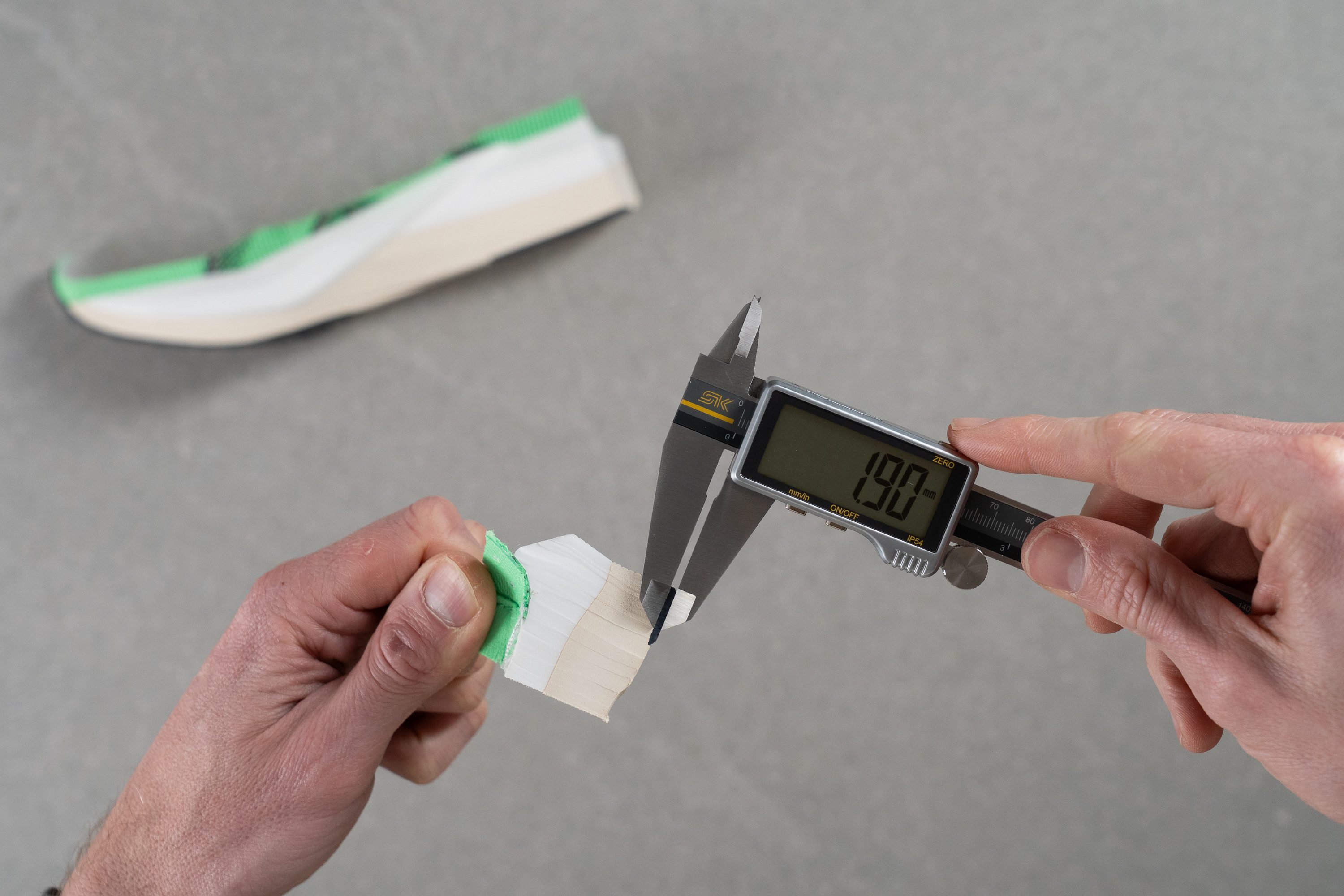
| Magic Speed 5 | 1.9 mm |
| Media | 3.1 mm |
Varios
Grosor de la plantilla
En esta review hemos visto cómo las Magic Speed 5 están entre el entrenamiento y la competición. La plantilla, que tiene un grosor de solo 2,5 mm, claramente se inclina hacia un diseño centrado en la competición.
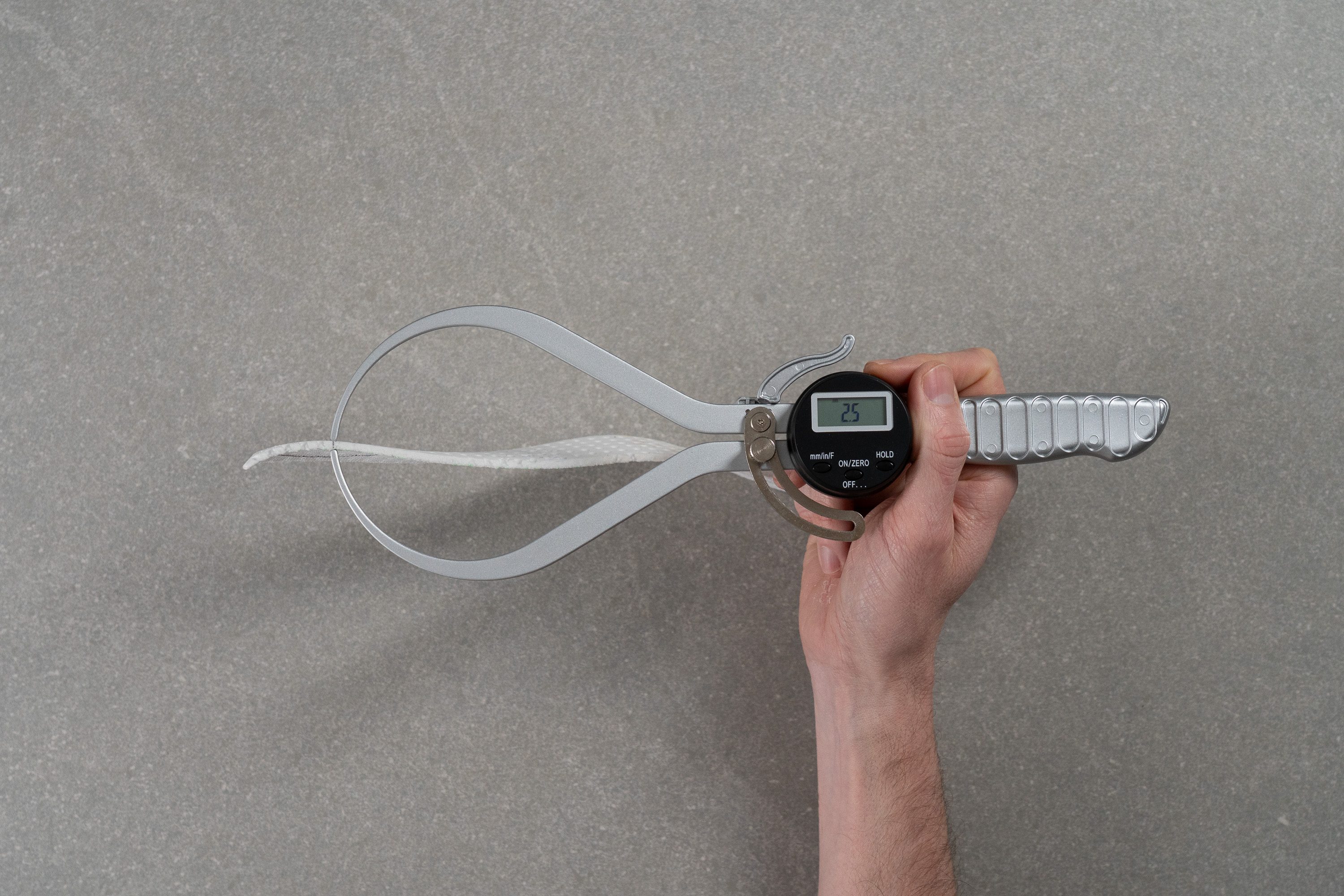
| Magic Speed 5 | 2.5 mm |
| Media | 4.4 mm |
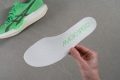
Plantilla extraíble
Nos gustó que la plantilla fuese extraíble, además de que todas las perforaciones que tiene hacen que el flujo de aire sea incluso mejor.
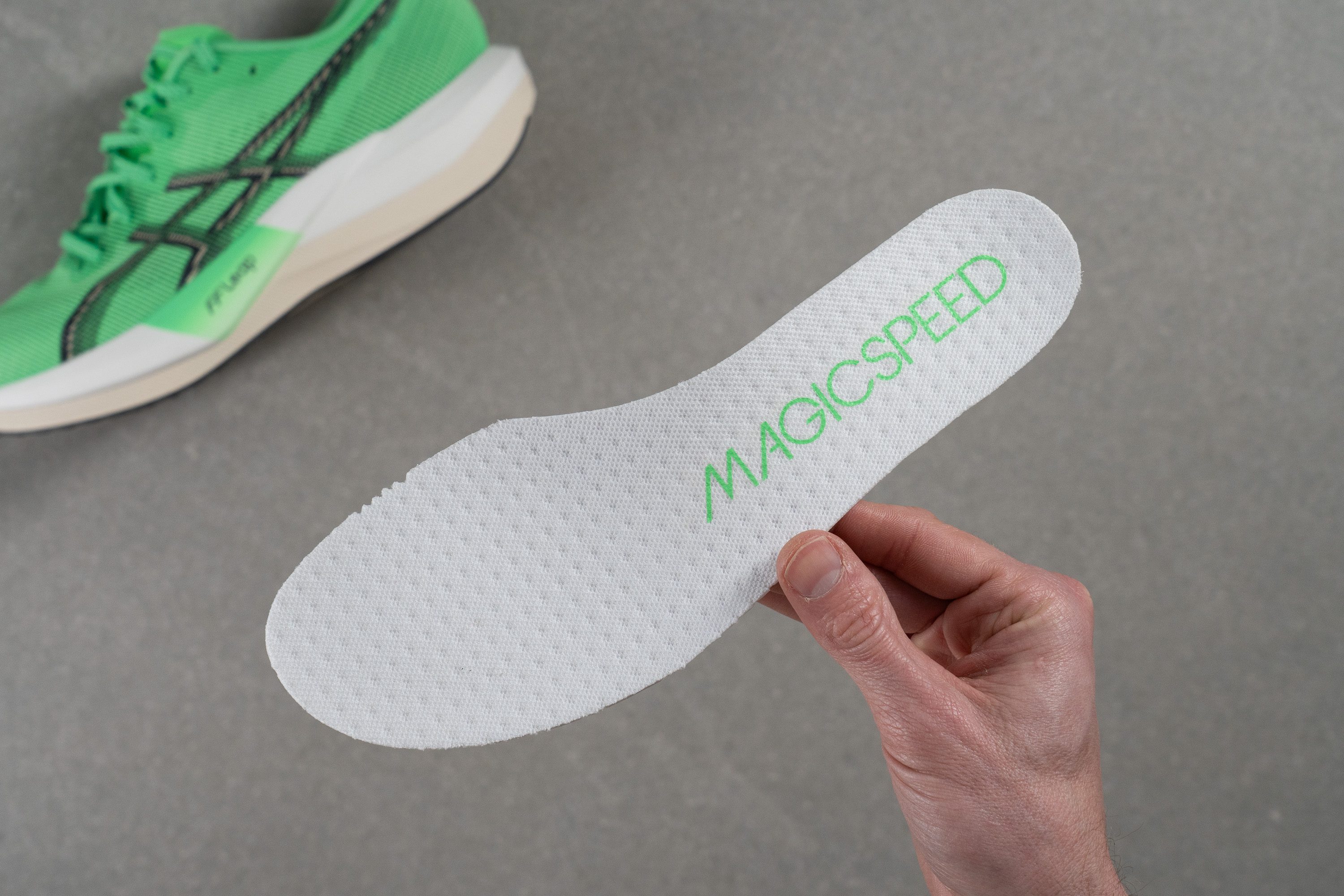
| Magic Speed 5 | Sí |
Elementos reflectantes
No creemos que la falta de elementos reflectantes sea un problema para este tipo de zapatillas. Aunque estaría genial que los tuviesen, tampoco nos importa su ausencia.
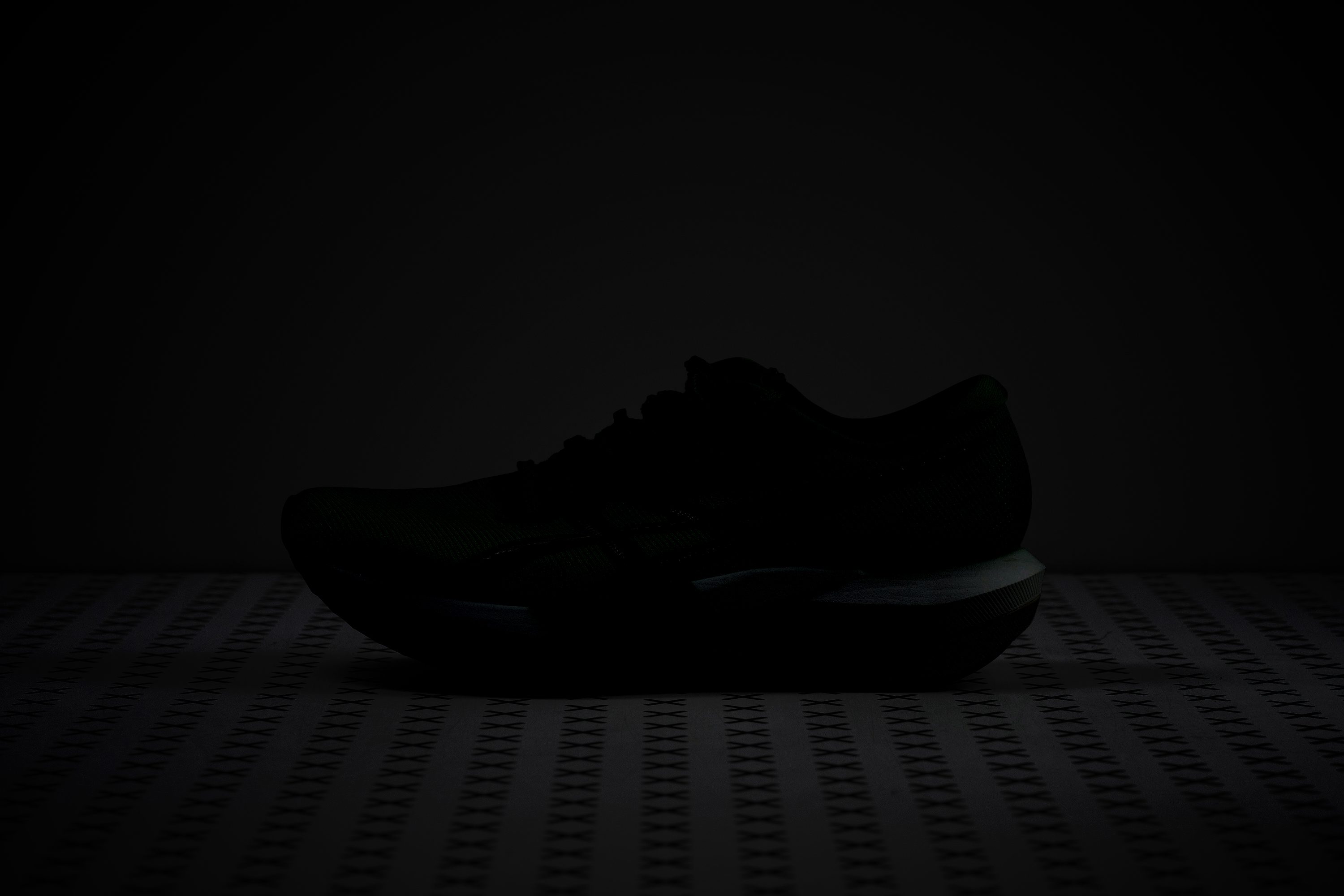
| Magic Speed 5 | No |
Acolchado de la lengüeta
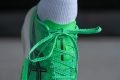
Cuando Nike presentó los cordones con relieve al sacar sus legendarias Vaporfly, no tardaron nada en convertirse en un gran éxito en el mundo de las zapatillas de running. ASICS siguió su ejemplo con la serie Metaspeed, que fue una decisión inteligente en ese momento. Ahora, estos cordones tan estupendos han llegado, por primera vez, a la línea Magic Speed.
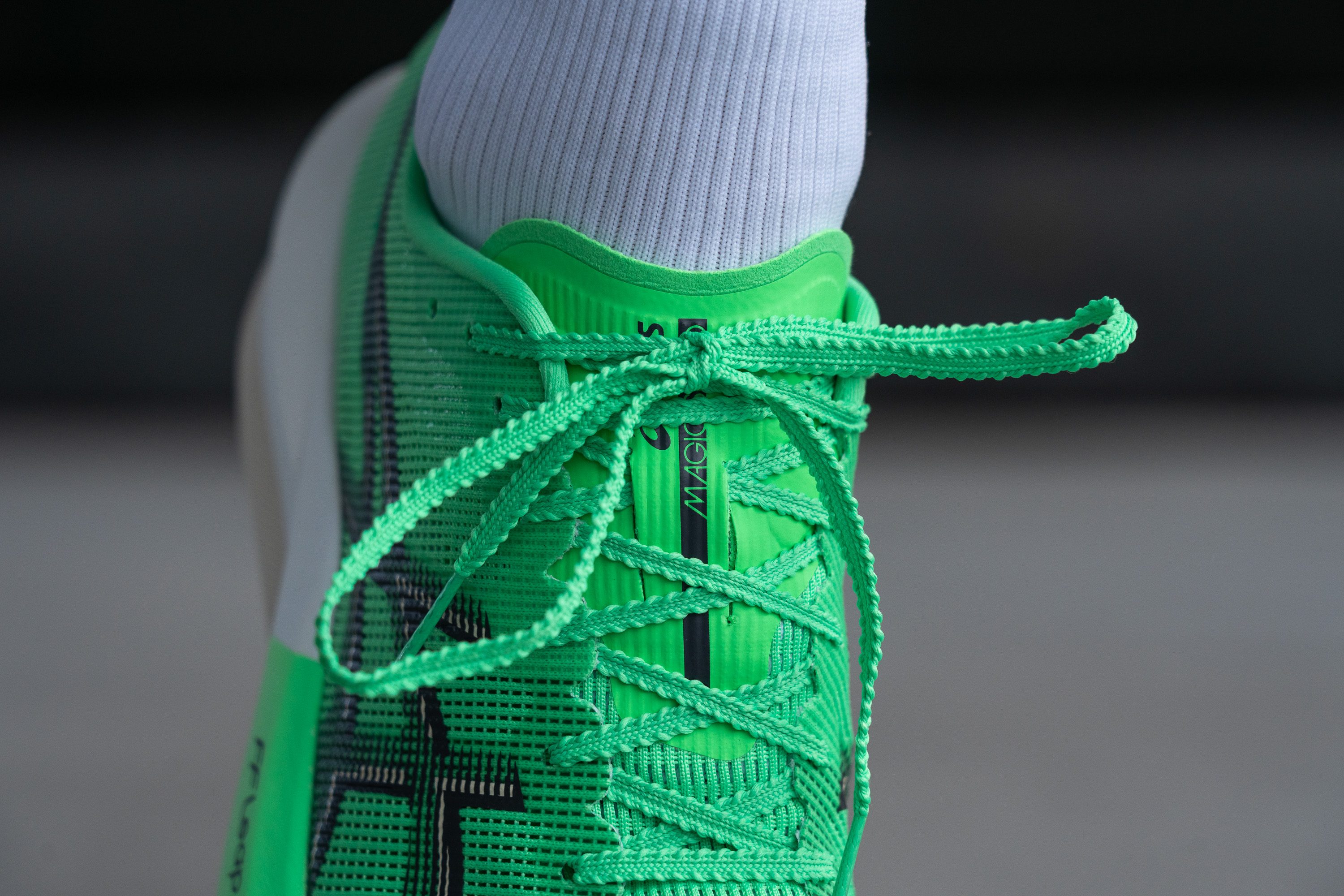
La lengüeta está claramente inspirada en el diseño general de las Metaspeed. Cuando medimos su grosor, nuestro calibre marcó solo 0,8 mm, así que no está muy acolchada. Vamos, que es importante que mantengas bajo control la presión de los cordones.
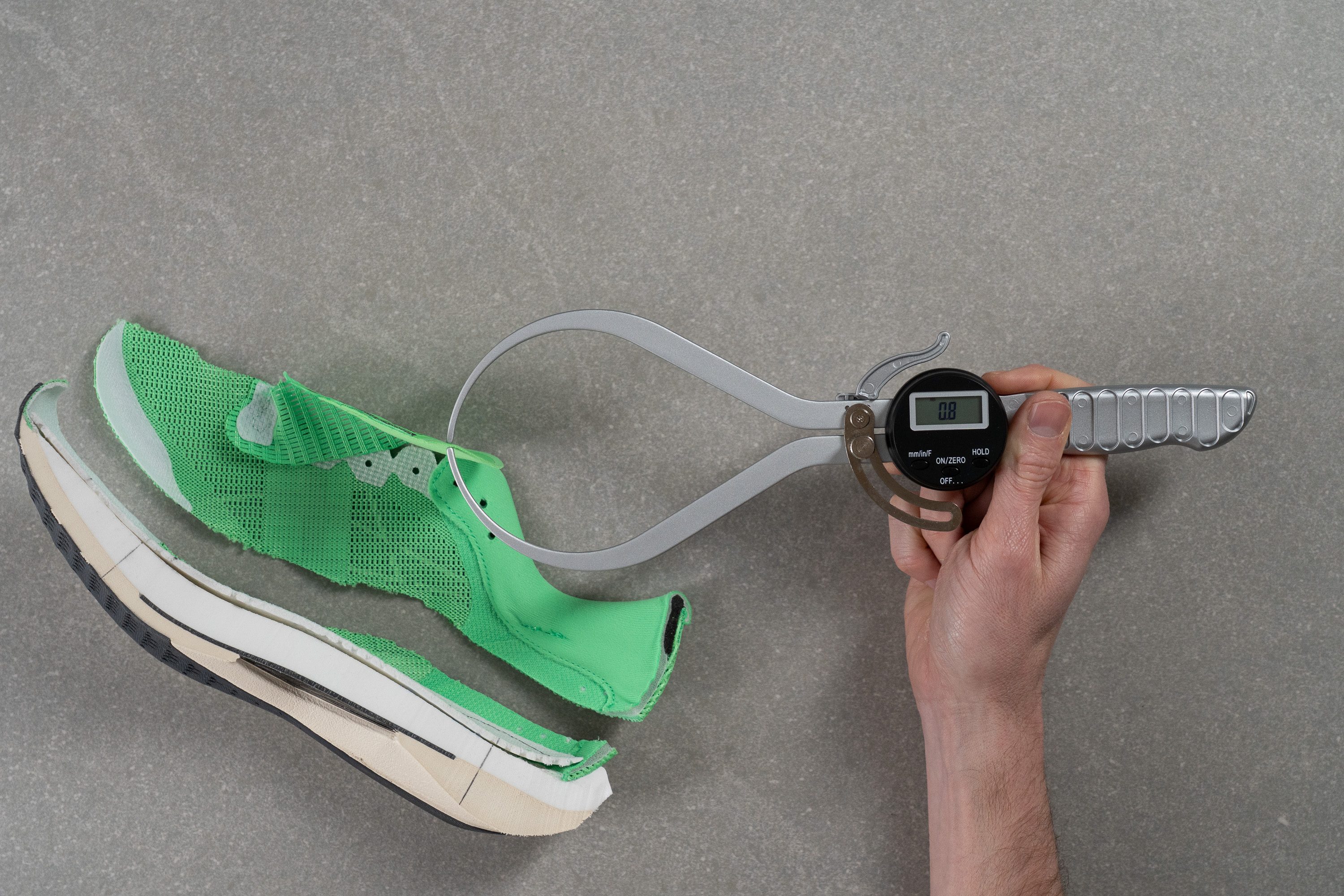
| Magic Speed 5 | 0.8 mm |
| Media | 5.8 mm |
Lengüeta: tipo de refuerzo
Otra clara referencia a las Metaspeed es que la lengüeta no esté reforzada, así que se puede mover libremente. A ver, no, esto no es ideal para entrenar a diario, pero sí que se ajusta al objetivo de mantener a las Magic Speed 5 como una opción de competición asequible.
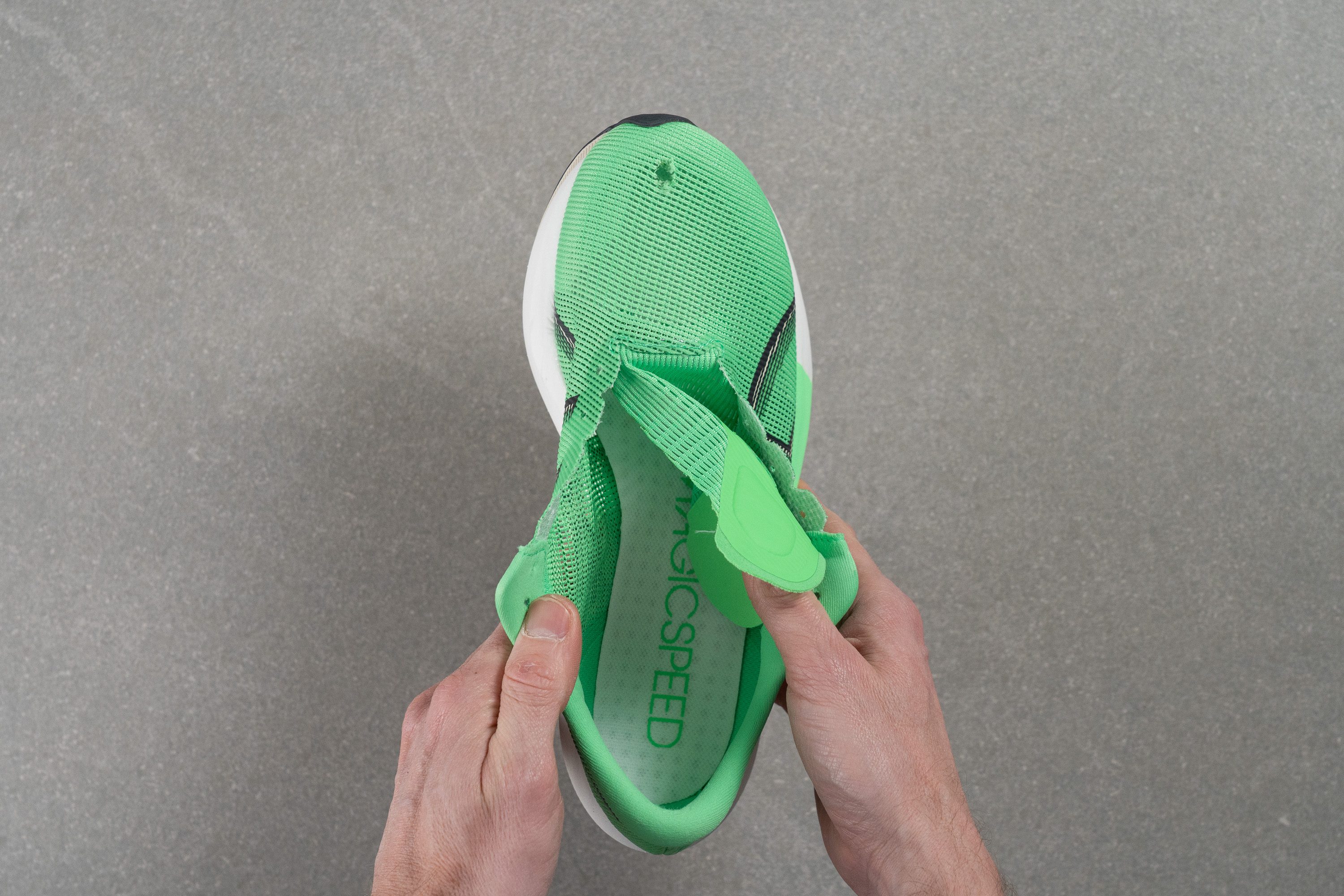
| Magic Speed 5 | Ninguno |
Tirador del talón
El talón de las Magic Speed 5 es otro guiño a la línea Metaspeed. No tiene tirador, apostando por un diseño impecable y minimalista que se centra en reducir el peso.
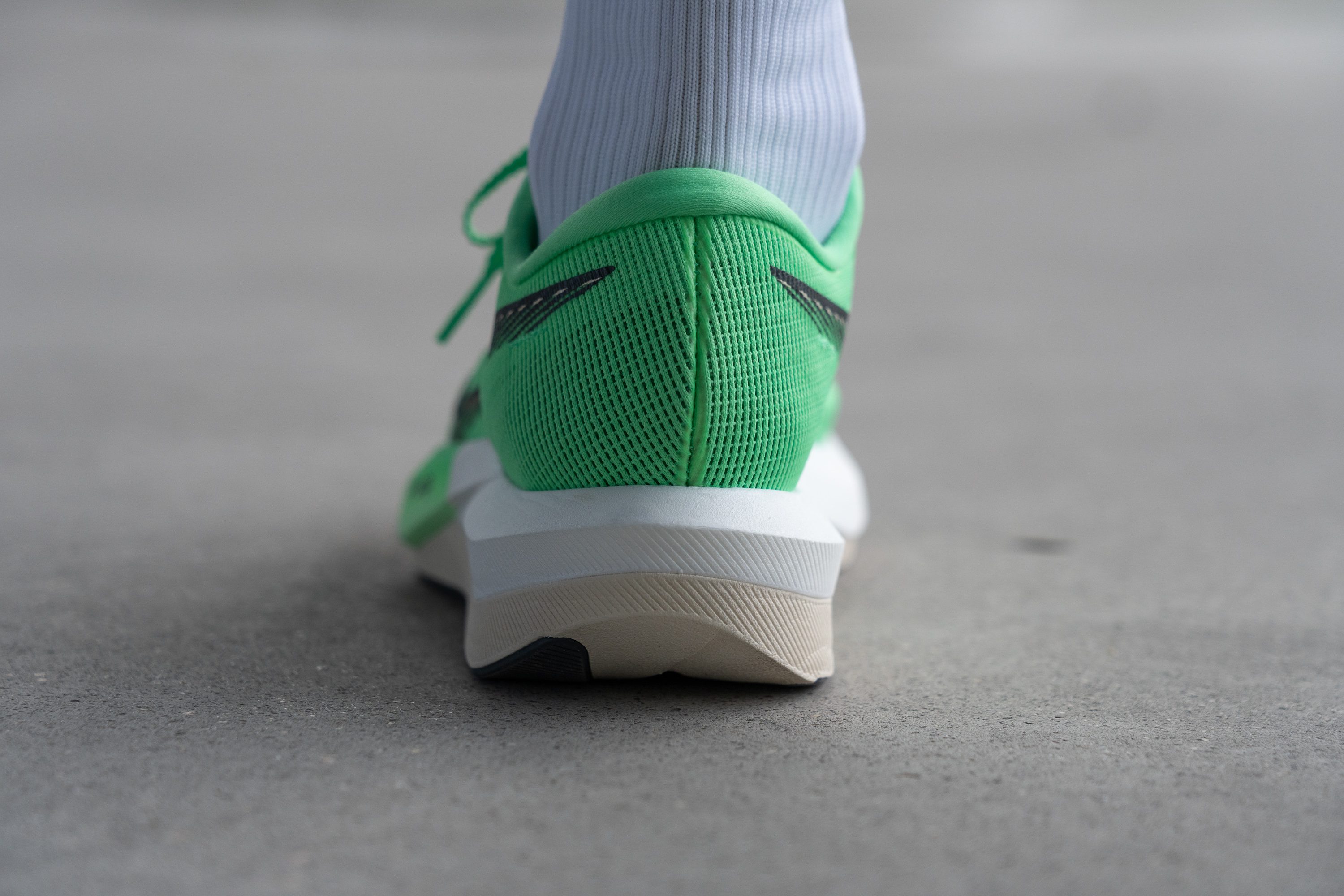
| Magic Speed 5 | Ninguno |
Precio
Creemos que las Magic Speed 5 tienen una relación calidad-precio sólida teniendo en cuenta sus características. Utilizar la espuma FF Blast Max en lugar de la FF Blast+ las habría hecho incluso más atractivas pero, incluso así, su precio nos parece adecuado. Son más baratas que muchas superzapatillas, y ofrecen una combinación interesante de ligereza y velocidad.
| Magic Speed 5 | $180 |