Guide: Flexible vs. Stiff Running Shoes

Why are stiff running shoes getting the spotlight? Why do runners flex and twist shoes in running stores? How is stiffness related to your running performance?
20+ hours of research is summarized in this guide - covering both scientific studies, authoritative articles and our lab data.
|
Choose flexible running shoes if you are looking for comfort and shoes for long runs. Most daily trainers focus on flexibility. Choose stiff running shoes if you want to improve your running performance and do fast runs, or if you’re looking for stability features for overpronation. |
It's important to highlight the difference between shoes that are longitudinally flexible (you can easily bend them) and torsionally flexible (you can easily twist them). In this guide, we focus on longitudinal stiffness.
This is an overview of longitudinal stiffness and torsional rigidity depending on the pace in road running shoes:
| Road running shoes | Average longitudinal stiffness (bending) |
Average torsional stiffness (twisting)
|
| Daily | 14.2N | 3.5 |
| Tempo | 14.9N | 3.9 |
| Competition | 21.3N | 4.5 |
If you were actually looking for soft shoes and not flexible ones, or firm midsoles and not stiff ones, check out our guide Soft vs. Firm running shoes.
As always, a disclaimer: individual approach matters a lot, especially when talking about performance improvement. Even this study suggests it when it comes to finding optimal bending stiffness for a runner. There are a lot of things that influence responsiveness and stiffness is only one of them. It has to play perfectly with other pieces of the puzzle to deliver the promised running performance improvement.
Testing the stiffness in the lab
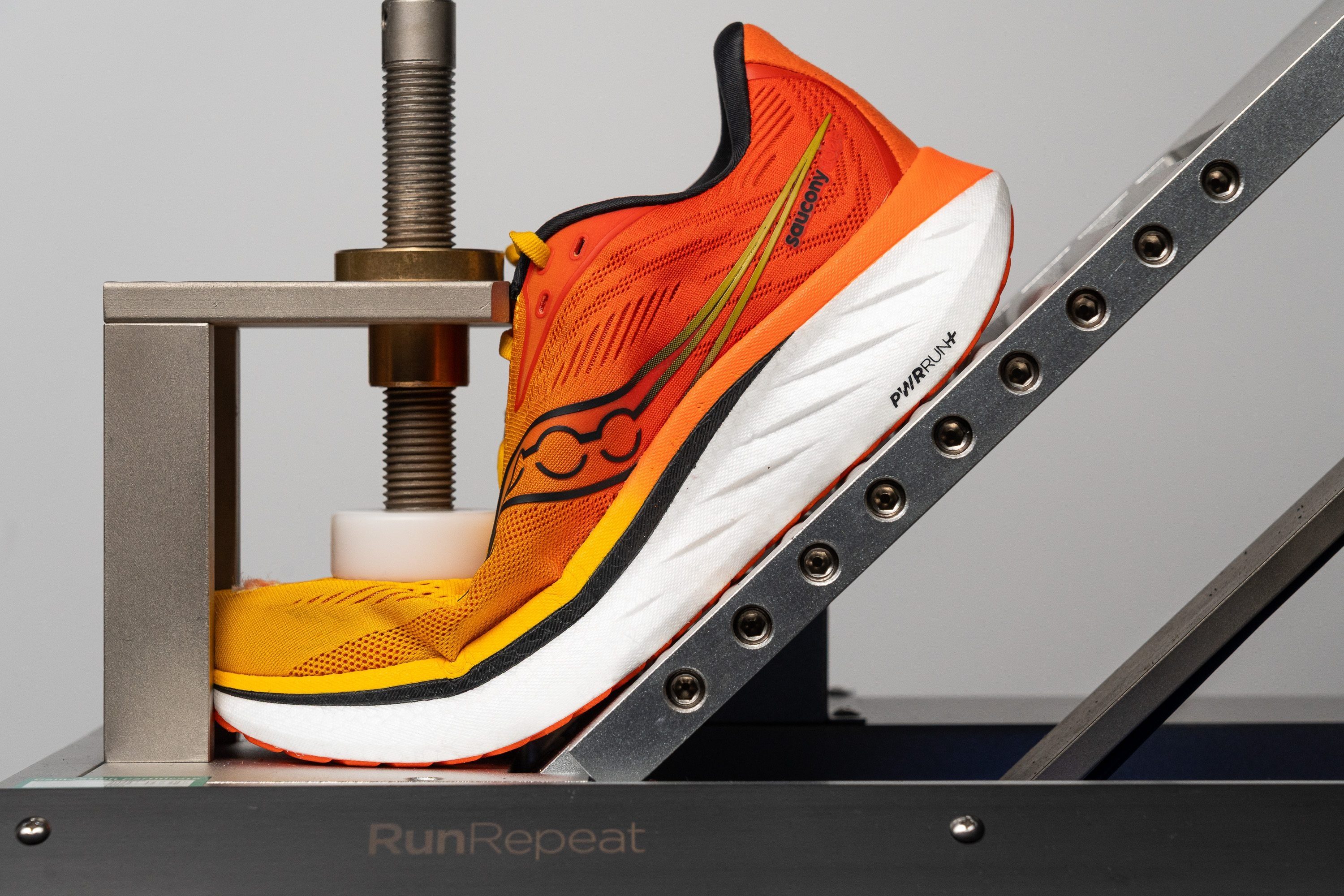
To objectively test the stiffness of shoes, we bought a specialized machine that allows us to do that. First, we lock the forefoot in place. This lifts the heel due to the forefoot rocker. We adjust the angle of the plate so that it touches the heel. This is a starting position and we bend the shoe to 30 degrees from there. While doing so, we measure the force needed to bend the shoe to 30 degrees.
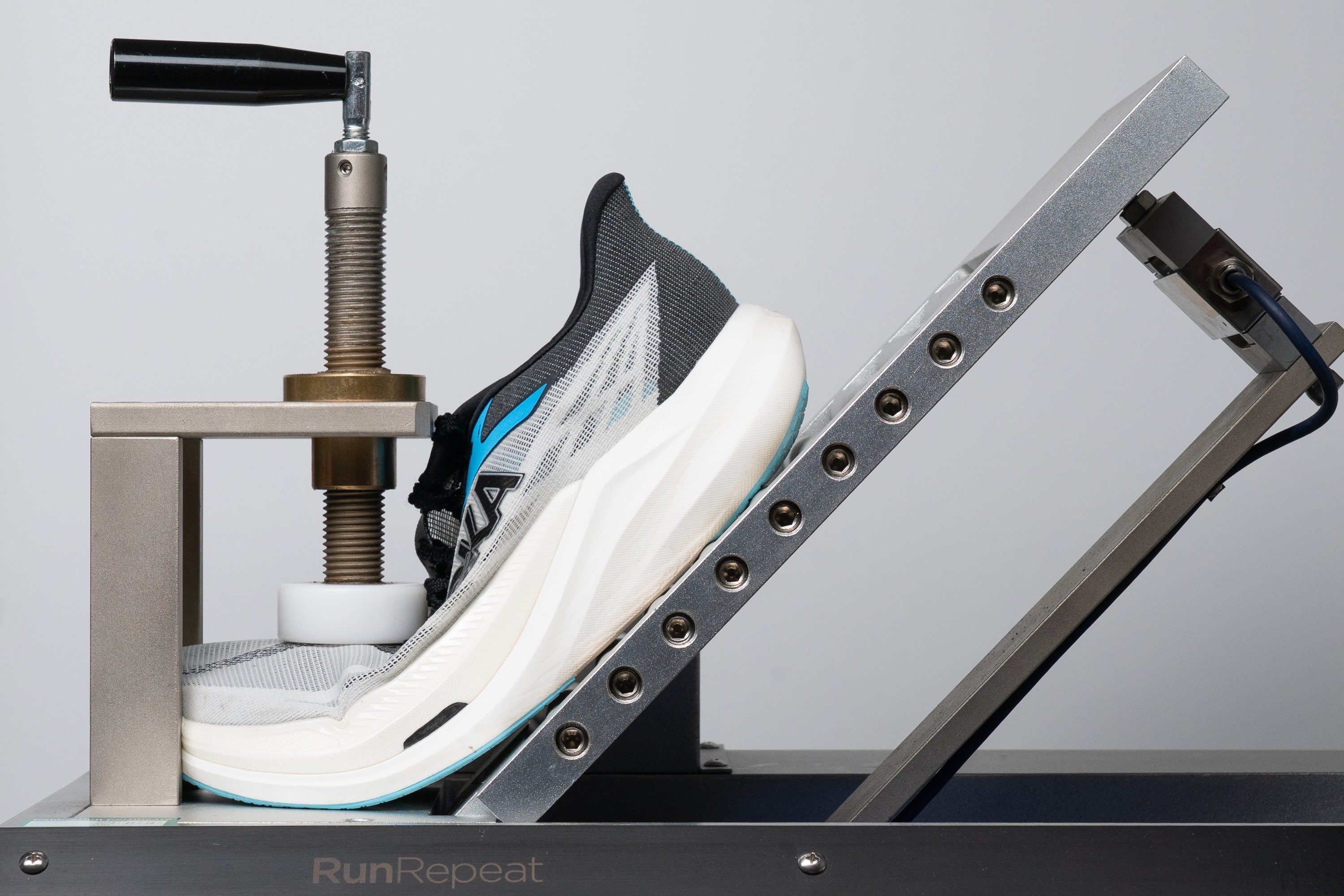
When it comes to the lab test results, we consider running shoes flexible when the force needed to bend them to 30 degrees is lower than 12N, moderate when the force falls between 12 and 17N, and stiff when the force is higher than 17N.
Stiffer shoes improve running performance
What stiff shoes are mostly about is responsiveness: you can raise the stiffness of the shoes to improve speed and economy, but only up to a point. After that, performance drops. However, that point isn’t fully understood.
Even though the brands are working hard on it, it still can’t be fully dissected because no runner’s body is the same, and that’s why the individual approach is important. It’s also why carbon-plated premium shoes might work better for elite runners who land on the forefoot than for recreational (slower, heavier) runners. This is an illustrative example of what happens to running performance when the stiffness of the shoes increases (as explained in this study).
This study has shown that stiffness is beneficial if it does not disturb the natural joint flexion.
What to pay attention to when running in stiff shoes
If you're making a big change from flexible daily beaters to stiff shoes, we recommend paying attention to:
- Your gait. Does it change significantly when running in stiff shoes? Can your body keep up? Are you in pain or feeling great?
- Sound. Listen to your landing: the quieter it is, the better the shoe for you. How loud your landings are can depend on the flexibility of the shoe and whether it works for you.
- Stack height. Stiff running shoes are high-stacked. Are you used to being so high off the ground? And, as always, is the heel drop adequate for you?
It’s also important to note that the stiffness of your forefoot is dominant: the total stiffness during running is dominated by the stiffness of your forefoot and not by that of the shoe. Forefoot stiffness and midsole bending stiffness act together during push-off, but the shoe stiffness is generally much lower than the mean human forefoot stiffness (source).
2 types of stiff running shoes
Stiff running shoes are usually split into two groups based on the purpose of their stiffness:
- Stiff running shoes for stability and protection. They don’t have carbon plates. These shoes are stiff due to their stability features for mild or severe overpronation (we’ve covered pronation in great detail in this guide).
- Stiff shoes for performance use soft foams or combinations of foams together with (carbon/nylon) plates that stiffen them up.
Stiffness in the form of stability & protection
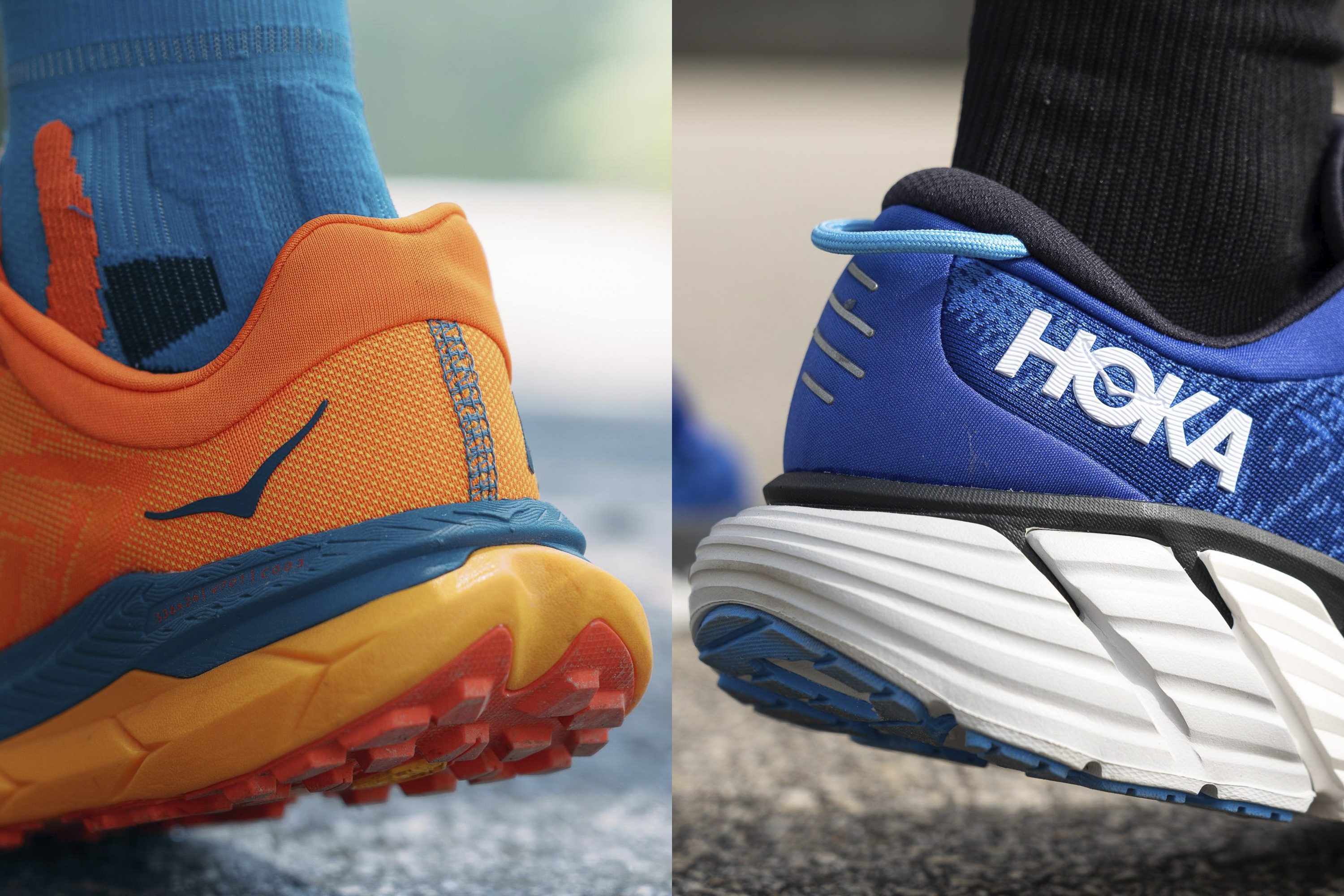
This is a list of features of running shoes that are stiff because they offer stability and protection:
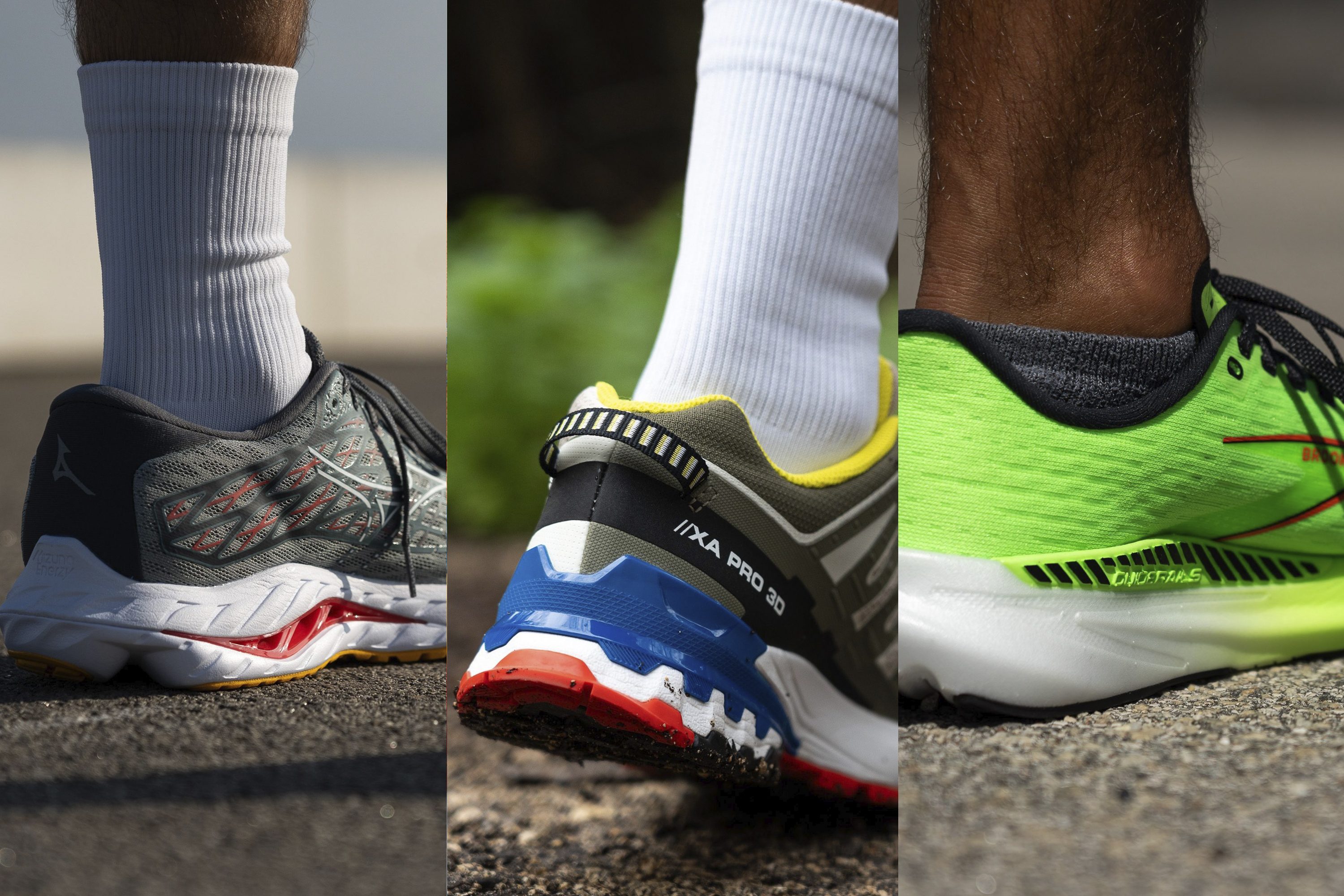
- They can have a dual-density midsole, guide rails, and other supportive elements to help with overpronation.
- They are more expensive than neutral shoes (with no stability features), cheaper than carbon-plated shoes.
- They are less responsive and usually made for daily runs (not races).
- Usually made for heel strikers.
This is how a heel focused on stability (for overpronation) looks like:
| We have covered this topic in great detail in our guide: Arch Support for Runners: What, How and Why. |
Stiffness for performance (speed)
Some running shoes are stiffer not because they are made for overpronators but because they offer a different set of features, often aimed at speed. Carbon-fiber plates first come to mind. However, it's important to note that while they have a task to stiffen the foam that's usually very soft, it does not mean that the shoe overall will get significantly stiffer in every case. 67% of stiff shoes do not feature carbon-fiber plates.
Looking at competition shoes, where we can find the majority of plated shoes, we can see that the difference in stiffness and energy return is not as big as expected when compared to plateless race shoes:
- Carbon-plated race shoes | Average energy return: 72.9% | Average stiffness: 21.0N
- Plateless race shoes | Average energy return: 68.8% | Average stiffness: 14.4N
What can you expect from carbon-plated shoes?
- They improve the running economy (shown here and here).
- They reduce the amount of energy lost at the metatarsophalangeal joint (as explained here).
- Take some getting used to, especially for walking.
- May give the best results if forefoot striking in them.
- Rocker geometry.
- Very responsive, feel like trampolines.
- Made for elite runners and those chasing their PBs, and are usually premium priced.
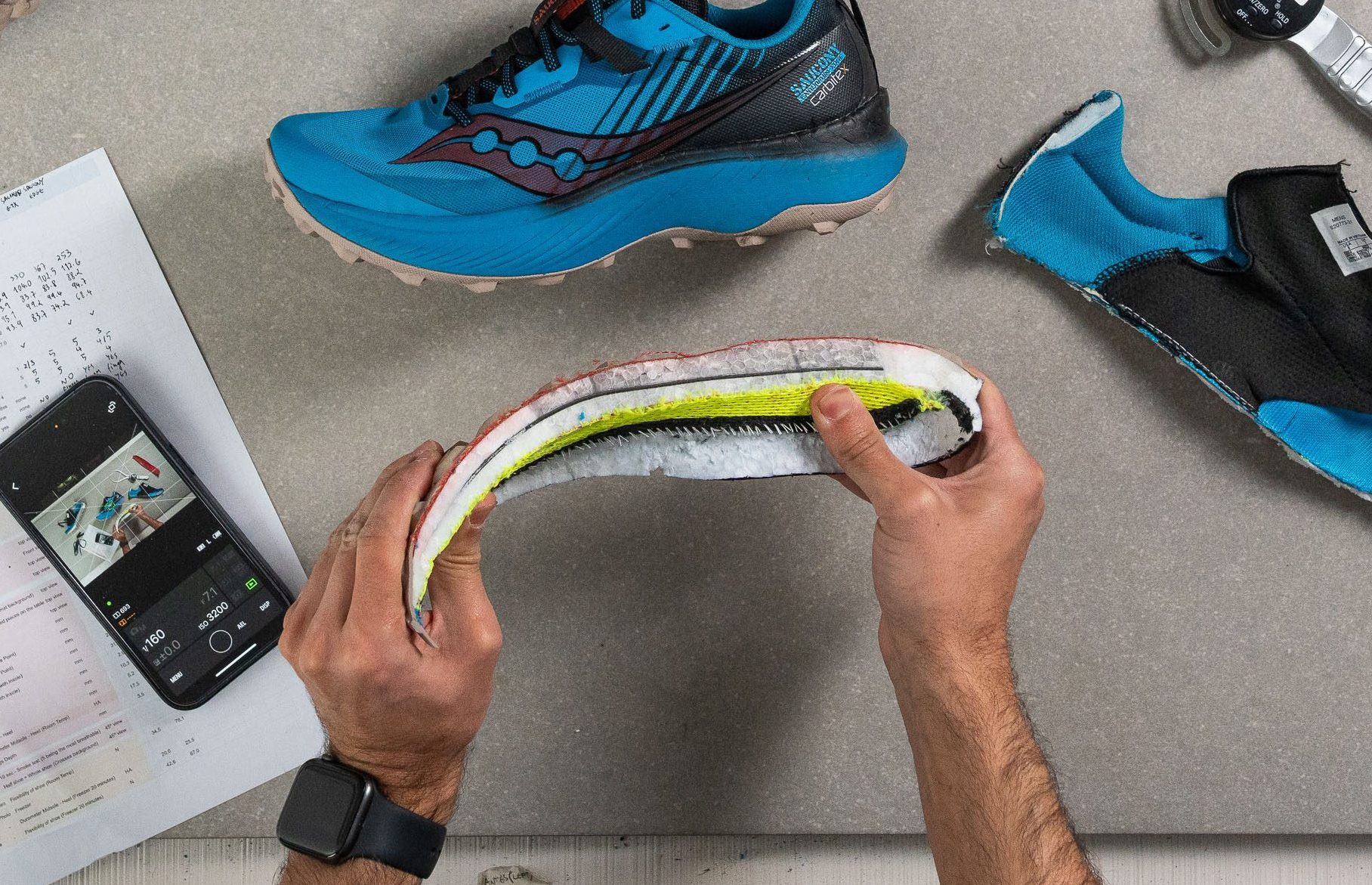
To learn more about these, read our in-depth guide on carbon-fiber plated shoes. They cause significantly more positive work and less negative work at the metatarsophalangeal joint and less positive work at the knee joint.
Stiffest running shoes
2 reasons carbon plates might not work for you
High-priced carbon-plated shoes are created for advanced and elite runners with the intention of improving their running economy and performance.
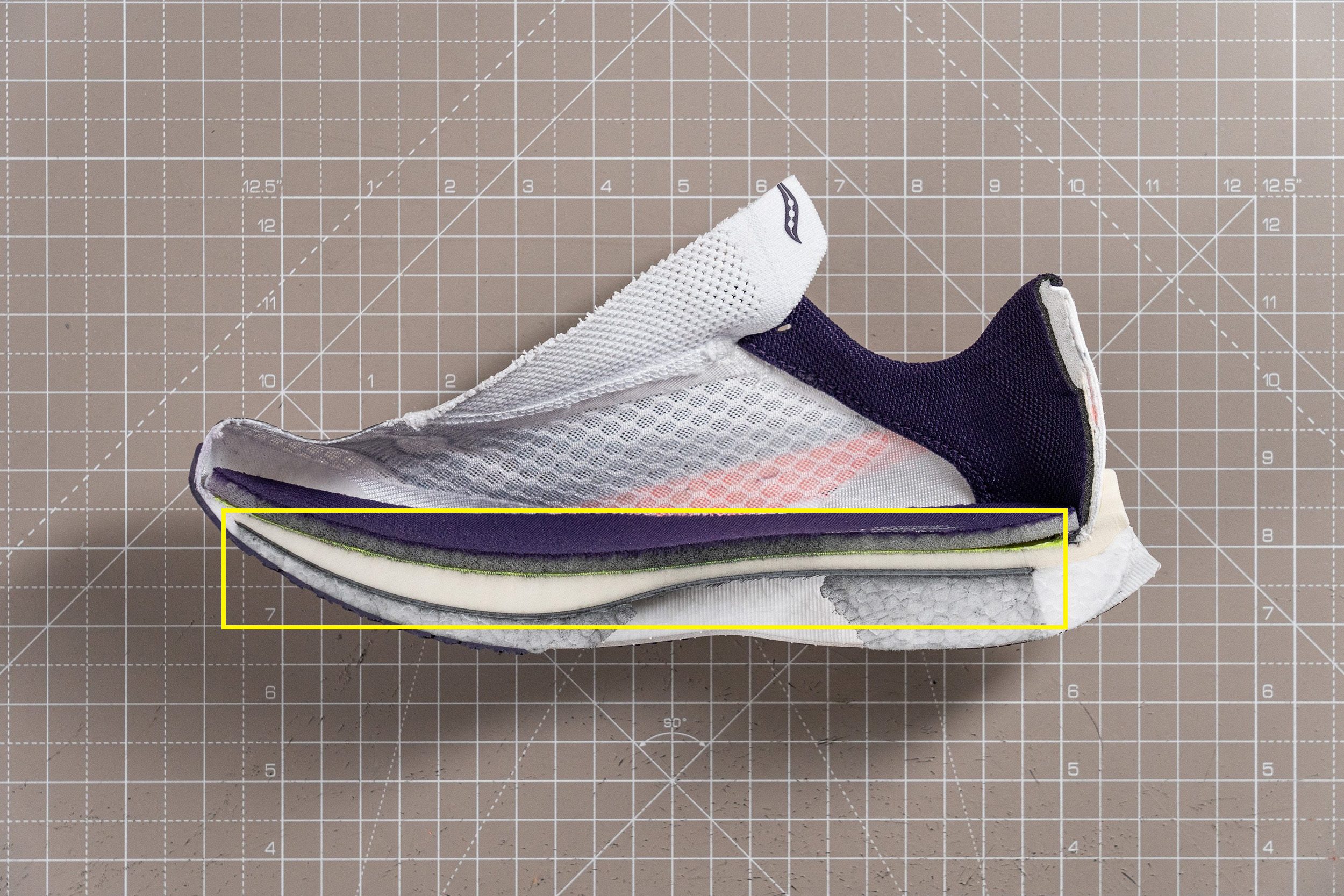
Here are 2 reasons why this matters:
- While foams allow for great tolerance levels, carbon plates and plate stiffness do not. For them to work (great), researchers at Nike focused on a group of runners with similar characteristics (weight, contact time, pace, limb stiffness). This is why Vaporfly 4% might not work for you if you’re slower than pro runners or, simply, weigh more.
- The so-called spring or pop in running shoes - the most wanted feature that promises responsiveness and better performance, is specially tuned for runners who have a certain stride. If you strike the land in a different way, have stronger or weaker impact forces, different ground contact times… you simply won’t get the same propulsion as elite runners. To learn more about responsiveness, we recommend reading our guide: Energy return in running shoes explained.
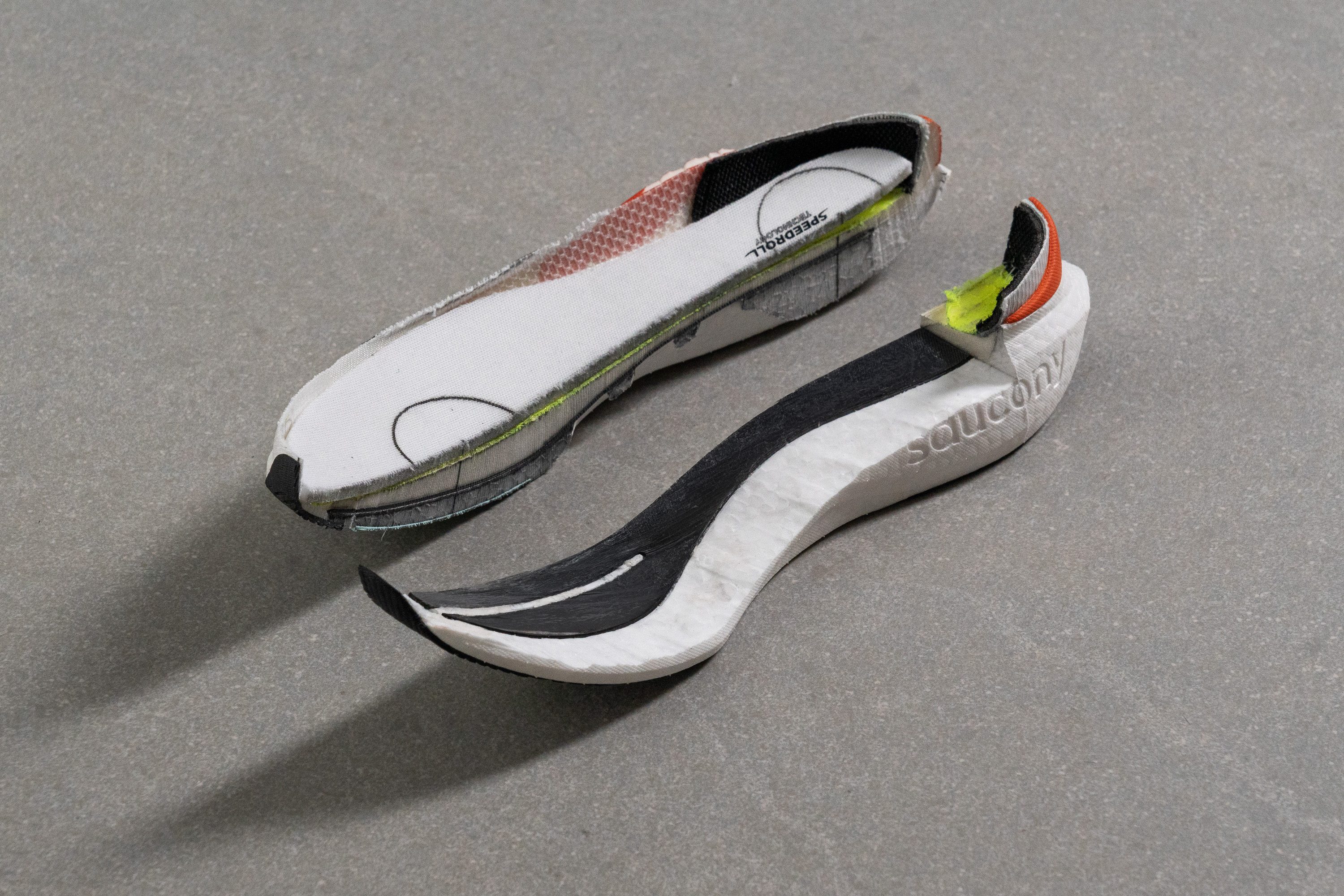
Here's how it looks like when we cut a carbon-plated running shoe in our lab:
We've covered this topic in great detail in our guide: Carbon-Plated Shoes Cut In Half, Explained and Lab-Tested.
Flexibility changes with cold weather
In our lab, we used to test the shoe's flexibility after it had spent 20 minutes in the freezer (we stopped with the introduction of Methodology 2.0). This allowed us to understand how foams behave in cold weather. The average change between room-temperature flexibility and post-freezer flexibility was 38.1%.
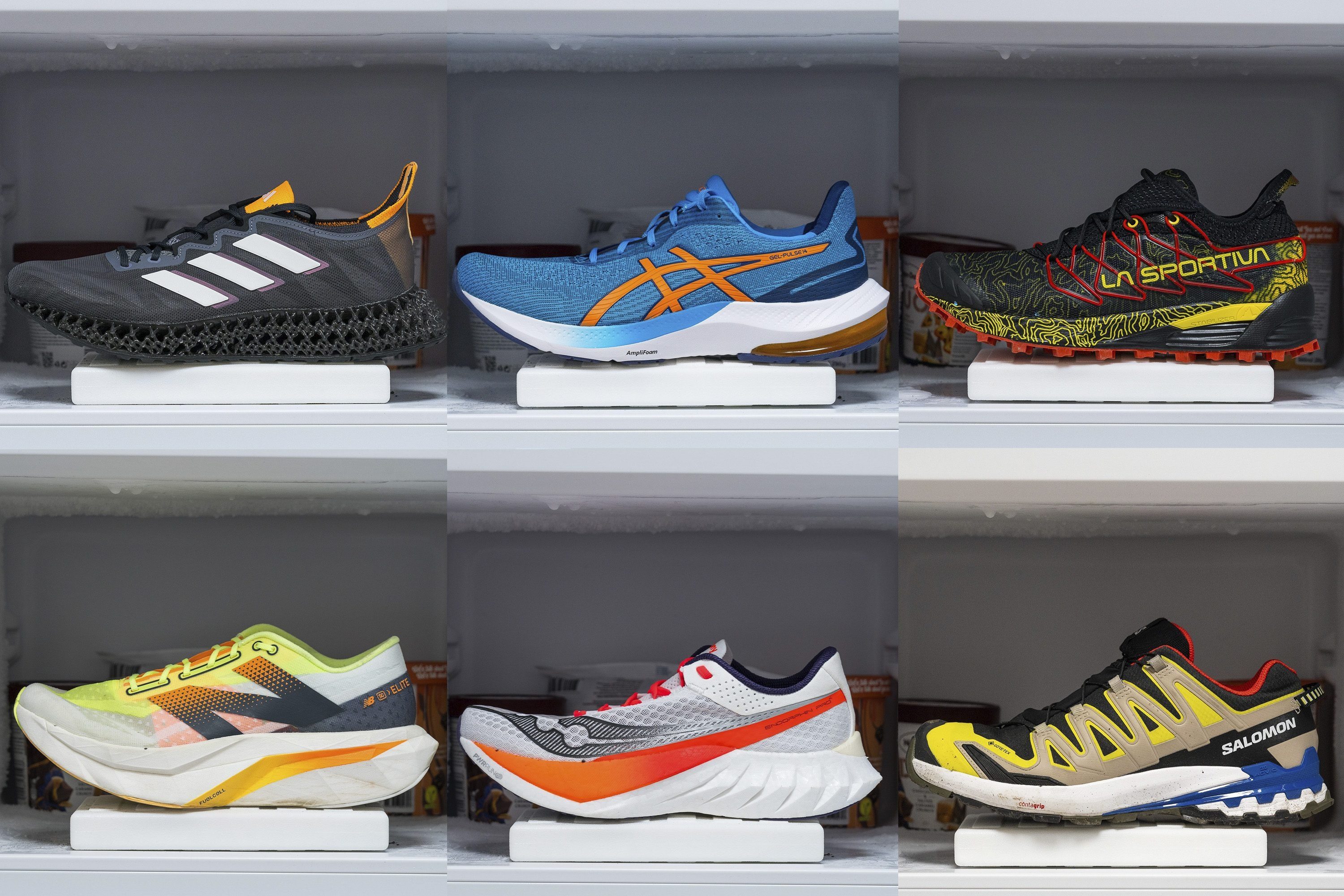
Shoe experts and enthusiasts around the world reported different experiences depending on the temperature. The most curious case was Bondi 7, where we read everything from “extremely stiff” to “really flexible”.
Stiffness isn't the only thing that changes with temperature. To learn about, well, basically everything that changes in running shoes once we expose them to cold weather, read our guide Effects of temperature on running shoes.
4 features of flexible running shoes
Flexible running shoes are made for comfort. This feature was highlighted when the minimalist trend hit the scene - one of the main characteristics of minimalist and barefoot running shoes is being able to flex them and bend them. Some, even up to a point where you can curl them up completely due to no stability features inserted.
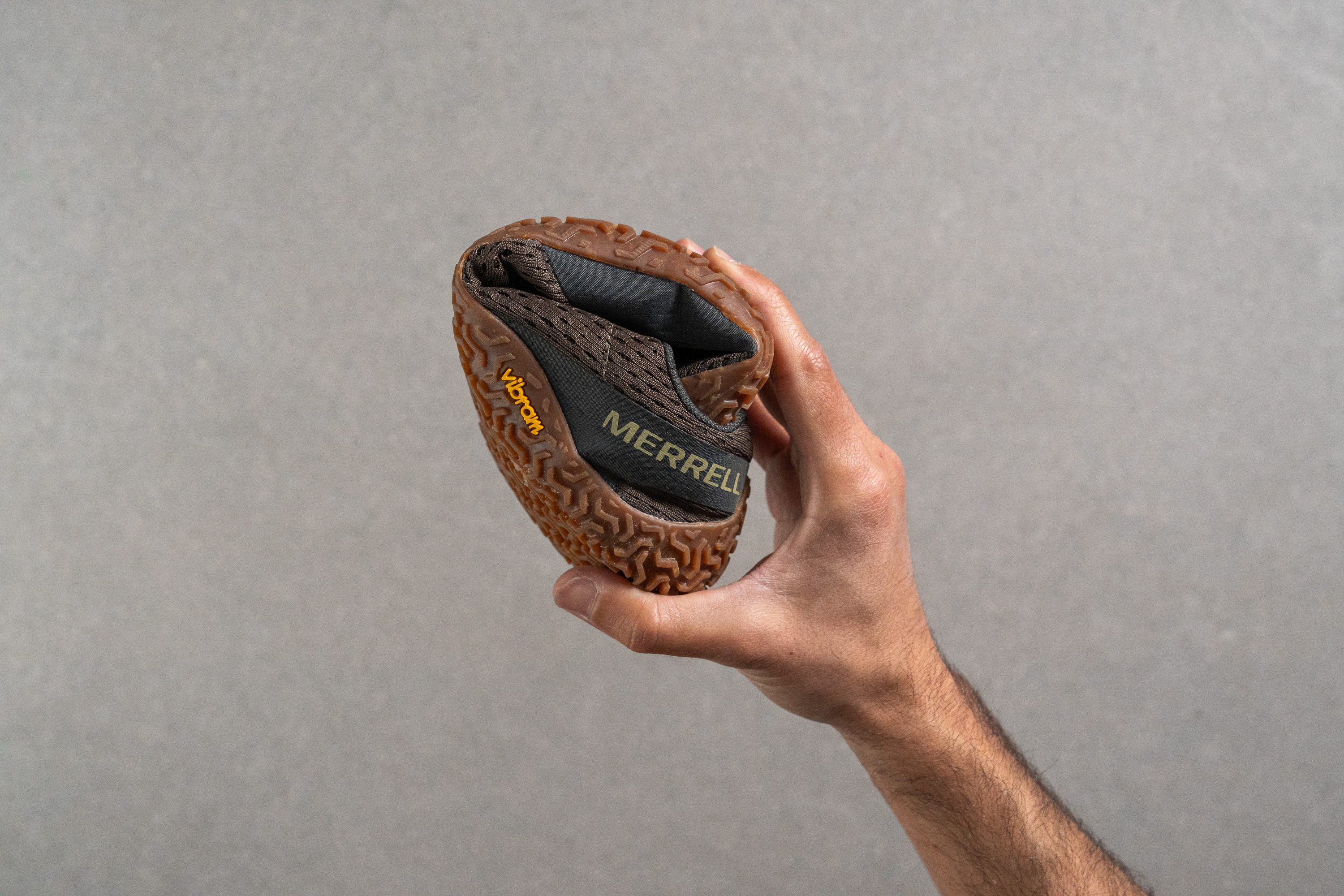
Flexible running shoes are, in general, characterized by:
- Being made for comfort.
- Having no stability features. They are usually neutral and recommended for runners who don’t overpronate.
- Having a better grip than stiff shoes because they can adapt to the terrain better. This is especially important in trail running.
- Being lightweight.
Up to recently, flexibility meant comfort. However, new technologies are making it possible for stiff shoes to be comfortable as well, even for them to have plush cushioning. These technologies are also allowing stiff shoes to be lightweight, a feature that used to belong to flexible running shoes mostly.
Most flexible running shoes