


Our verdict
- Daily running 82
- Tempo 48
- Race 25
- Stability 92
Pros
- Excellent stability without a broad platform
- Low-stack design enhances ground feel
- Strong traction
- Generous toebox works for most feet
- Versatile enough for all-day wear
- Comfortable upper
- Dependable fit with semi-gusseted tongue
- Full-length outsole coverage
- High build quality
- Interesting option for forefoot strikers
- Impressive ventilation
Cons
- Poor energy return limits performance
- Low drop may not suit everyone
- Flat rocker limits fast turnover
- Subpar durability
Comparison
The most similar running shoes compared
+ + Add a shoe | |||||
|---|---|---|---|---|---|
| Our score | 79 Good | 78 Good | 84 Great | 79 Good | |
| Price | $165 | $175 | $150 | $130 | |
| Pace | Daily running | Daily running | TempoDaily running | TempoDaily running | |
| Shock absorption | Low | Low | Low | Low | |
| Energy return | Low | Low | High | Low | |
| Traction | High | High | Moderate | High | |
| Arch support | Neutral | Neutral | Neutral | Neutral | |
| Weight lab Weight brand | 8.9 oz / 252g 8.8 oz / 249g | 9.1 oz / 258g 9.4 oz / 266g | 8.5 oz / 241g 8.4 oz / 238g | 7.3 oz / 207g 7 oz / 198g | |
| Lightweight | ✗ | ✗ | ✓ | ✓ | |
| Drop lab Drop brand | 3.3 mm 2.0 mm | 5.6 mm 5.0 mm | 1.9 mm 0.0 mm | 4.5 mm 4.0 mm | |
| Strike pattern | Mid/forefoot | Mid/forefoot | Mid/forefoot | Mid/forefoot | |
| Size | - | - | - | True to size | |
| Midsole softness | Firm | Firm | Balanced | - | |
| Difference in midsole softness in cold | Small | Small | Normal | Small | |
| Toebox durability | Decent | Decent | Good | Bad | |
| Heel padding durability | Bad | Bad | Bad | Good | |
| Outsole durability | Decent | Decent | Good | Bad | |
| Breathability | Breathable | Moderate | Moderate | Breathable | |
| Width / fit | Medium | Medium | Wide | Medium | |
| Toebox width | Medium | Medium | Wide | Narrow | |
| Stiffness | Moderate | Moderate | Flexible | Moderate | |
| Torsional rigidity | Moderate | Moderate | Moderate | Flexible | |
| Heel counter stiffness | Stiff | Stiff | Flexible | Moderate | |
| Heel lab Heel brand | 26.2 mm 24.0 mm | 30.2 mm 31.0 mm | 23.5 mm 22.0 mm | 28.0 mm 29.0 mm | |
| Forefoot lab Forefoot brand | 22.9 mm 22.0 mm | 24.6 mm 26.0 mm | 21.6 mm 22.0 mm | 23.5 mm 25.0 mm | |
| Widths available | Normal | Normal | NormalWide | Normal | |
| Orthotic friendly | ✓ | ✓ | ✓ | ✓ | |
| Season | SummerAll seasons | All seasons | All seasons | SummerAll seasons | |
| Removable insole | ✓ | ✓ | ✓ | ✓ | |
| Ranking | #265 Bottom 34% | #285 Bottom 29% | #146 Top 37% | #245 Bottom 39% | |
| Popularity | #385 Bottom 4% | #366 Bottom 9% | #242 Bottom 40% | #144 Top 36% |


Who should buy
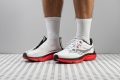
In our view, the Lems ZENSPEED Lite is a very interesting shoe for runners that:
- Are loyal to Lems for hiking or casual shoes and have been waiting for the brand to enter the running shoe world.
- Prefer a low-stack design with a firm, highly-stable ride.
- Need a single shoe to handle daily walks, all-day work, gym sessions, and casual runs.

Who should NOT buy
The ZENSPEED Lite comes with a very low heel-to-toe drop, which may not suit every runner's natural gait. If you prefer a slightly higher drop, the Lems ZENSPEED+ is a better fit for that preference.
We also think the limited energy return holds back the shoe's full potential and range. If you prioritize speed and want a more energetic, bouncy ride, the Topo Cyclone 3 and Altra Escalante 5 offer more in this area.

Cushioning
Shock absorption
The ZENSPEED Lite takes a different approach from most modern running shoes, delivering a more classic, close-to-the-ground experience.
Our testing supports this, with 110 SA of shock absorption in the heel and 93 SA in the forefoot.

| ZENSPEED Lite | 100 SA |
| Average | 131 SA |
Energy return
Unfortunately, the energy return is equally old-school. The shoe genuinely feels like something from 2010, lacking the explosive bounce we've come to expect from modern running shoes. We measured just 37.5% energy return in the forefoot, while the heel performed only slightly better at 39.2%.
In our opinion, Lems can absolutely create a shoe with classic vibes while bringing energy return into the modern era, and that's the direction we'd like to see. Whether the foam is soft or firm comes down to personal preference, but technology has evolved, and we'd expect energy return to reach at least the 60% range here.
| ZENSPEED Lite | 37.5% |
| Average | 61.5% |
Heel stack
The ZENSPEED Lite's retro character is especially clear in its midsole design, with our measurements showing a heel stack height of just 26.2 mm.

Therefore, we think it's a great option if you prefer a low-stack shoe. On the other hand, if you're used to today's thicker running shoes and don't want to embrace that 2010s running-shoe zeitgeist, this probably isn't the shoe for you.

| ZENSPEED Lite | 26.2 mm |
| Average | 35.6 mm |
Forefoot stack
The forefoot measures 22.9 mm, which isn't as far below the lab average as the heel, but we still consider it a clearly low-stack design.

| ZENSPEED Lite | 22.9 mm |
| Average | 27.1 mm |
Drop
Where the ZENSPEED Lite breaks from the classic formula is its heel-to-toe drop.

Lems went with a 3.3 mm drop, which certainly lives up to the brand's claim of promoting "Natural Running" as their motto. It's not the most appealing setup for heel strikers, but considering Lems' extensive range of zero-drop casual shoes, a high-drop design was never really on the table.

| ZENSPEED Lite | 3.3 mm |
| Average | 8.4 mm |
Midsole softness
The ZENCELL foam used in the ZENSPEED Lite is clearly tuned for an intentionally firm ride. In fact, we found it firmer than what would generally be considered a firm shoe today, so runners who prefer a plush, cushioned feel won't find it here.
Going firmer makes sense given the low stack, as a foam that compresses too much could undermine the platform. However, 47.7 AC may still feel too firm for many runners. And it gets even firmer in cold conditions, with our testing showing a 17% change after 20 minutes in the freezer.

| ZENSPEED Lite | 47.7 AC |
| Average | 35.4 AC |
Rocker
The ZENSPEED Lite stays true to its natural-running philosophy with a relatively flat midsole profile. As a result, the ride feels straightforward and predictable, matching the shoe's low-stack character.
The downside is that runners expecting quick turnovers for tempo runs won't find much assistance here, as the shoe's geometry simply doesn't encourage a fast, aggressive transition.

Size and fit
Size
Internal length

| ZENSPEED Lite | 269.5 mm |
| Average | 269.3 mm |
Width / Fit
Lems positions the ZENSPEED Lite as having a slightly narrower toebox than the ZENSPEED+, so we were ready to put that claim to the test.
Our measurements confirmed it, showing a toebox that's still slightly wider than average but a bit narrower than its sibling.

| ZENSPEED Lite | 96.7 mm |
| Average | 95.2 mm |
Toebox width
The toebox measured 76.0 mm, virtually identical to the ZENSPEED+, and our assessment suggests that it remains a viable option for runners with wide feet. It's not quite as spacious as an Altra, but it's certainly roomier than a shoe like an ASICS.

| ZENSPEED Lite | 76.0 mm |
| Average | 73.2 mm |
Toebox height
We also found a very generous toebox height, which further reinforces the comfortable fit of the Lems ZENSPEED Lite.
Our final measurement here came in at 29.9 mm.

| ZENSPEED Lite | 29.9 mm |
| Average | 27.0 mm |
Traction / Grip
Traction test
Lems has done a great job with the outsole rubber, as it delivered strong grip in our traction test. With a 0.69 score, the ZENSPEED Lite provides dependable traction across both dry and wet conditions.
| ZENSPEED Lite | 0.69 |
| Average | 0.53 |
Outsole design
The outsole is essentially identical to the one on the ZENSPEED+, with full-length rubber coverage that provides extra reassurance for runners who tend to wear through exposed foam quickly.

Flexibility / Stiffness
In our 30-degree bend test, the Lems ZENSPEED Lite proved more flexible than the average shoe, requiring just 13.6N of force.
We were somewhat surprised by this result, as shoes with firm foams and full-length rubber coverage typically require more force to bend, although the low stack height clearly plays an important role here.

| ZENSPEED Lite | 13.6N |
| Average | 15.5N |
Weight
The ZENSPEED Lite combines a comfortable, well-padded upper with a reasonable overall weight of 8.9 oz (252g).
We consider this a positive result because firm foams tend to be denser and heavier, while the full-length outsole coverage adds even more weight.

| ZENSPEED Lite | 8.9 oz (252g) |
| Average | 9.2 oz (261g) |
Breathability
Breathability test
Since this is the lighter member of the ZENSPEED family, we were eager to see whether its no-fuss design would translate into similarly unrestricted airflow.
It absolutely did. We recorded a maximum 5/5 in our smoke-pumping test, with very little apparent resistance to ventilation.

| ZENSPEED Lite | 5 |
| Average | 3.6 |
Stability
Lateral stability test
One of the biggest reasons to choose the ZENSPEED Lite is its impressive stability, especially considering that it doesn't rely on a particularly broad footprint.
The firm foam and low stack work together remarkably well here, giving the shoe an agile profile while still providing a highly-supportive platform.
Torsional rigidity
The high torsional rigidity of 16.7 Nm measured in our lab test is another key contributor to the stable feel we experienced with the shoe.

| ZENSPEED Lite | 16.7 Nm |
| Average | 14.3 Nm |
Heel counter stiffness
And guess what... another test highlights Lems' clear focus on support. The heel counter is stiffer than what we usually find in running shoes, scoring 4/5 instead of the 3/5 that we typically see in this area.
| ZENSPEED Lite | 4 |
| Average | 2.9 |
Midsole width - forefoot
The last two lab results, combined with the low stack height, explain how Lems achieves such a stable platform without relying on a broad footprint.
Our first measurement came in at 112.4 mm in the forefoot. True to its decade-ago vibes!

| ZENSPEED Lite | 112.4 mm |
| Average | 115.1 mm |
Midsole width - heel
The heel follows a similar configuration, measuring just a few millimeters below the current lab average. At 89.1 mm, the shoe never feels overly large or clunky.

| ZENSPEED Lite | 89.1 mm |
| Average | 91.1 mm |
Durability
Toebox durability
The upper uses engineered mesh that performs well in terms of comfort, but unfortunately, our testing revealed a weakness in durability. In our first test on the toebox, it scored just 2/5.
| ZENSPEED Lite | 2 |
| Average | 2.6 |
Heel padding durability
The heel padding performed even worse, earning our lowest possible rating of 1/5. This could be particularly concerning for runners who are prone to developing holes in this area.
| ZENSPEED Lite | 1 |
| Average | 3.4 |
Outsole durability
And for runners who don't wear through the heel lining but tend to destroy outsoles quickly, we don't have much encouraging news either.
In our final Dremel test, the ZENSPEED Lite showed almost twice the wear we usually see, with 1.8 mm of damage.
| ZENSPEED Lite | 1.8 mm |
| Average | 1.1 mm |
Outsole thickness
The outsole is slightly thicker than usual at 3.5 mm, which is particularly welcome given the poor durability score we recorded in our previous test.

| ZENSPEED Lite | 3.5 mm |
| Average | 3.1 mm |
Misc
Insole thickness
The cork-based insole adds 4.5 mm of thickness to the overall setup.

| ZENSPEED Lite | 4.5 mm |
| Average | 4.4 mm |
Removable insole
You can remove the insole and swap it for a spare one you have at home. We think that's a smart move if you want to add a bit more bounce to the ride, although don't expect any miracles.

| ZENSPEED Lite | Yes |
Reflective elements
We love it when brands turn their logo into a reflective element, and Lems nailed it with the ZENSPEED Lite. It looks fantastic at night!
| ZENSPEED Lite | Yes |
Tongue padding
The lacing system is simple but well-executed, with flat laces that pair nicely with the punched eyelets. Lems also added an extra eyelet at the top, giving runners the option to use alternative lacing techniques.

The tongue strikes a great balance between comfort and lightness. We measured 6.0 mm of padding, which provides plenty of cushioning without adding the weight associated with thicker 10 or 12 mm tongues.

| ZENSPEED Lite | 6.0 mm |
| Average | 5.8 mm |
Tongue: gusset type
The tongue is exceptionally well-executed, with a semi-gusseted design made from a paper-thin fabric that provides a secure fit without restricting airflow or adding unnecessary weight.

| ZENSPEED Lite | Both sides (semi) |
Heel tab
The heel features a no-frills design without a heel tab, but we were impressed by its overall build quality.

| ZENSPEED Lite | None |
Price
The Lems ZENSPEED Lite comes at a slightly higher price than a regular daily trainer like the Nike Pegasus 42, placing it closer to the premium end of the market. For runners looking for a low-stack shoe with plenty of support and comfort, the price may be justified, but those prioritizing performance can find more value-friendly options in the market.
| ZENSPEED Lite | $165 |
| Average | $158 |