























Our verdict
- Daily running 17
- Tempo 63
- Race 95
- Stability 37
Pros
- First true sub-100g marathon super shoe!
- Amazing energy return
- High shock absorption despite low weight
- Innovative ENERGYRIM adds plate-like stiffness
- New, ultra-plush Lightstrike Pro Evo foam
- Continental replaces liquid rubber
- Aggressive rocker boosts forward roll
- Perfect match for midfoot and forefoot strikers
- Already delivered WRs and sub-2 marathons in one race!
- 29% lighter than the Evo 2!
Cons
- Extremely expensive for most runners
- Not for heel strikers
- Very narrow and restrictive fit
- Limited availability
Awards
- Top 7% in road running shoes
- Top 5% in adidas running shoes
- Top 4% most popular running shoes
Comparison
The most similar running shoes compared
+ + Add a shoe | |||||
|---|---|---|---|---|---|
| Our score | 91 Superb | 92 Superb | 91 Superb | 92 Superb | |
| Price | $500 | $270 | $275 | $290 | |
| Pace | Competition | Competition | Competition | Competition | |
| Shock absorption | High | High | High | High | |
| Energy return | High | High | High | High | |
| Traction | High | High | High | High | |
| Arch support | Neutral | Neutral | Neutral | Neutral | |
| Weight lab Weight brand | 3.5 oz / 99g 3.5 oz / 98g | 5.6 oz / 159g 6 oz / 170g | 6.2 oz / 176g 6.2 oz / 177g | 7.4 oz / 210g 7.2 oz / 204g | |
| Lightweight | ✓ | ✓ | ✓ | ✓ | |
| Drop lab Drop brand | 5.9 mm 3.0 mm | 6.9 mm 5.0 mm | 5.6 mm 4.0 mm | 5.7 mm 8.0 mm | |
| Strike pattern | Mid/forefoot | Mid/forefoot | Mid/forefoot | Mid/forefoot | |
| Size | True to size | True to size | Slightly small | Slightly small | |
| Midsole softness | Soft | Soft | Soft | Soft | |
| Difference in midsole softness in cold | Small | Small | Small | Small | |
| Toebox durability | Bad | Bad | Decent | Bad | |
| Heel padding durability | Decent | Good | Decent | Decent | |
| Outsole durability | Bad | Good | Decent | Good | |
| Breathability | Moderate | Breathable | Moderate | - | |
| Width / fit | Narrow | Narrow | Medium | Medium | |
| Toebox width | Narrow | Medium | Narrow | Medium | |
| Stiffness | Moderate | Moderate | Stiff | Stiff | |
| Torsional rigidity | Flexible | Moderate | Flexible | Flexible | |
| Heel counter stiffness | Flexible | Flexible | Flexible | Flexible | |
| Plate | Carbon plate | Carbon plate | Carbon plate | Carbon plate | |
| Rocker | ✗ | ✓ | ✓ | ✓ | |
| Heel lab Heel brand | 38.1 mm 39.0 mm | 38.9 mm 39.5 mm | 35.6 mm 39.0 mm | 39.8 mm 39.5 mm | |
| Forefoot lab Forefoot brand | 32.2 mm 36.0 mm | 32.0 mm 34.5 mm | 30.0 mm 35.0 mm | 34.1 mm 31.5 mm | |
| Widths available | Normal | NormalWide | Normal | Normal | |
| Orthotic friendly | ✗ | ✓ | ✓ | ✓ | |
| Season | All seasons | SummerAll seasons | All seasons | - | |
| Removable insole | ✗ | ✓ | ✓ | ✓ | |
| Ranking | #19 Top 5% | #16 Top 4% | #29 Top 8% | #14 Top 4% | |
| Popularity | #16 Top 4% | #171 Top 43% | #270 Bottom 33% | #110 Top 28% |


Who should buy
After pushing the adidas Adizero Adios Pro Evo 3 to the limit, we found that it's:
- Ideal for runners who want the newest top-tier technology no matter the price.
- A great match for fans of ultra-light super shoes who love a barely-there feel.
- Best for marathoners who do not heel strike and enjoy the rolling feel of a massive forefoot rocker.
- A perfect super shoe for those seeking marginal gains and enjoying a plush foam underfoot.
Who should NOT buy
The adidas Adizero Adios Pro Evo 3 is extremely expensive. We find its sky-high price is hard to justify for amateurs, especially when shoes like the ASICS Metaspeed Ray or the PUMA Fast-R Nitro Elite 3 also deliver feather-light builds and world-class speed for less money.
We also found in the lab that the Evo 3 has a restrictive, narrow-feeling toebox that may not suit many of you. If you want a more relaxed fit in a super shoe, we proved there are better choices like the Nike Alphafly 3 or the New Balance FuelCell SuperComp Elite v5.
Cushioning
Shock absorption
The challenge adidas faced with this shoe was insane, as combining excellent shock absorption to protect the legs over a full marathon with such a crazy low weight seemed an impossible task.
But the updated Lightstrike Pro Evo foam reaches another level here, delivering an unmatched weight-to-cushioning ratio and scoring 153 SA in the heel and 142 SA in the forefoot.
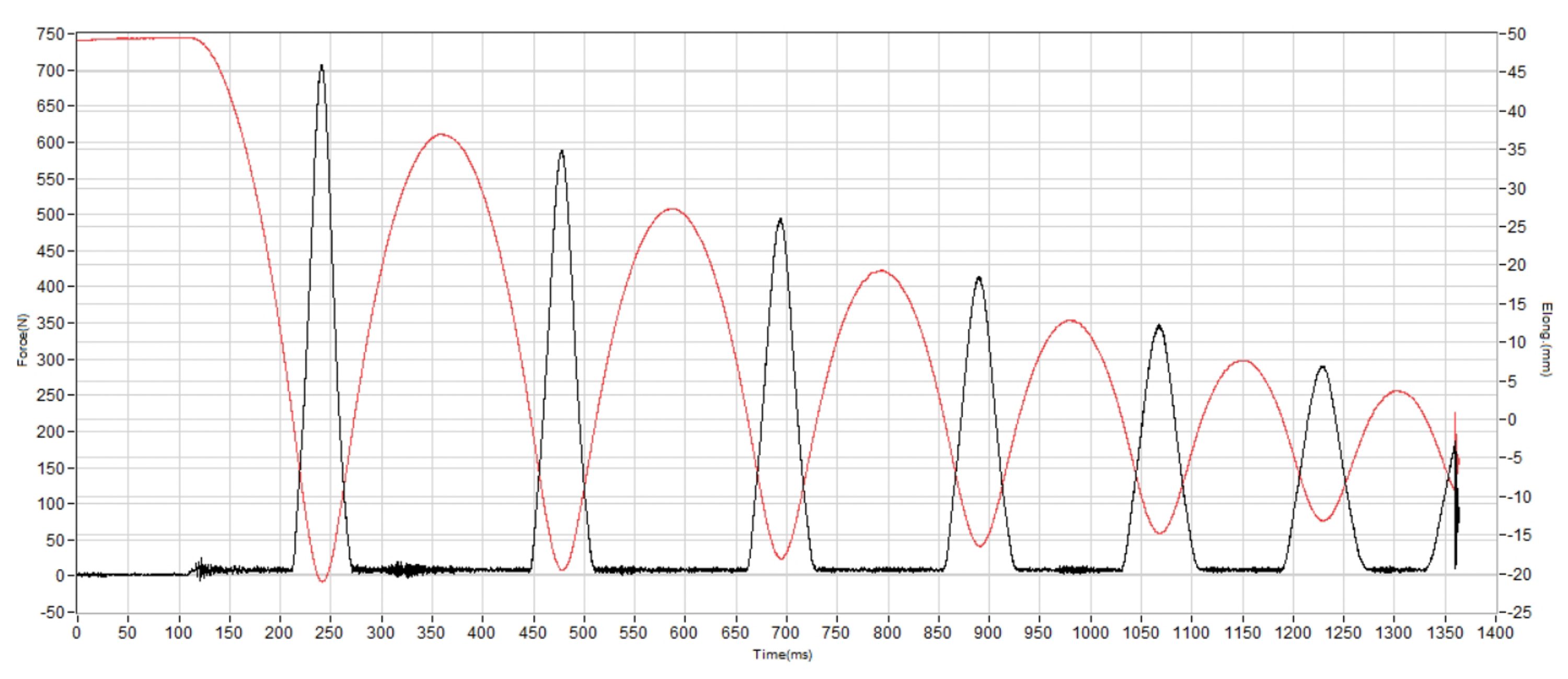
| Adizero Adios Pro Evo 3 | 153 SA |
| Average | 131 SA |
Energy return
While we had doubts about the shock absorption before testing the shoe, we were pretty sure that energy return was going to be among the best. In part, because there's no way you can ask for half a thousand dollars without offering excellent bounce.
So yes, adidas delivered here. We found 76.8% in the heel and 80.2% in the forefoot, again highly impressive considering how light the shoe is. We also find it positive that the better result appears in the front of the shoe, as this shoe is definitely not a good option for heel strikers at all.
| Adizero Adios Pro Evo 3 | 80.2% |
| Average | 61.5% |
Heel stack
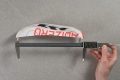
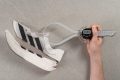
Creating a sub-100g running shoe was not impossible, as we've seen some prototypes from China in the last few years, but adidas is the first brand to truly offer the trifecta of a maxed-out stack height to World Athletics rules, marathon-proof shock absorption, and two-digit weight. In the spec sheet, they declare 39 mm of stack height in the heel, and we found it extremely close at 38.1 mm.
This was not possible with 2025 tech. The regular Lightstrike Pro foam is too heavy for that, and even the previous Lightstrike Pro Evo compound from the Adizero Adios Pro Evo 2 is 50% heavier than this one!
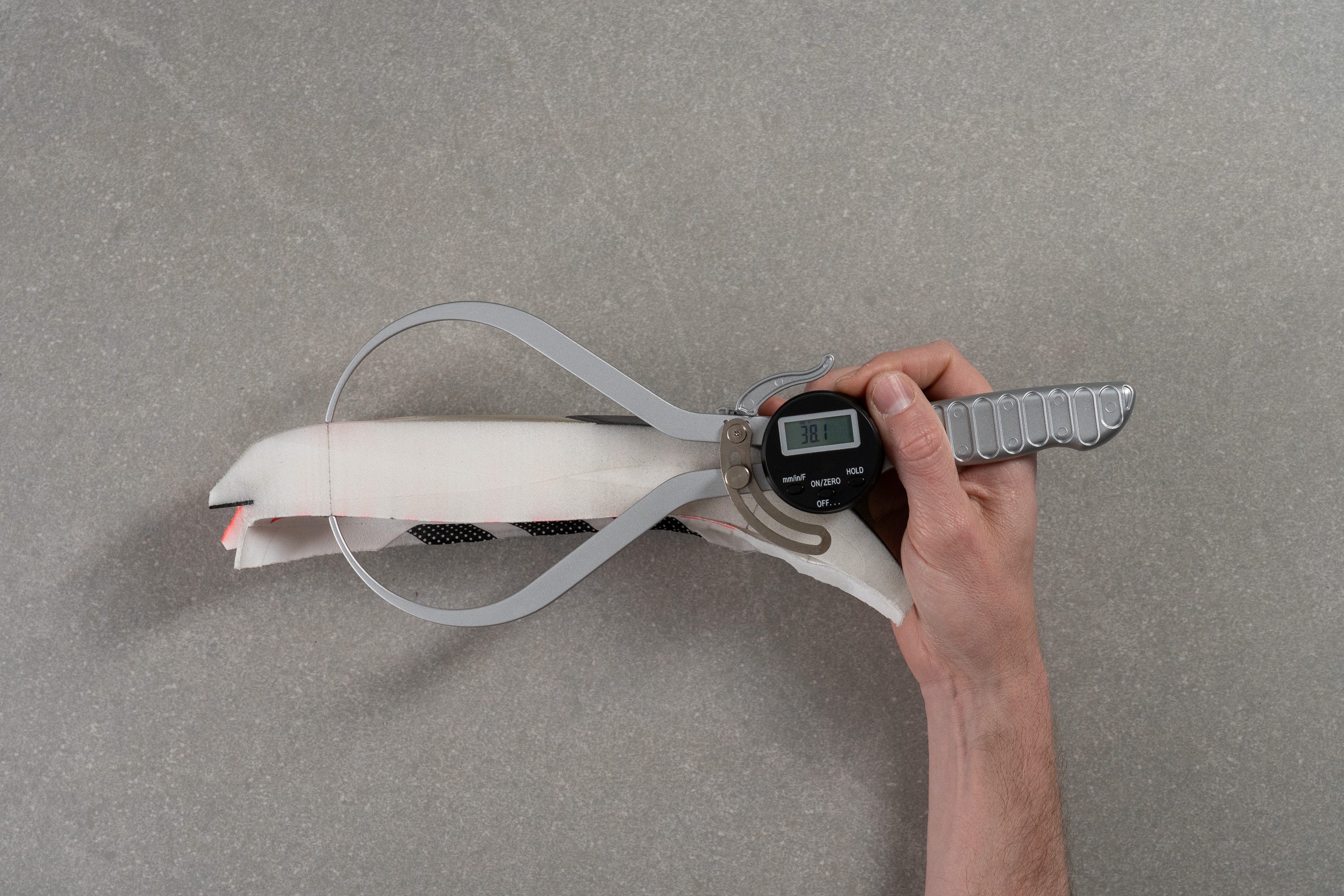
| Adizero Adios Pro Evo 3 | 38.1 mm |
| Average | 35.6 mm |
Forefoot stack
We found the forefoot to measure 32.2 mm when taking the reading at the designated World Athletics points, as we do on every shoe. Equally impressive than the heel, to be honest.
adidas states 36 mm here, but the forefoot rocker is so extreme that moving the calipers just a tiny bit can change the measurement a lot. Anyway, we triple-checked our own result, and that's what we declare here.
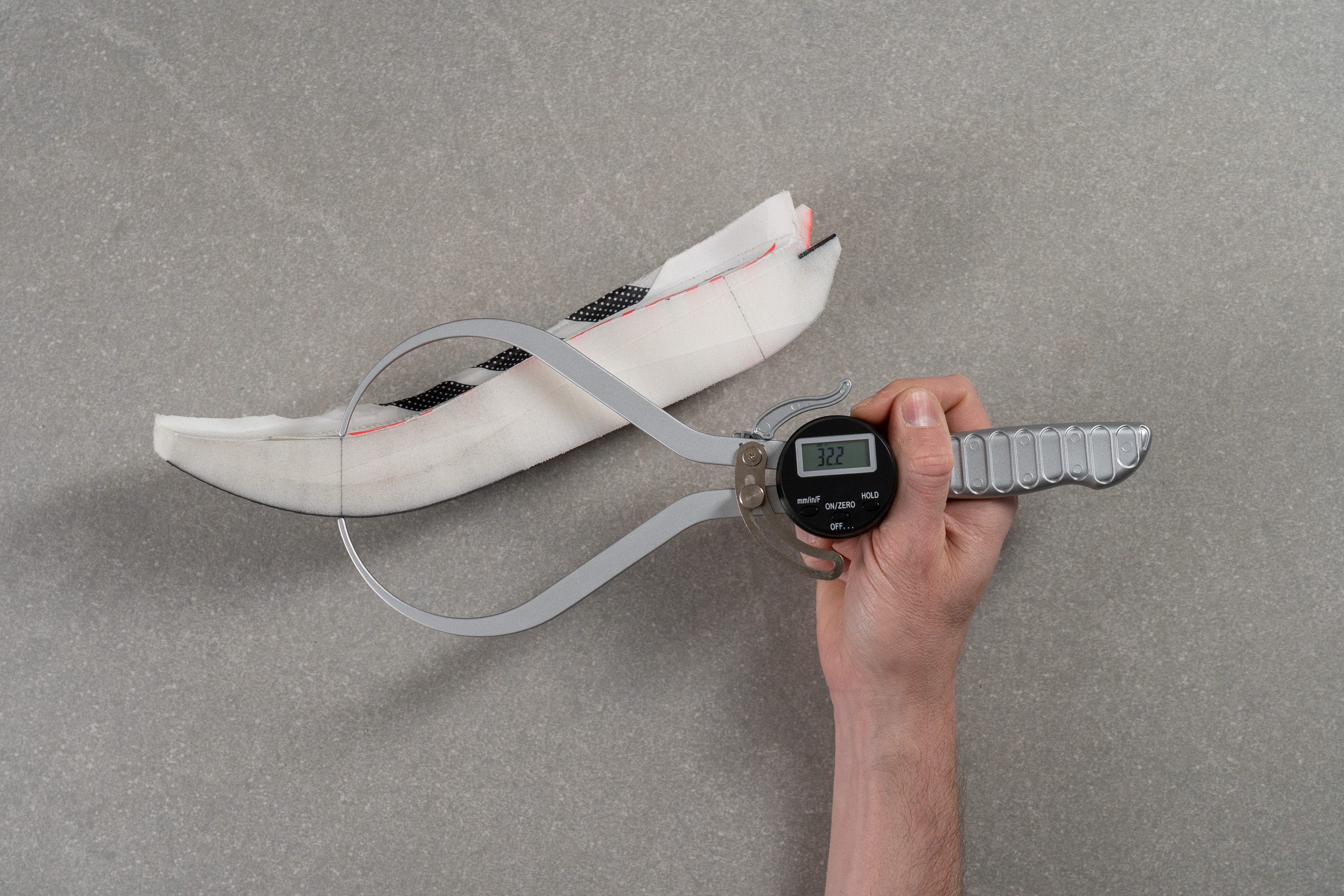
| Adizero Adios Pro Evo 3 | 32.2 mm |
| Average | 27.1 mm |
Drop
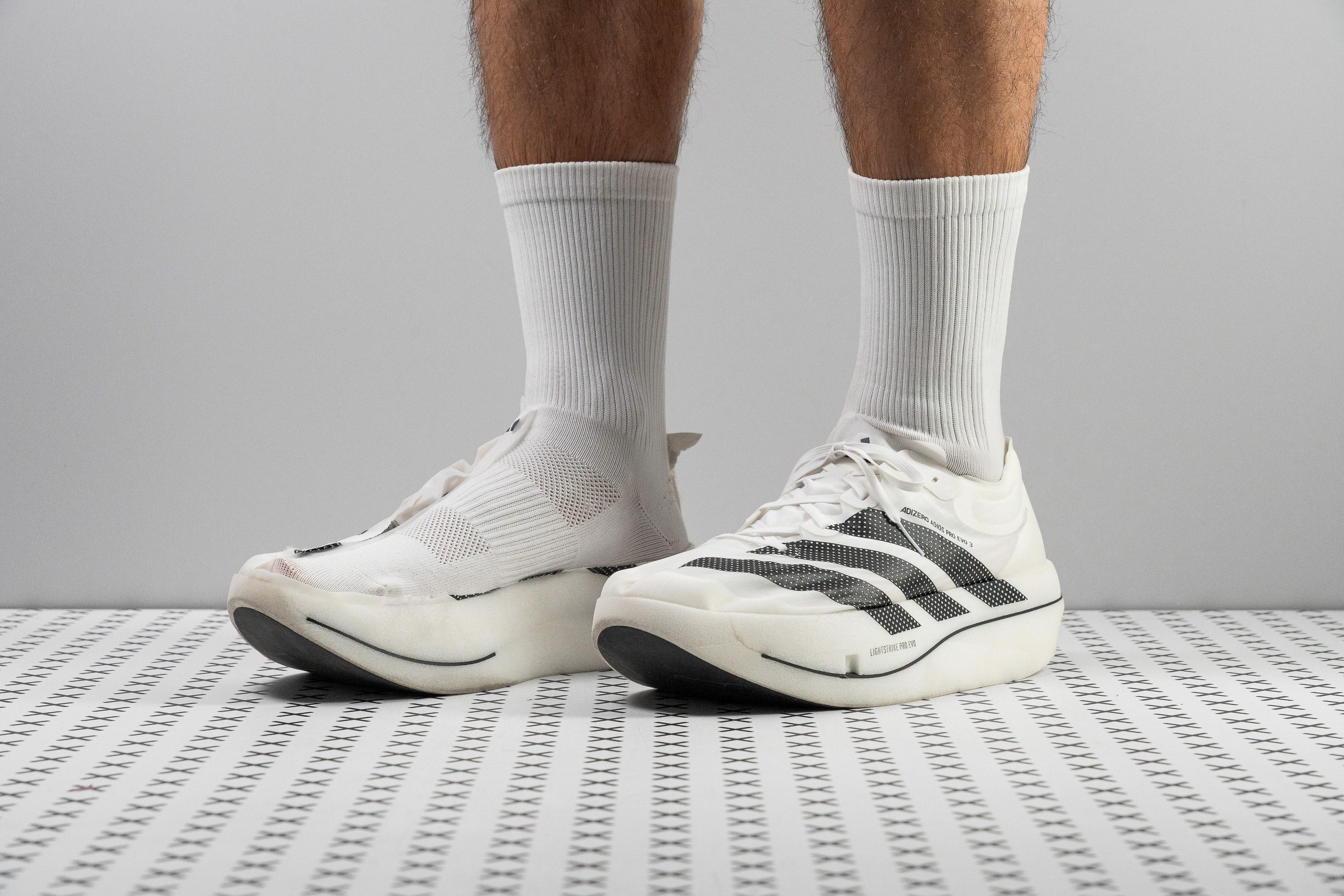
Obviously, adidas goes with a 3 mm drop based on 39-36 mm of stack height. For us, it's 5.9 mm, which also feels closer to how the shoe rides on foot. It's not that flat, but this shoe changes a lot depending on where you land, and speaking of that, the geometry clearly rewards midfoot strikers, as in most adidas super shoes.
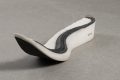
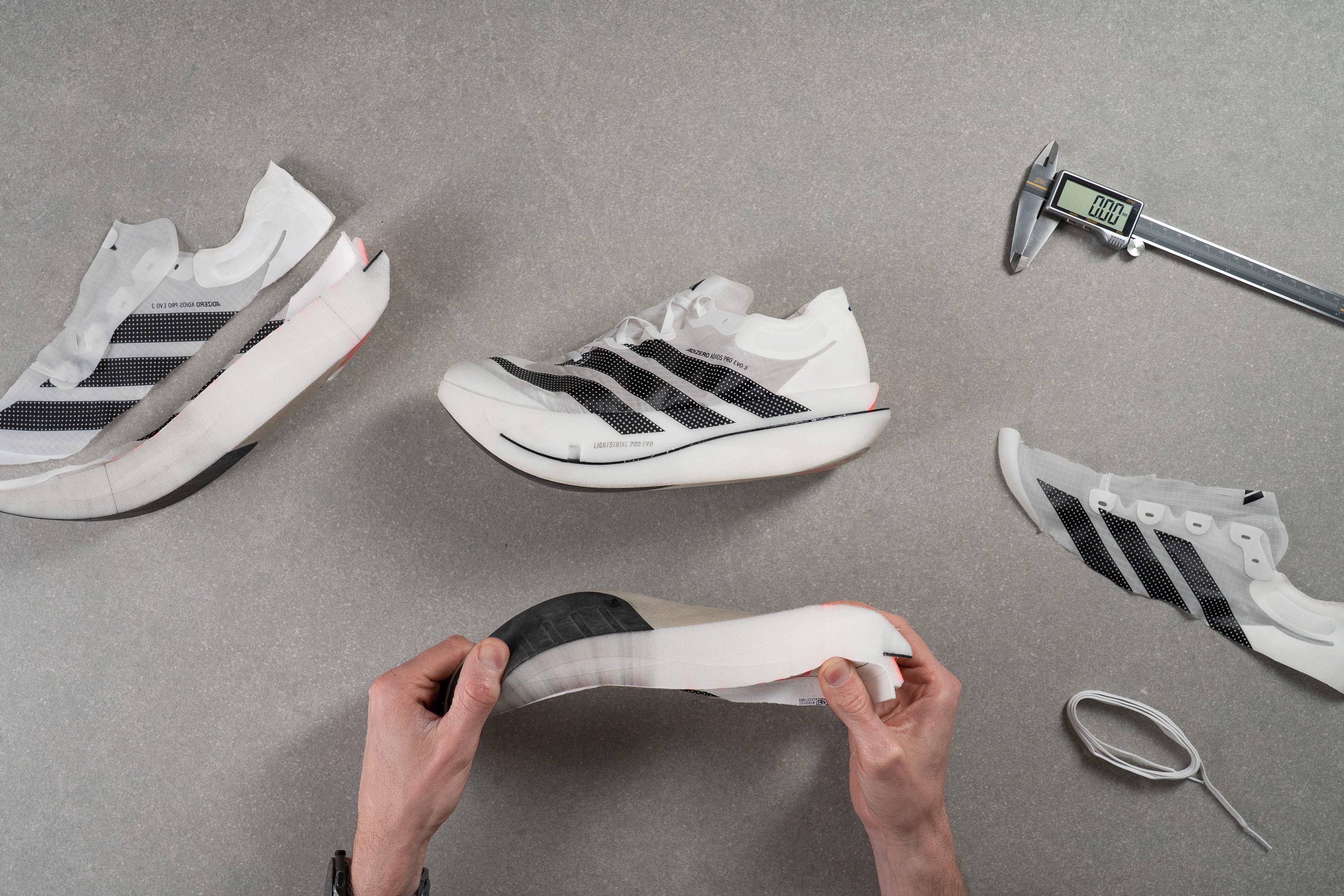
By the way, looking at this photo you may be wondering... no plate or ENERGYRODS? Don't worry, we will cover everything...
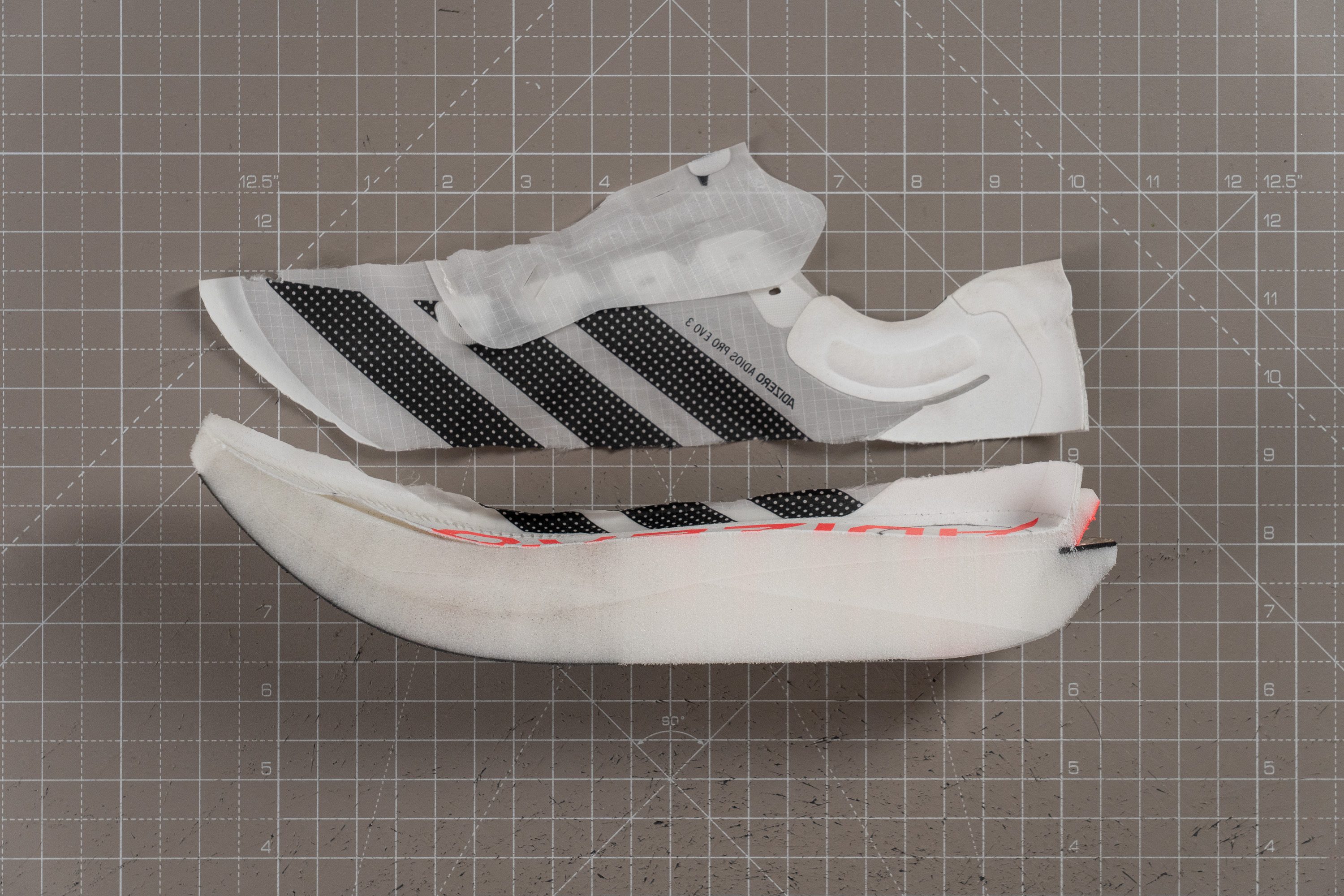
| Adizero Adios Pro Evo 3 | 5.9 mm |
| Average | 8.4 mm |
Midsole softness
Making a foam lighter means using a supercritical formulation and, of course, making it as airy as possible. Basically, the more air or gas you can place inside the midsole, the lower the final weight and the softer the shoe.
And the Evo 3 is insanely soft, which confirms that adidas is going this route after the Adios Pro 4 was significantly softer than the Adios Pro 3. For those of you who prefer a firmer and more predictable feel underfoot, this is not the right shoe.
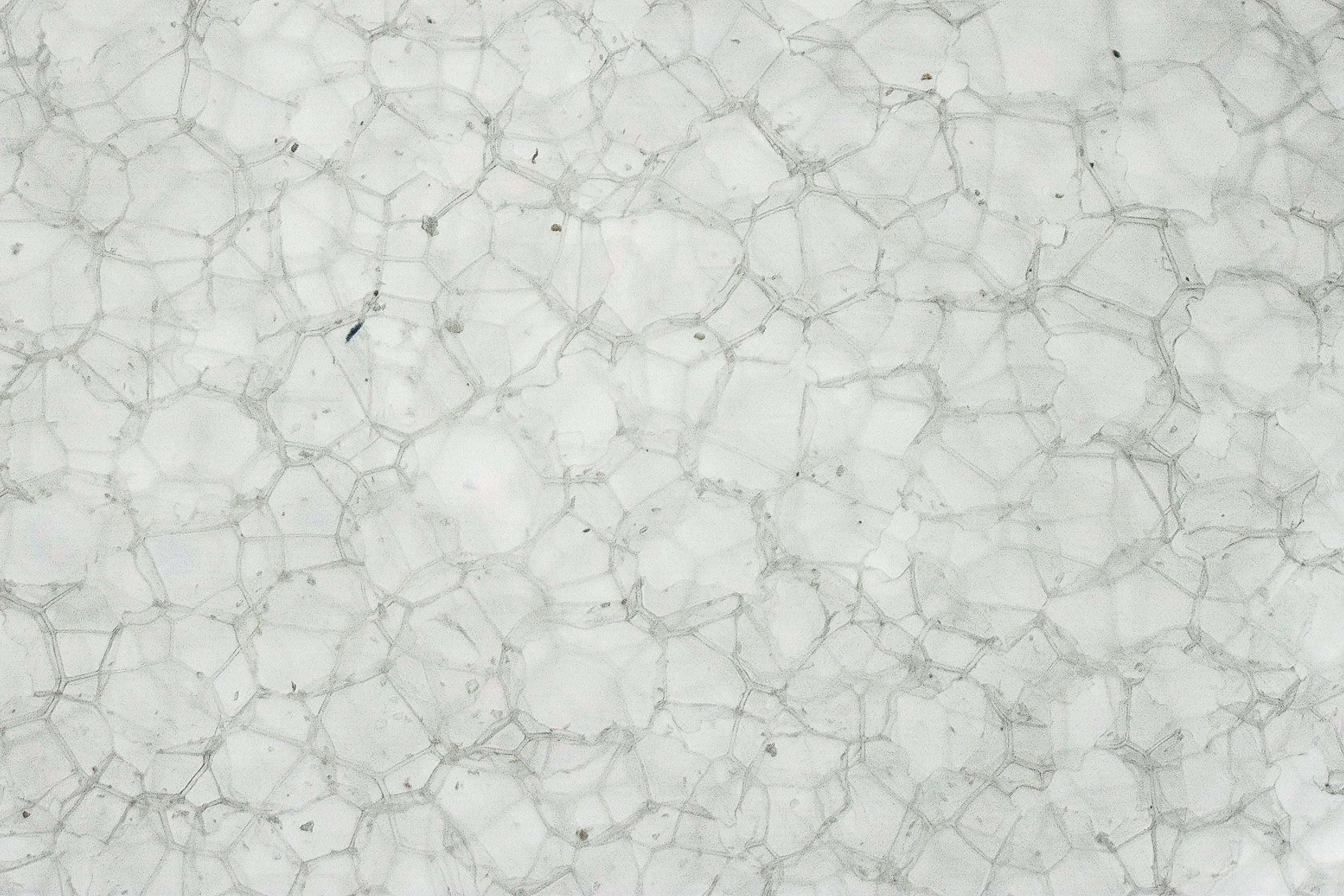
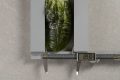
We sliced a piece of foam and examined it under our digital microscope. What we found was, by far, the least dense foam we've ever seen in the lab.
To put the extreme softness of this shoe into context, let's use some data: at 21.0 AC in our Asker C durometer, the Evo 3 is softer than what is widely known as the softest super shoe ever made, the Saucony Endorphin Elite 2, which scored 22.1 AC. Plus, this shoe has less outsole rubber, making the feel even more plush on every stride.
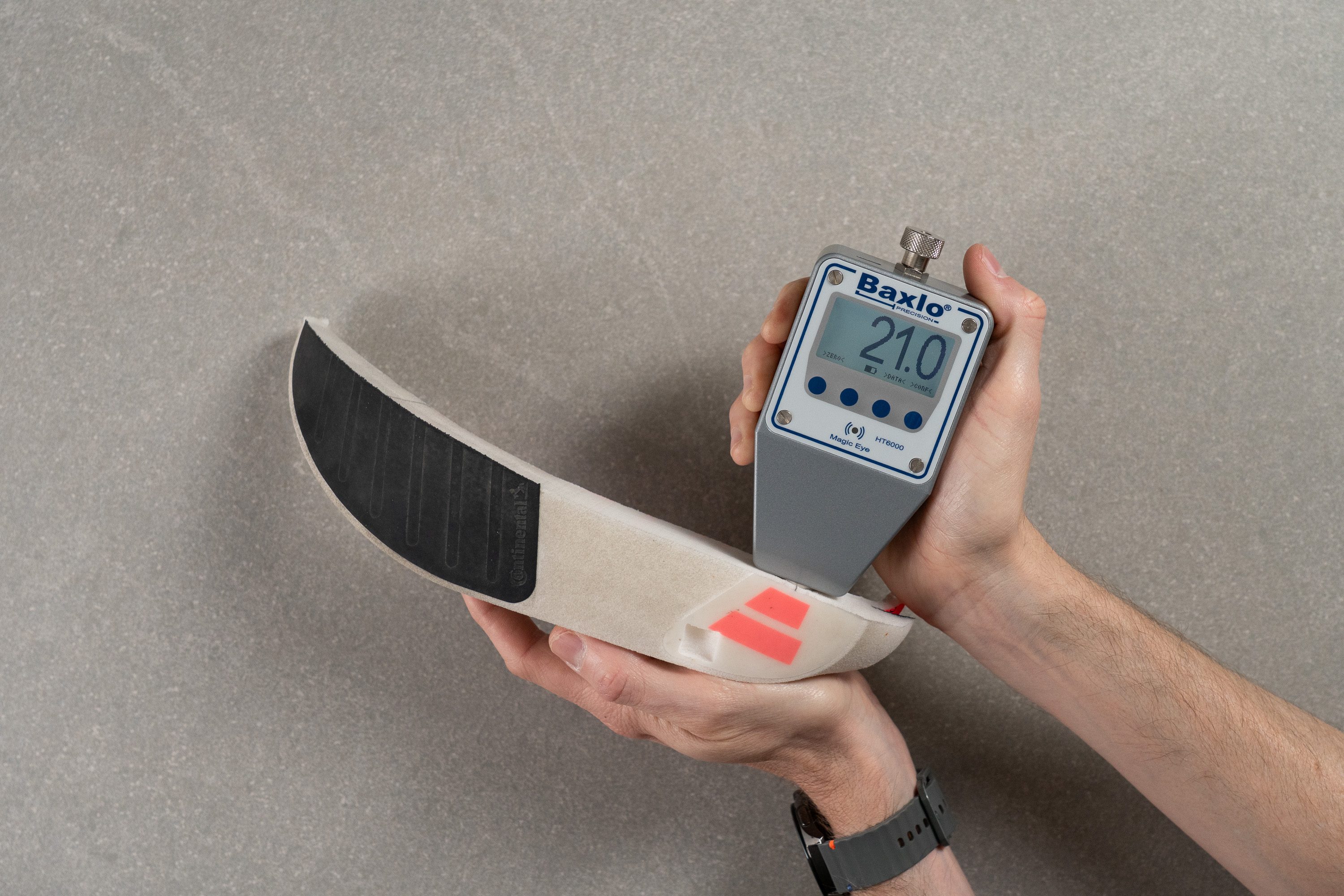
| Adizero Adios Pro Evo 3 | 21.0 AC |
| Average | 35.4 AC |
Rocker
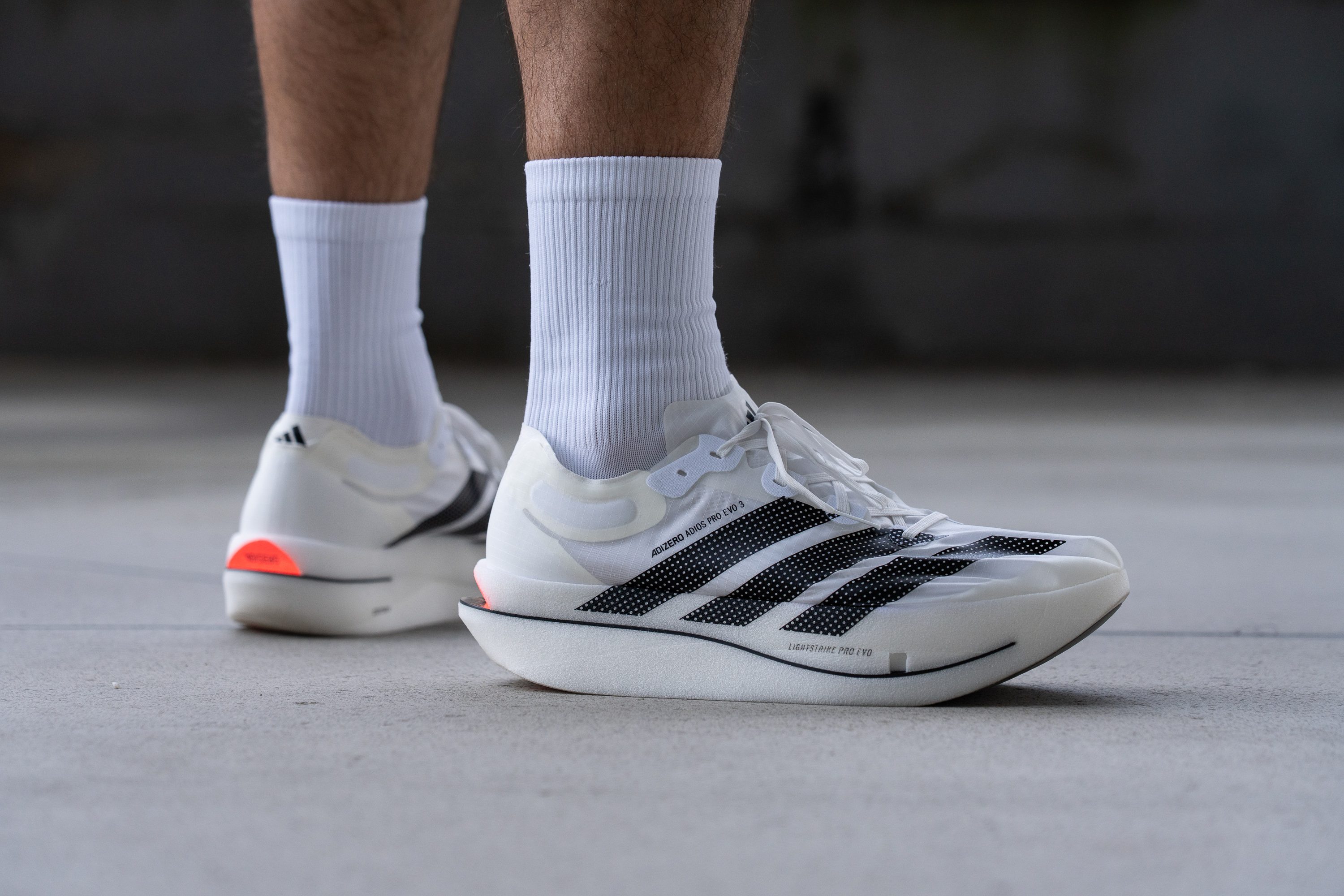
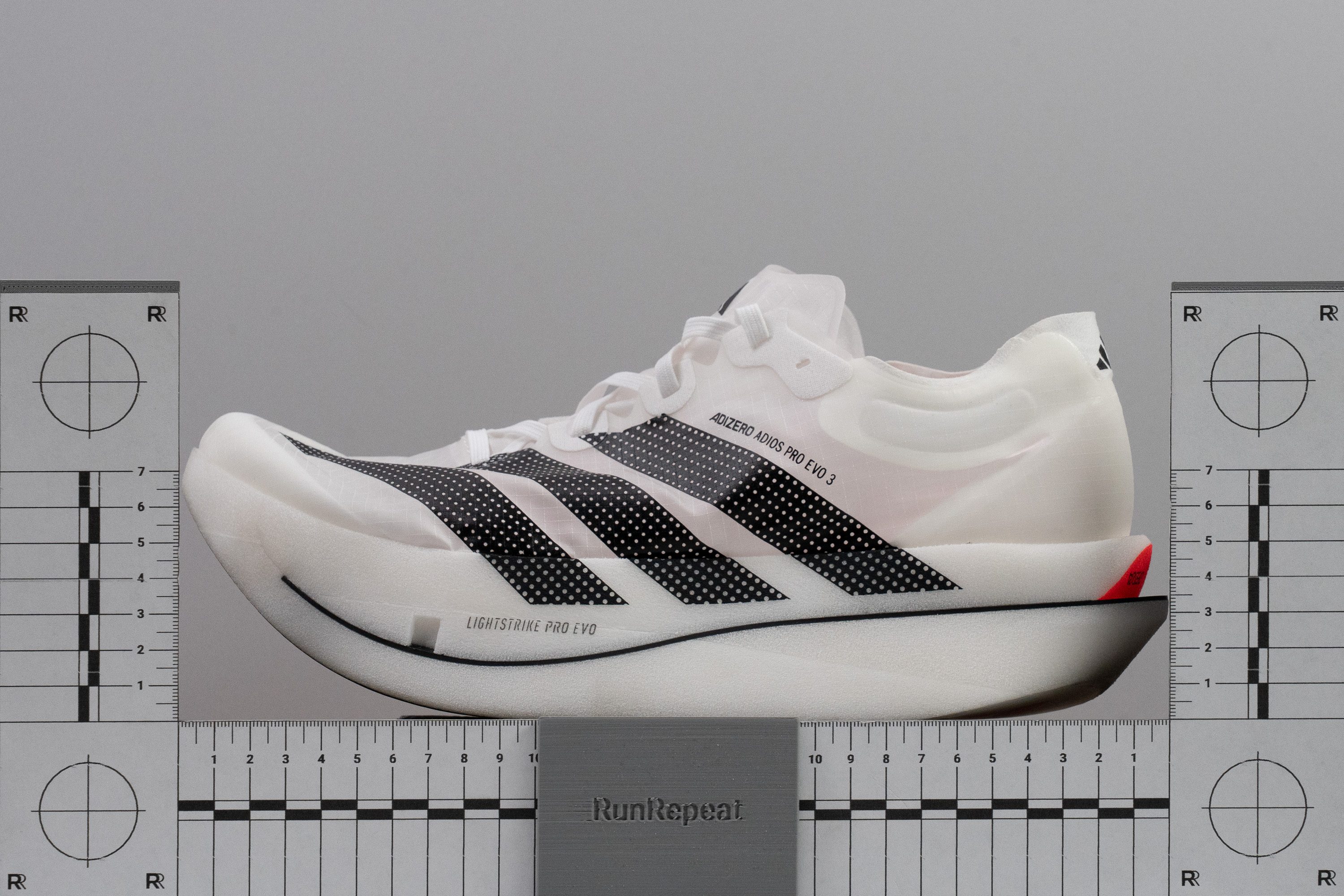
Everything is extreme with the adidas Adizero Adios Pro Evo 3. It's extremely light, extremely soft, and features one of the more extreme forefoot rockers we've ever tried. It rises all the way to 6.5 cm, which is absolutely wild and not ideal for those who prefer a more classic feel. If that's you, it's better to check something like the Nike Vaporfly 4 that only rises 3.5 cm.
The heel is also highly aggressive, featuring a unique design that notably extends the ENERGYRIM and the lower layer of foam to add some stability. And speaking of the ENERGYRIM...
Plate
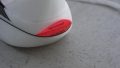
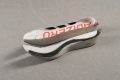
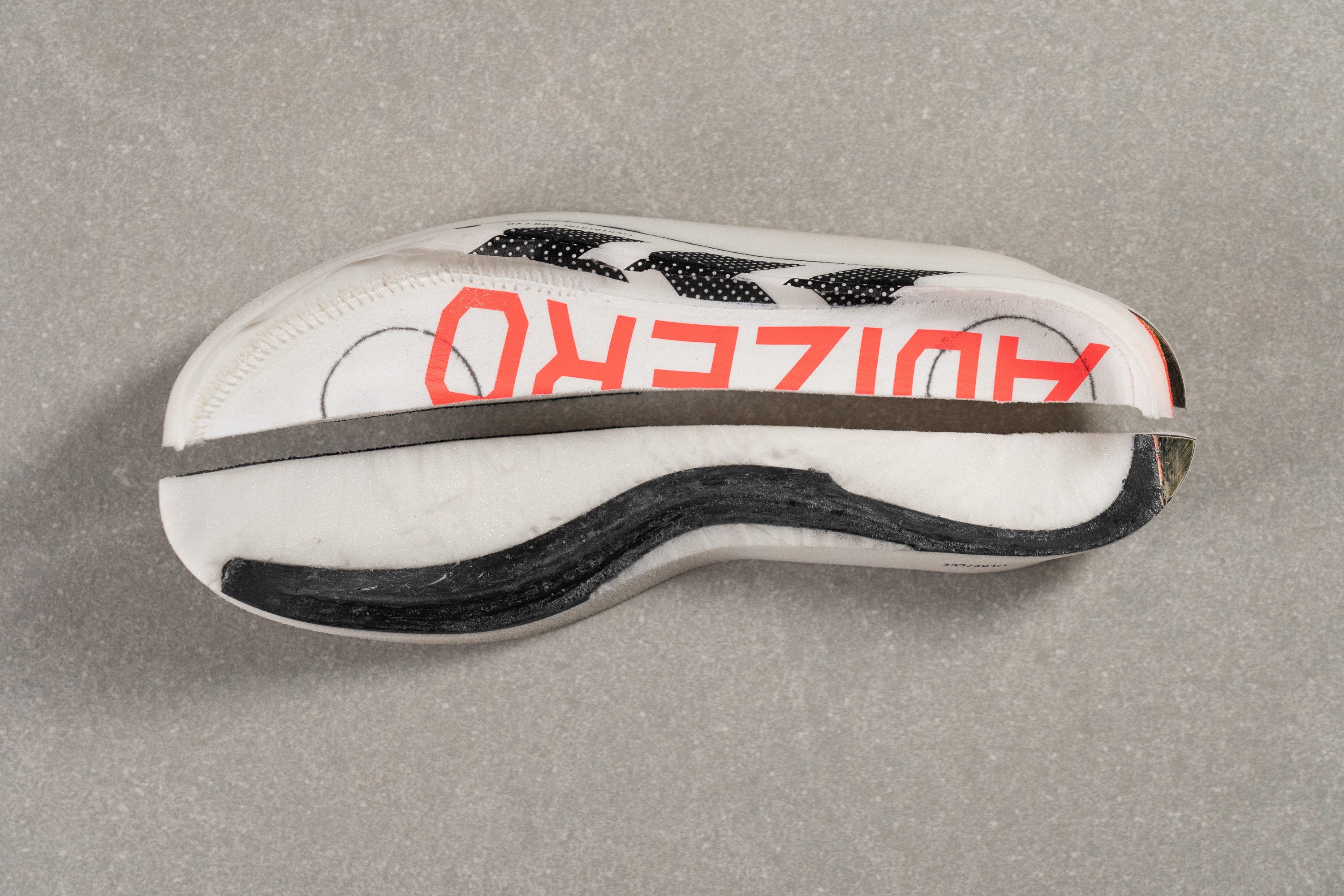
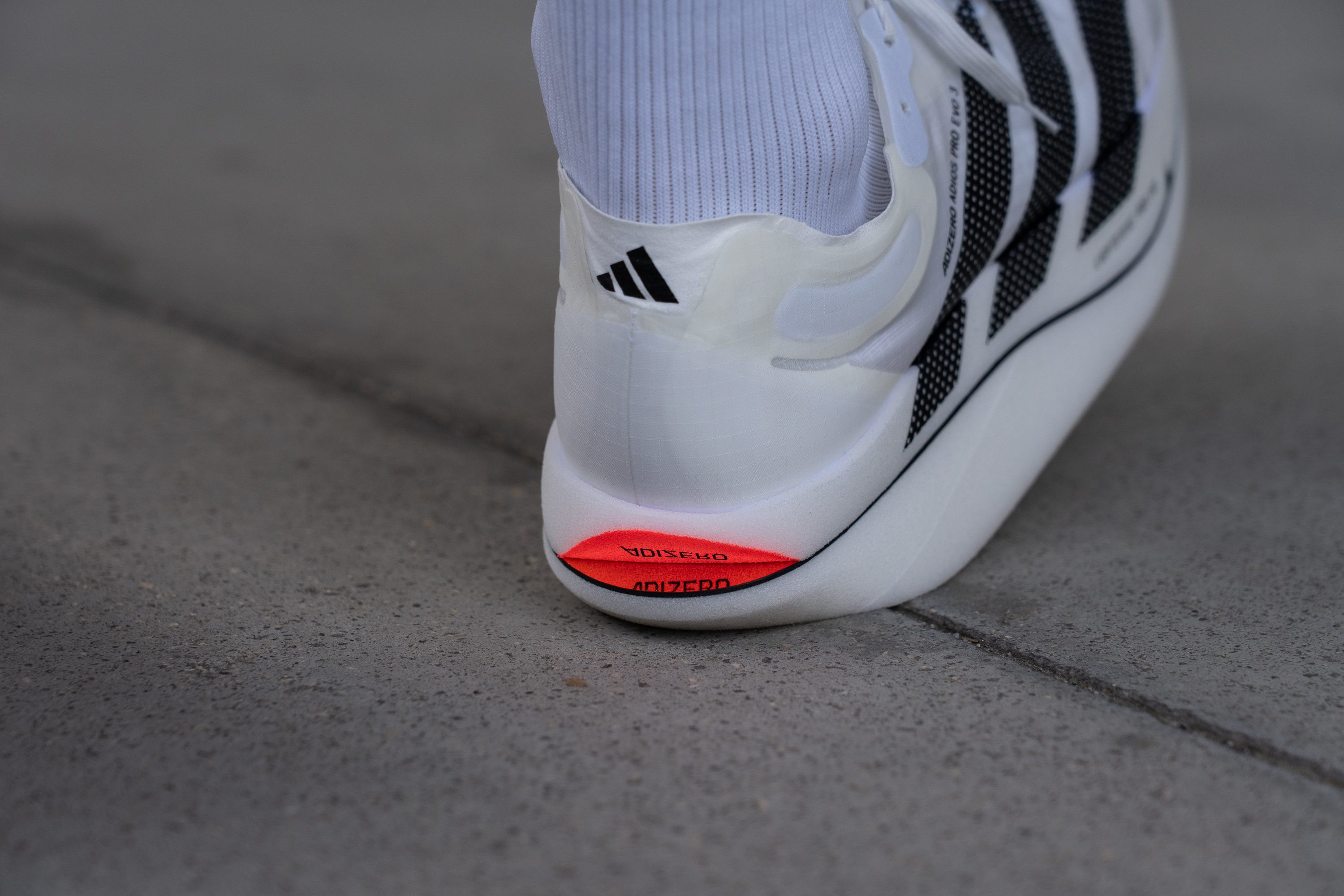
Another feature that made it possible to bring the shoe below 100g is the new stiffening agent. It's not a plate, and it's not the usual ENERGYRODS from adidas. This time, we have a carbon-fiber ENERGYRIM that surrounds the perimeter of the shoe in a U shape, stopping at the front. And the small mirror in the heel that may divide opinions, but we simply loved it.
With this technology, adidas definitely saves a few grams while keeping a stiff feel underfoot, and this also helps explain why the shoe feels ultra-plush. In most super shoes, you can clearly feel the firm carbon plate, but here the ENERGYRIM sits mainly on the outer side of the shoe, with a tilted, mountain-like shape that helps contain lateral motion and keep the top layer of foam centered.
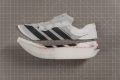
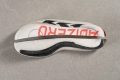
It also moves slightly inward on the medial side for stability purposes, providing some desperately-needed support under the arch. That's why in some of our photos the lateral side looks like it has a regular plate, but if you check the medial side, it stops in the heel and reappears in the forefoot. But cutting the shoe in half, as we do, removes all doubts.
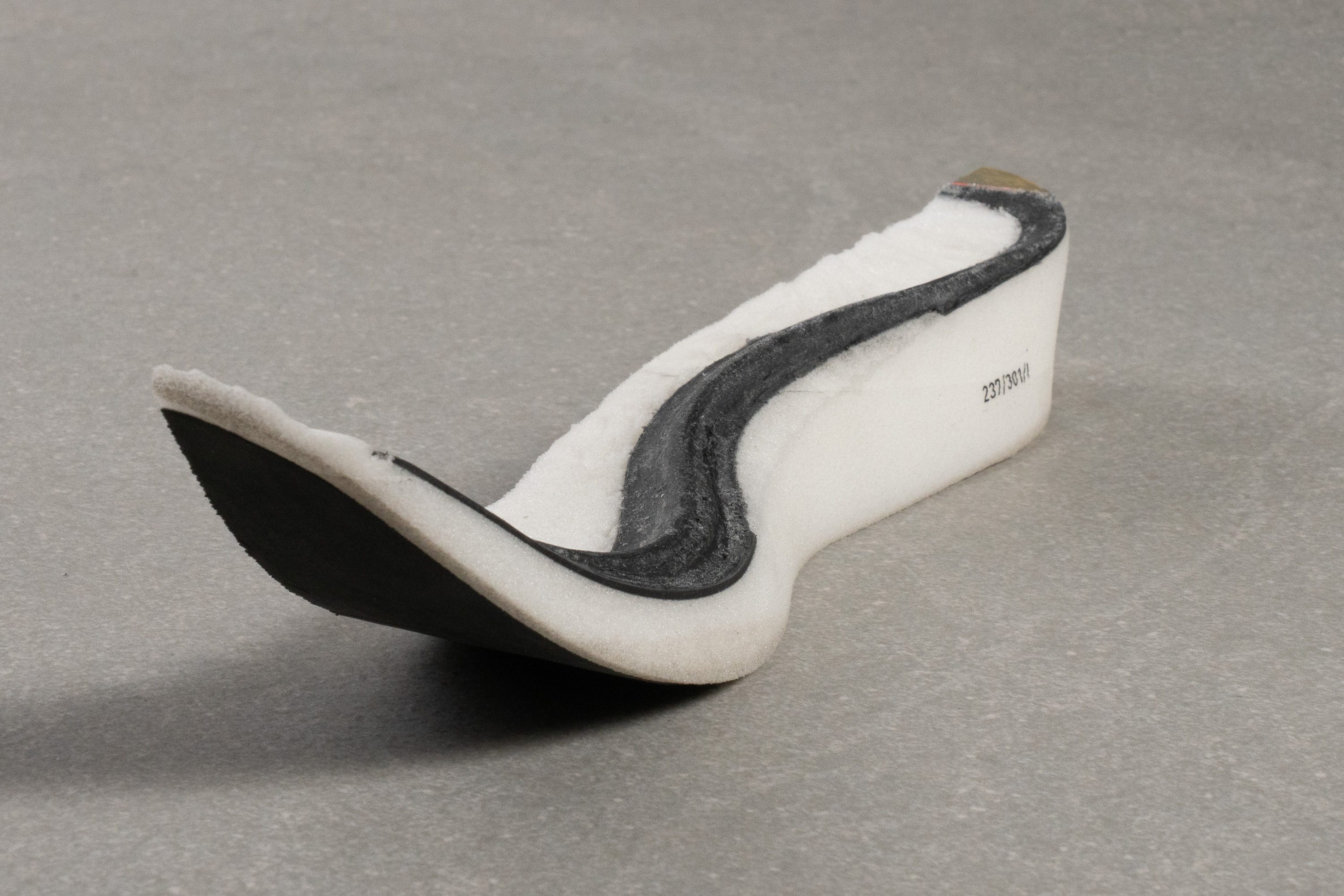
It's clear to us that not a single part of this shoe was left untouched in the search to cut weight, and this is the best example. By the way, those of you regulars to RunRepeat may remember that this ENERGYRIM looks similar to the solution used in the Adistar BYD, which was likely a useful test shoe, although the implementation here is a bit different.
All in all, ENERGYRIM shifts the stiffening structure to the perimeter, leaving more uninterrupted foam directly underfoot. This lets the midsole compress and rebound vertically (like using a plate, but using less weight) instead of dispersing energy through central rods or excess structure.
Size and fit
Size
adidas Adizero Adios Pro Evo 3 fits true to size (20 votes).
Internal length
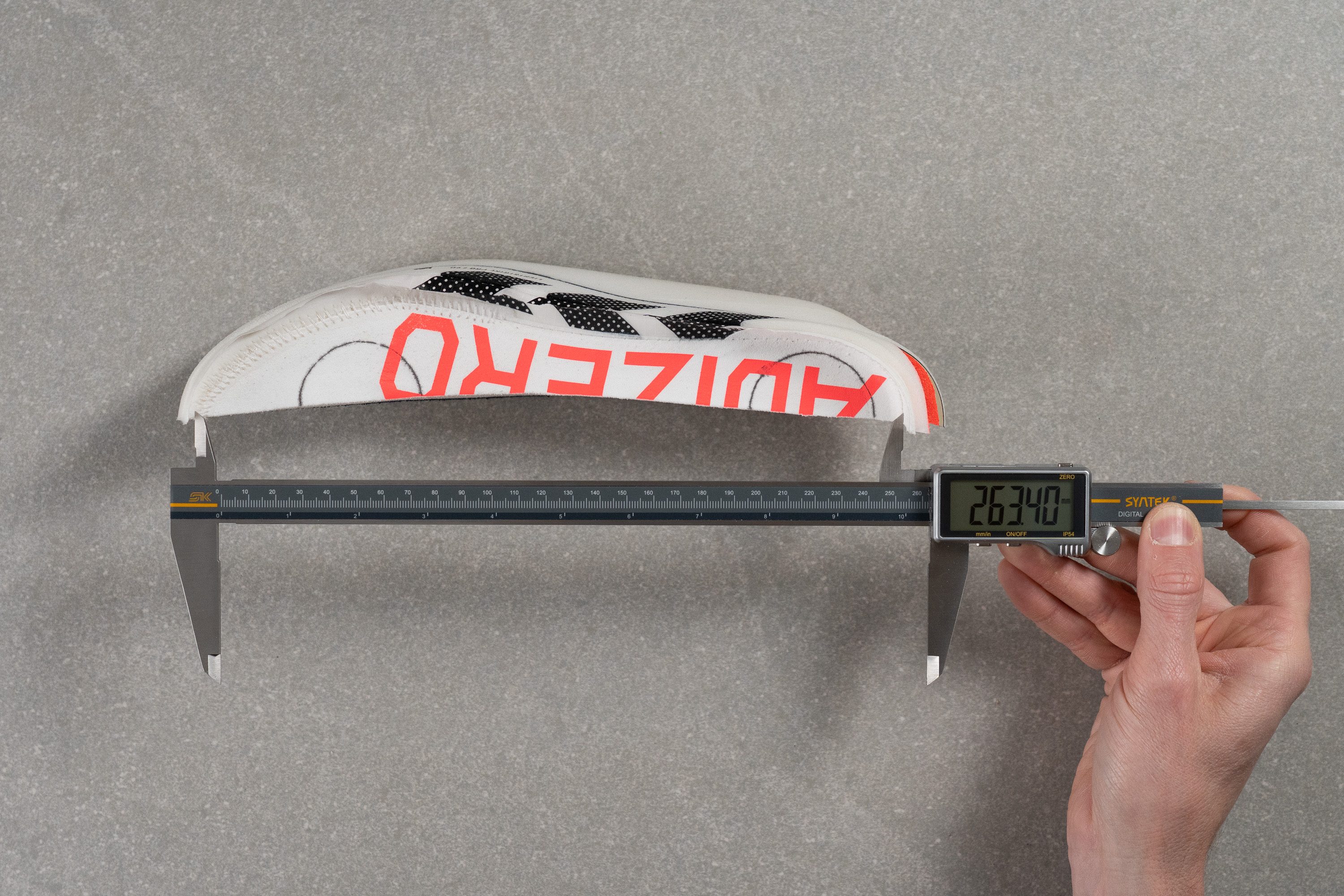
| Adizero Adios Pro Evo 3 | 263.4 mm |
| Average | 269.3 mm |
Width / Fit
As we noted before, extreme is the best way to define this shoe, and the fit follows the same idea. It's evident from the moment you unbox it (fun fact, the box is heavier than one Evo 3 shoe!), and it was also clear during our fit test.
With just 89.3 mm of width, the fit is really tight. Those with wide feet will really struggle here, while everyone else might accept the trade-off in interior space for having the lightest marathon shoe ever made.
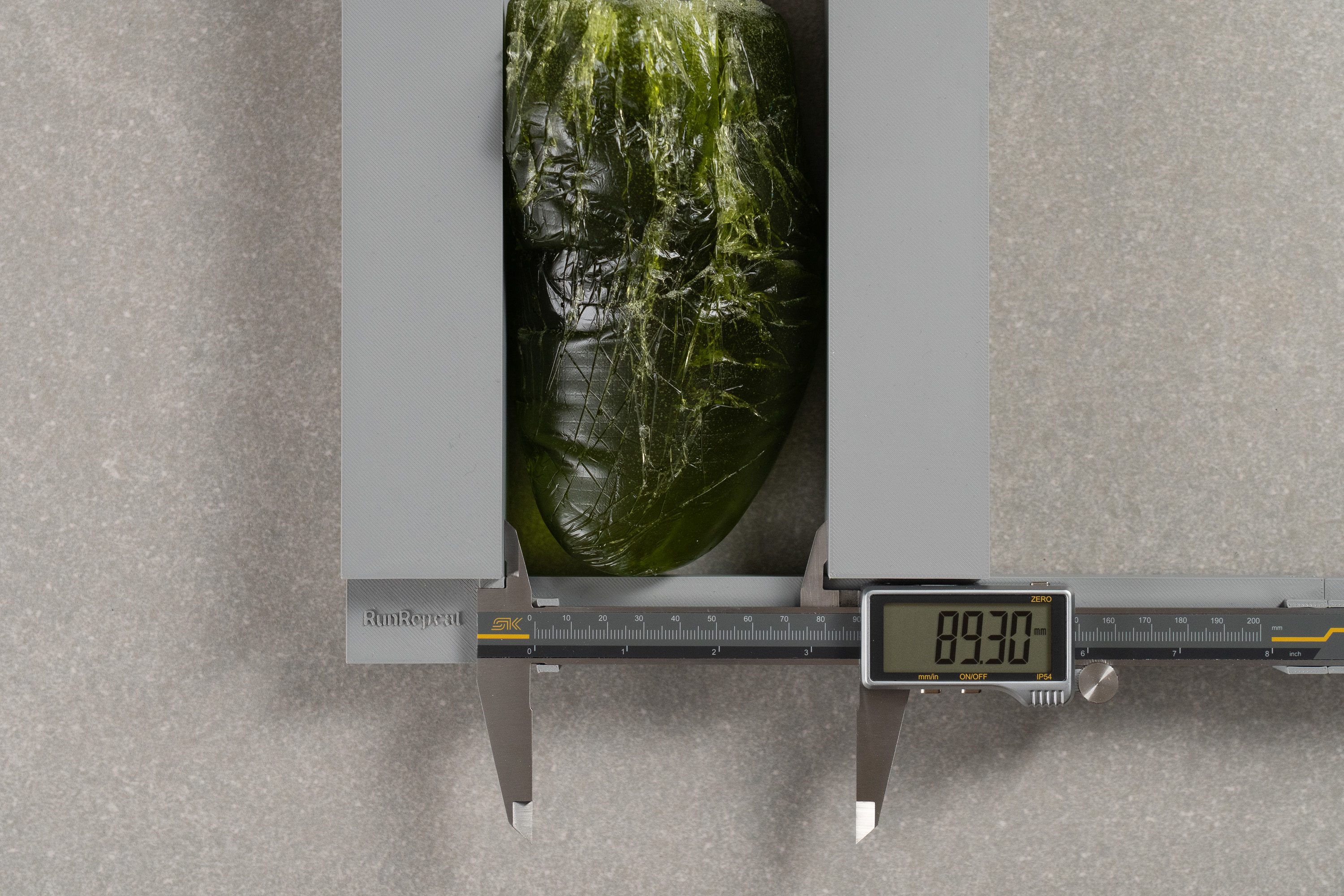
| Adizero Adios Pro Evo 3 | 89.3 mm |
| Average | 95.2 mm |
Toebox width
The toebox feels like a track spike with only 65.9 mm of width and a notably pointy shape. That's extremely narrow and leaves no room for comfort-focused concessions.
But why such a narrow toebox and restrictive fit? In our view, it all comes down to regaining some stability and containing lateral forces, helping keep the foot centered inside.
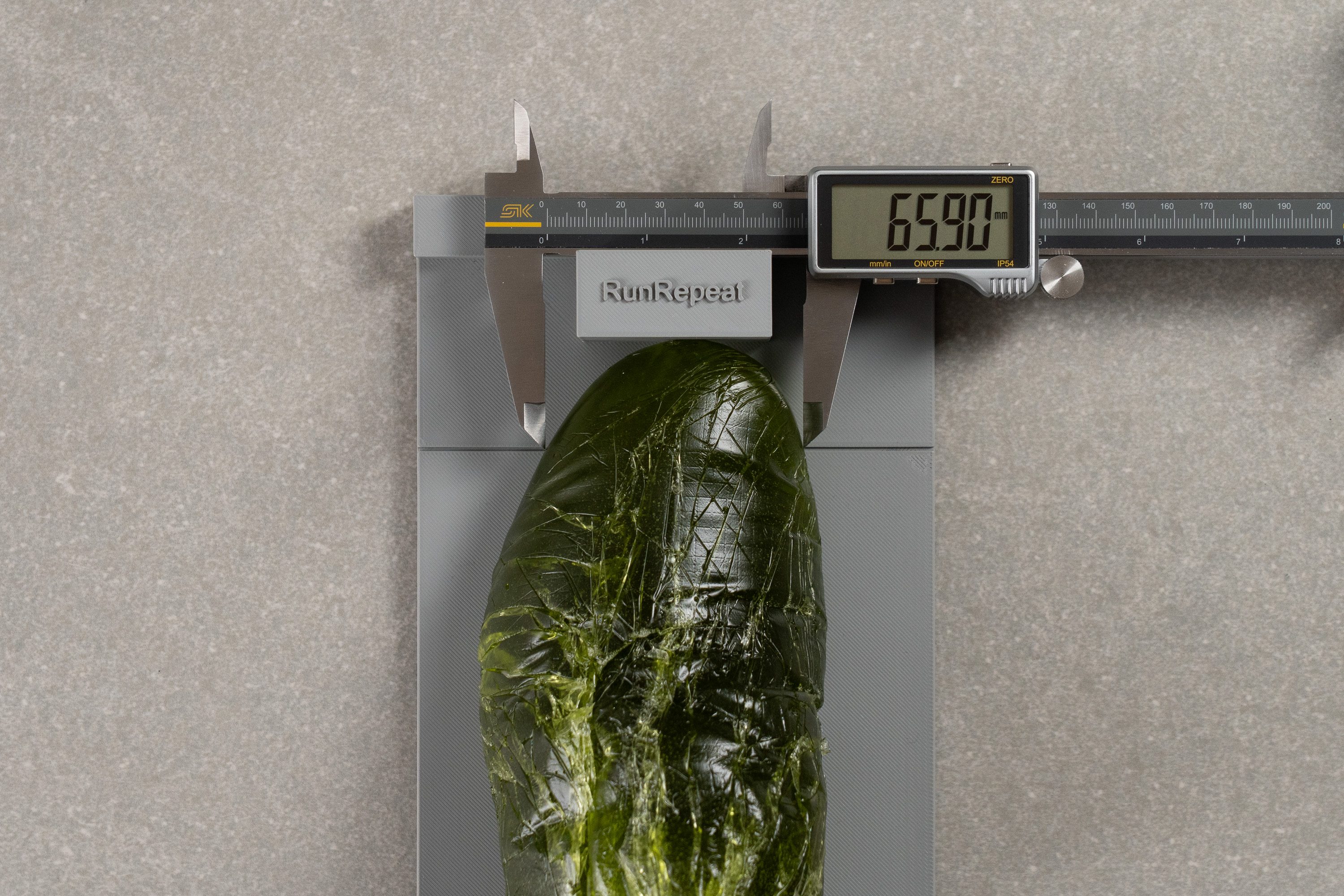
| Adizero Adios Pro Evo 3 | 65.9 mm |
| Average | 73.2 mm |
Toebox height
We also measured the height of the toebox, and it was nice to find some relief here.
With 29.9 mm of vertical clearance, if you get black toenails, it will likely be from sizing too short or from the toebox width, but not from upper pressure. And anyway, the upper is so lightweight and thin that it was unlikely to cause any discomfort.
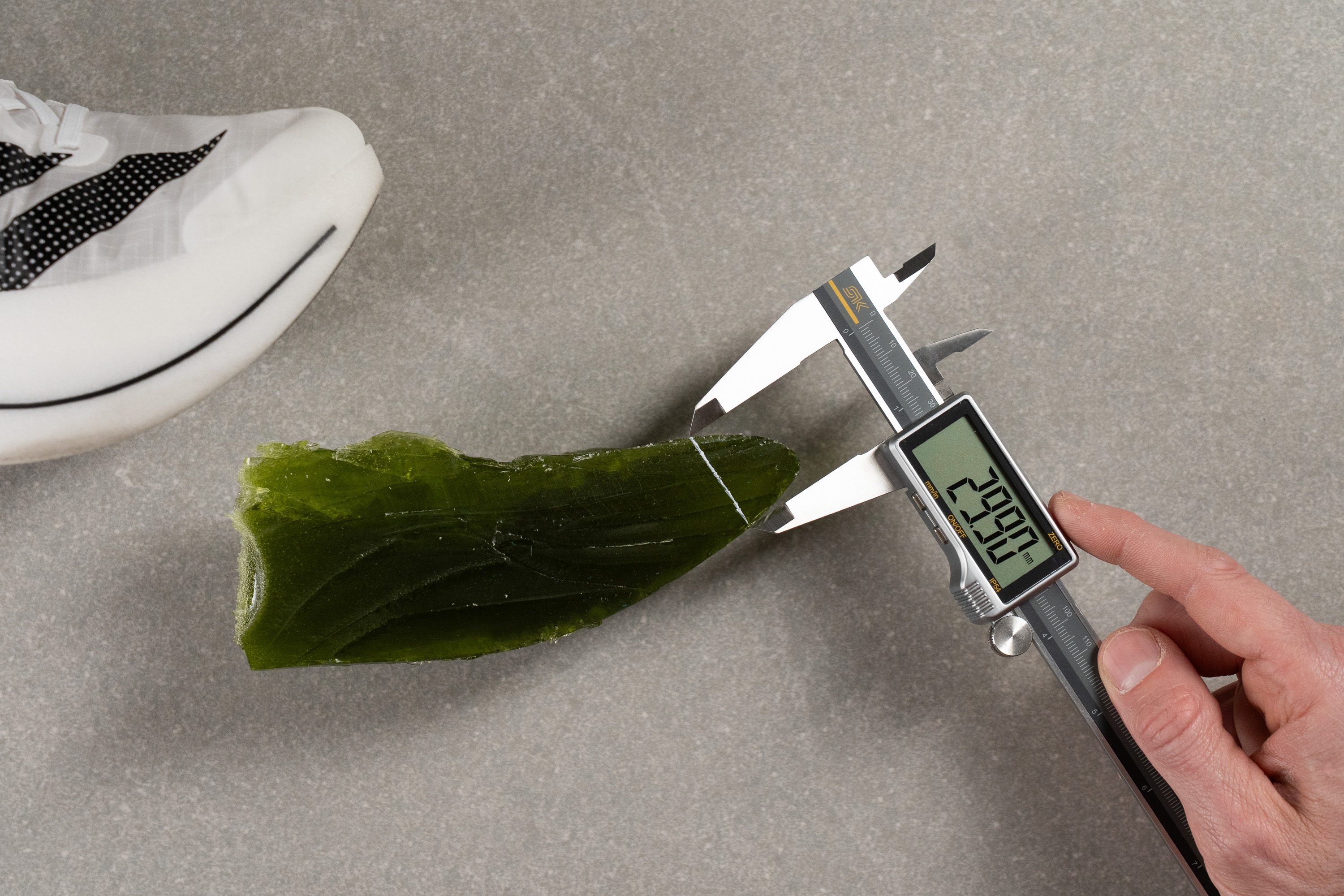
| Adizero Adios Pro Evo 3 | 29.9 mm |
| Average | 27.0 mm |
Traction / Grip
Traction test
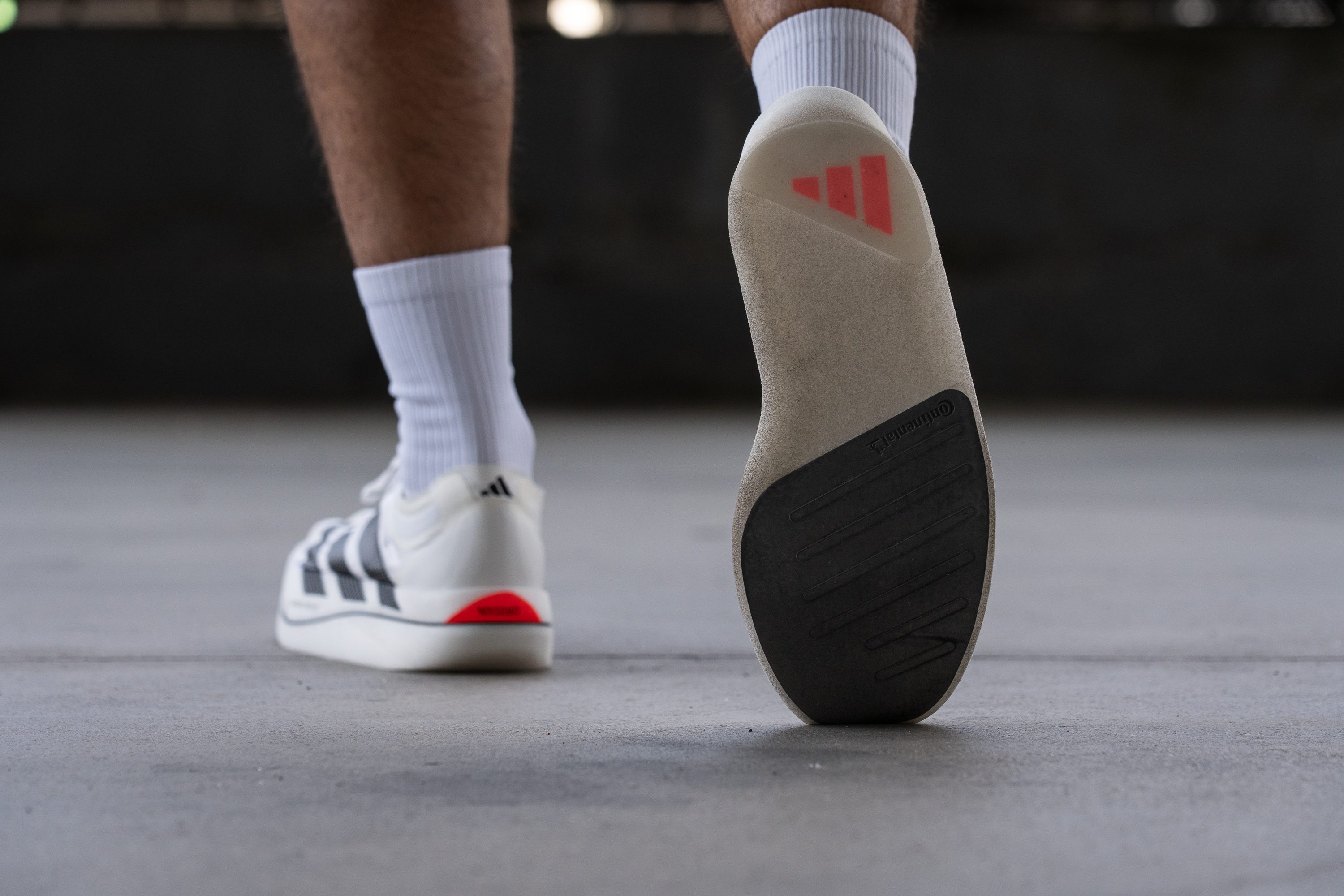
One key change in this shoe is the move from that strange liquid rubber coating to a more traditional (but of course ultra-lightweight) rubber developed specifically for this model by Continental.
It's a change we celebrate because amateurs and elites will now finally share the same outsole, as most elites previously raced in dev versions of the Evo 1 and 2 that used Continental rubber due to concerns about a slippery feel in wet conditions.
This new Continental rubber delivers solid traction over wet concrete with a 0.66 score. However, for the insane price of this shoe, some may expect excellent grip in the 0.75-0.90 range, and that's not happening here.
| Adizero Adios Pro Evo 3 | 0.66 |
| Average | 0.53 |
Outsole design
The outsole coverage is now better than before, but it's still built with performance in mind. There's a small translucent pad in the heel that contains an adidas logo, along with the already mentioned Continental rubber in the forefoot. Everything else is raw Lightstrike Pro Evo foam.
Flexibility / Stiffness
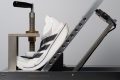
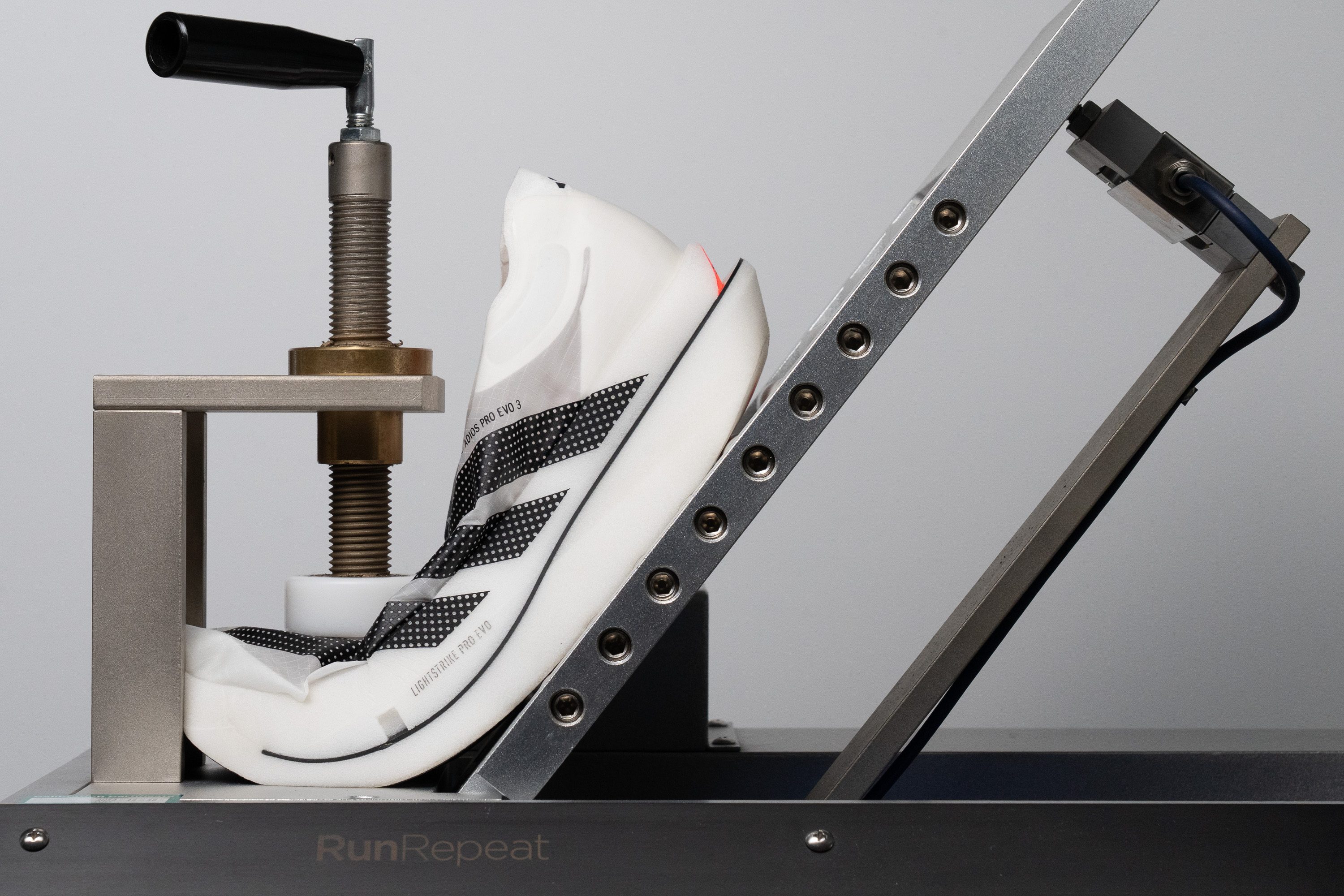
We proved with this lab test that the new ENERGYRIM offers a plate-like level of stiffness, as reaching 15.6N with such a low-density foam clearly requires a very rigid material embedded in the midsole.
And as you may already know, the magic recipe of super shoes requires a stiffening agent like this one working in combination with the foam, as the foam itself is not enough. And we got it here.
| Adizero Adios Pro Evo 3 | 15.6N |
| Average | 15.5N |
Weight
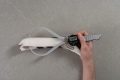
Well, here we are. The Evo 3 has already been impressive so far, but the weight is simply outrageous. We measured the shoe at only 3.5 oz or 99g, the first sub-100g shoe and first sub-4-oz shoe to make it into the lab. adidas also claims that its internal tests show a 1.6% improvement in running economy compared to the Evo 2.
For our part, we want to add some context to this weight with a simple table that compares it to some of the best super shoes available right now:
| Shoe | Weight | Difference |
| adidas Adizero Adios Pro Evo 3 | 3.5 oz (99g) | Baseline |
| adidas Adizero Adios Pro Evo 2 | 4.9 oz (139g) | -29% |
| adidas Adizero Adios Pro 4 | 7.1 oz (200g) | -51% |
| Nike Vaporfly 4 | 5.9 oz (166g) | -40% |
| PUMA Fast-R Nitro Elite 3 | 6.1 oz (173g) | -43% |
| ASICS Metaspeed Sky Tokyo | 5.7 oz (163g) | -39% |
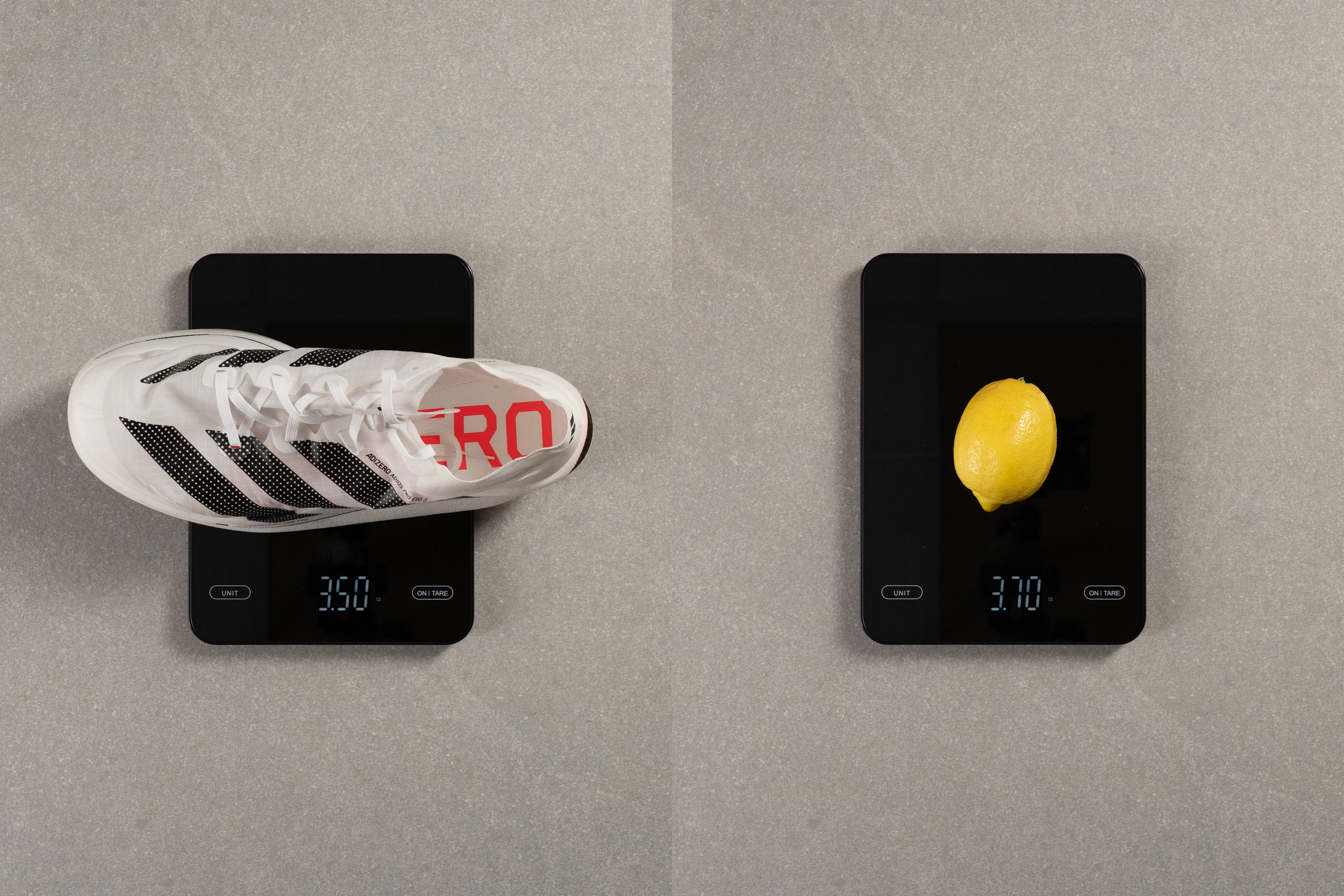
| Adizero Adios Pro Evo 3 | 3.5 oz (99g) |
| Average | 9.2 oz (261g) |
Breathability
Breathability test
One of the few weaknesses we found in the Evo 2 was its breathability, and adidas clearly addressed that in this update. With a solid result of 75 BR, the Evo 3 manages sweat much more effectively, helping keep your feet dry throughout your next race.
| Adizero Adios Pro Evo 3 | 75 BR |
| Average | 75 BR |
Drying potential
NewWe kept the Evo 3 inside our breathability machine for another 3 hours to evaluate its drying potential. This test measures how much artificial sweat evaporates from the shoe over time, and the Evo 3 released a solid 65% of the trapped moisture.
Combined with its strong breathability, we think this makes it a great choice for hot-weather marathons or races with changing conditions.
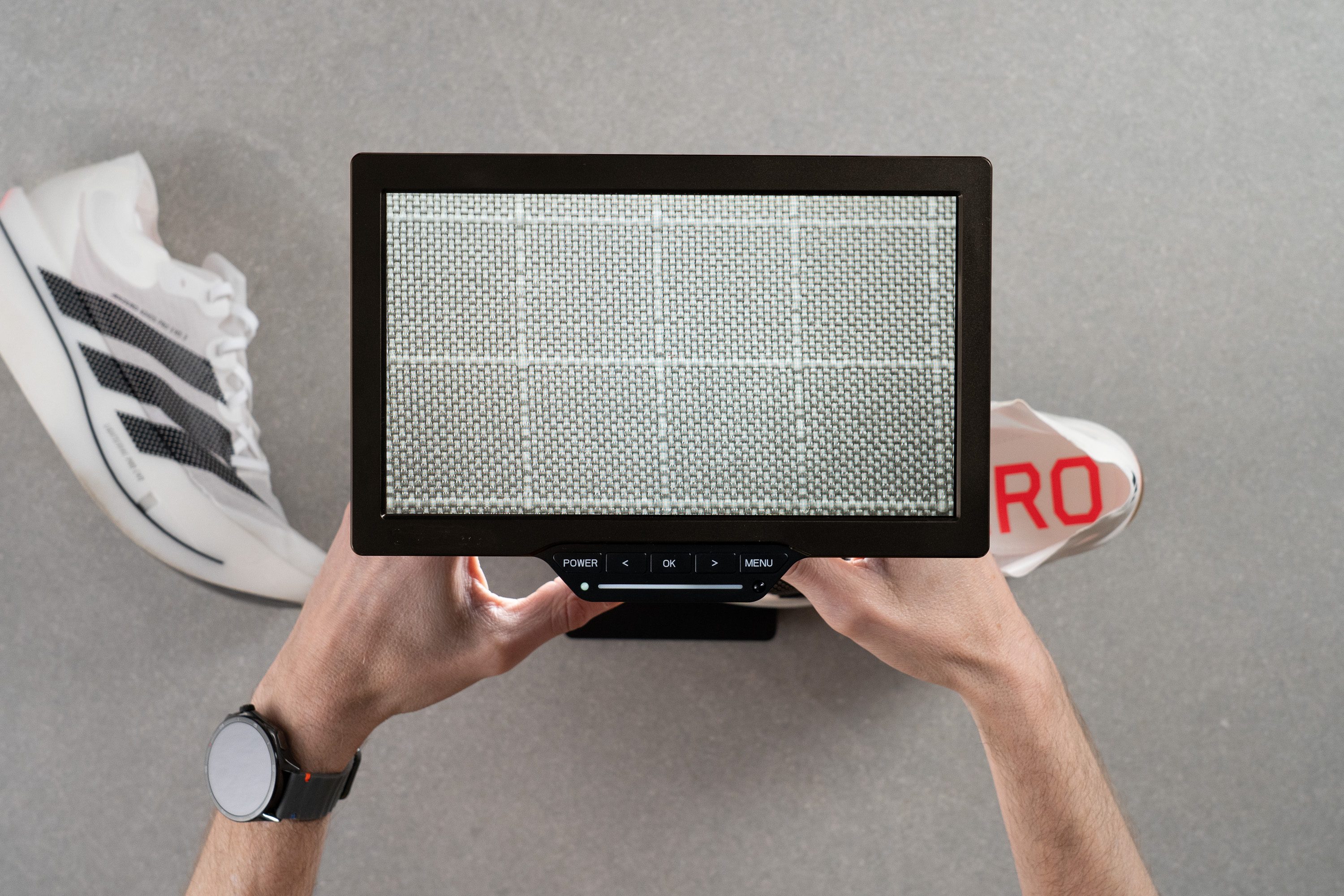
| Adizero Adios Pro Evo 3 | 65% |
| Average | 53% |
Stability
Lateral stability test
The adidas Adizero Adios Pro Evo 3 is anything but a stable running shoe. The ENERGYRIM system and the snug fit certainly help, but let's not forget that this is a max-stack, ultra-soft marathon racer with moderate platform width.
You must accept a wild ride as part of the trade-off if you choose this shoe, and we think that runners with solid neutral form and a midfoot or forefoot strike are the ones who should go for it.
Torsional rigidity
As we showed before with our lab photos, the ENERGYRIM does not run around the full perimeter of the shoe and is more of a U shape. Because of that, the lack of a full-length outsole, and the soft Lightstrike Pro Evo foam, we found some torsional flexibility, and it scored low in our test at only 8.3 Nm.
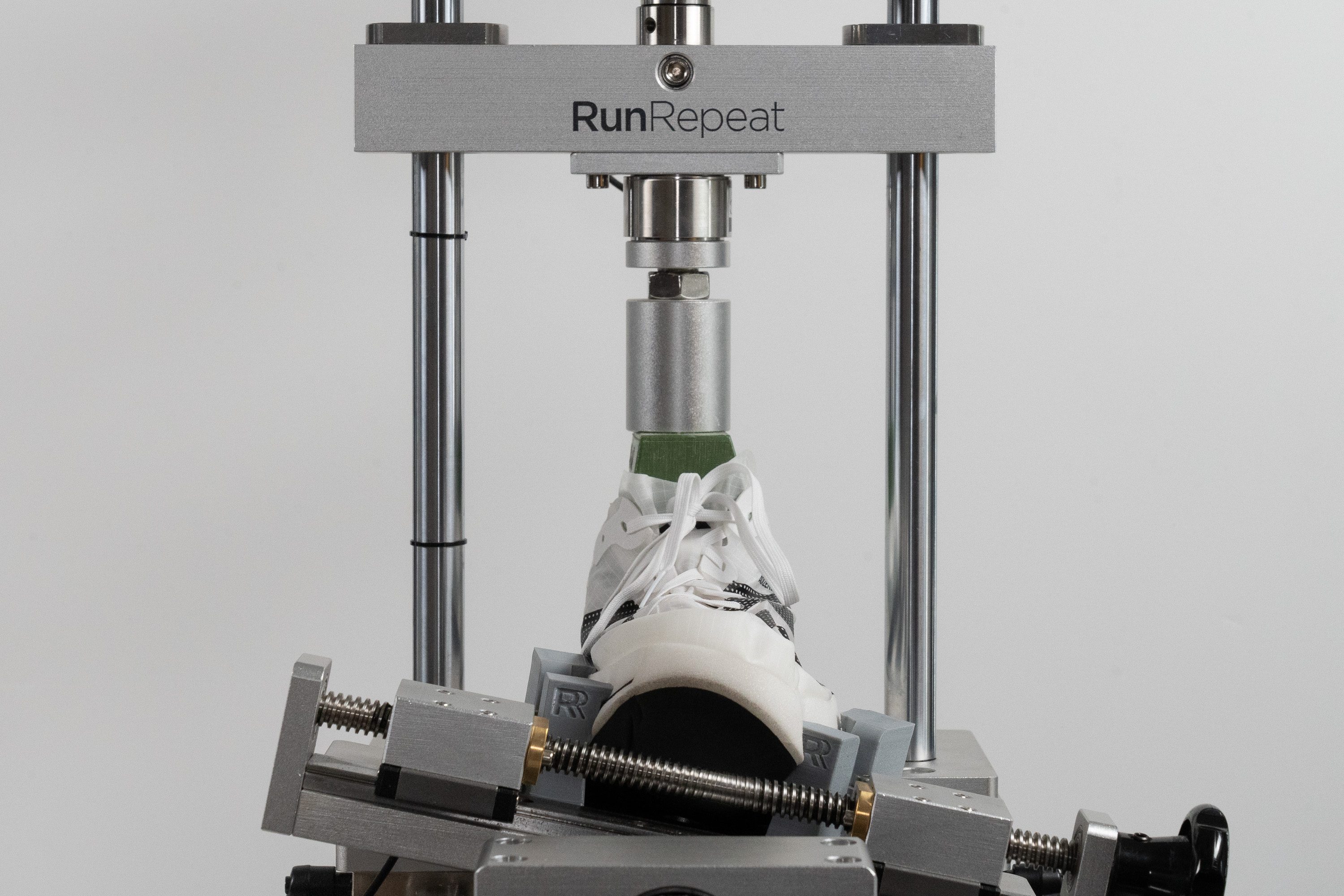
| Adizero Adios Pro Evo 3 | 8.3 Nm |
| Average | 14.3 Nm |
Heel counter stiffness
The heel counter is non-existent and adds no support. The upside is that runners who are sensitive to a stiff design here won't have that issue, but heel strikers won't find much stability either. This is absolutely an elite-first racing shoe.
| Adizero Adios Pro Evo 3 | 1 |
| Average | 2.9 |
Midsole width - forefoot
We found that the forefoot offers a solid landing platform with 114.5 mm.
In our view, it's surprisingly wide considering the weight of the shoe. Sometimes ultra-lightweight shoes use very narrow midsole dimensions to save weight, but it seems that adidas developed the technology to keep an average width here, and that's excellent news especially for the marathon distance.
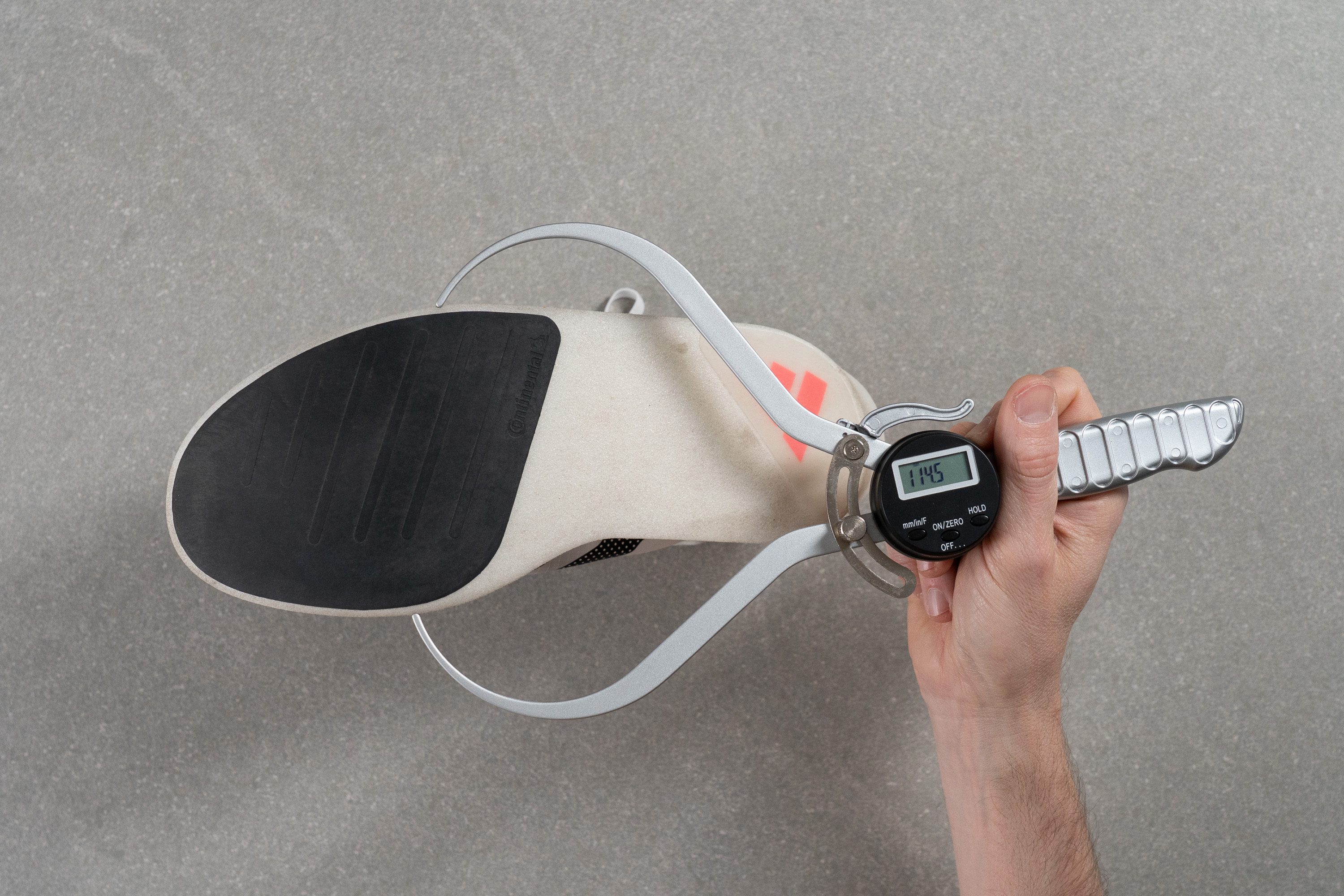
| Adizero Adios Pro Evo 3 | 114.5 mm |
| Average | 115.1 mm |
Midsole width - heel
We endorse the Adizero Adios Pro Evo 3 for midfoot and forefoot strikers because of its unique shape.
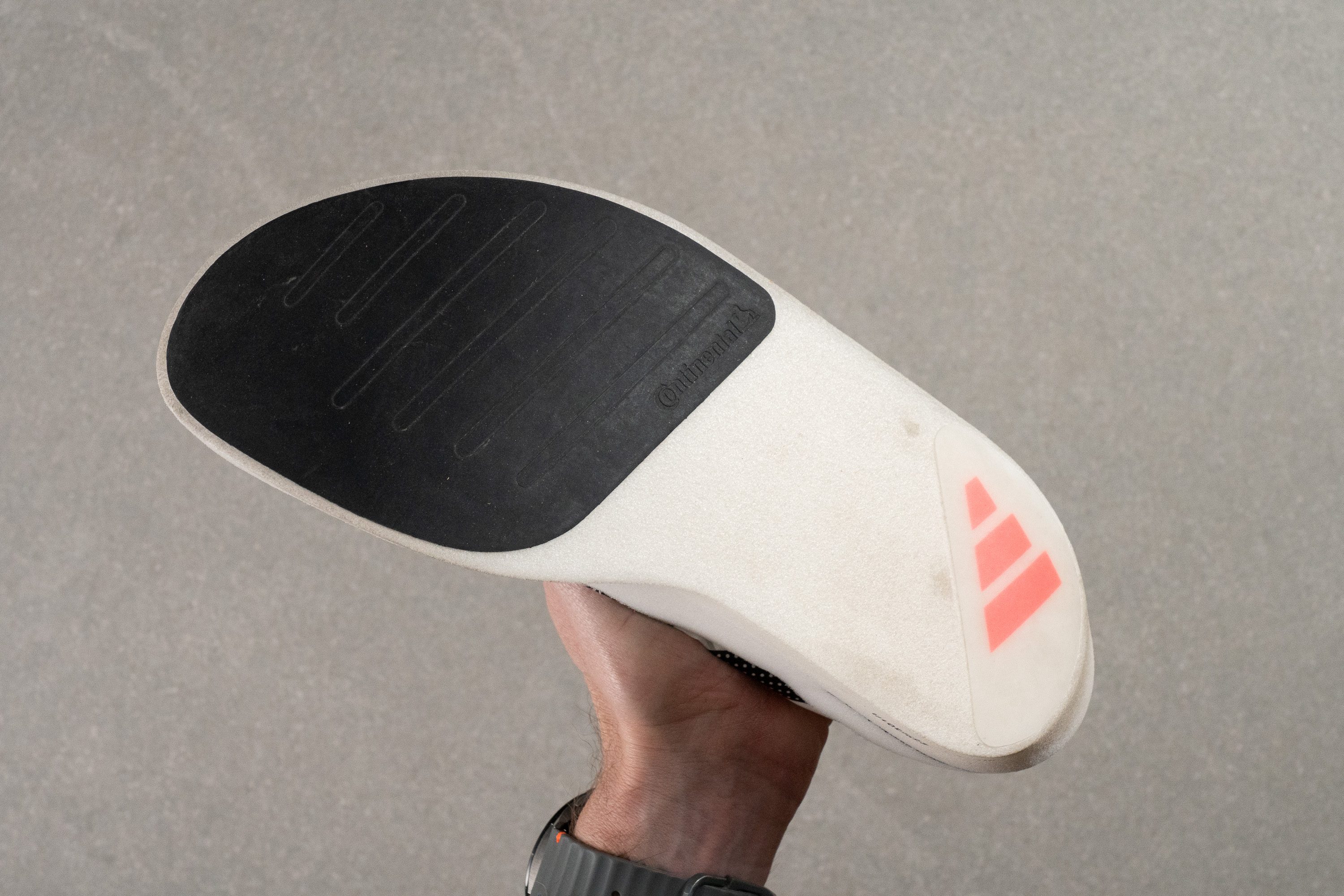
It has a wider-than-usual midfoot area that surprised us, as it's basically the opposite of the usual Adizero Adios Pro design since the first version in 2020, which has always featured a very narrow midfoot section. It's also really impressive that adidas was able to make it that wide while keeping the shoe so light.
However, the heel is definitely narrow at 83.7 mm. That doesn't pair well with a spongy foam that works against stability, but midfoot strikers will find it surprisingly good thanks to the ENERGYRIM and midsole design.
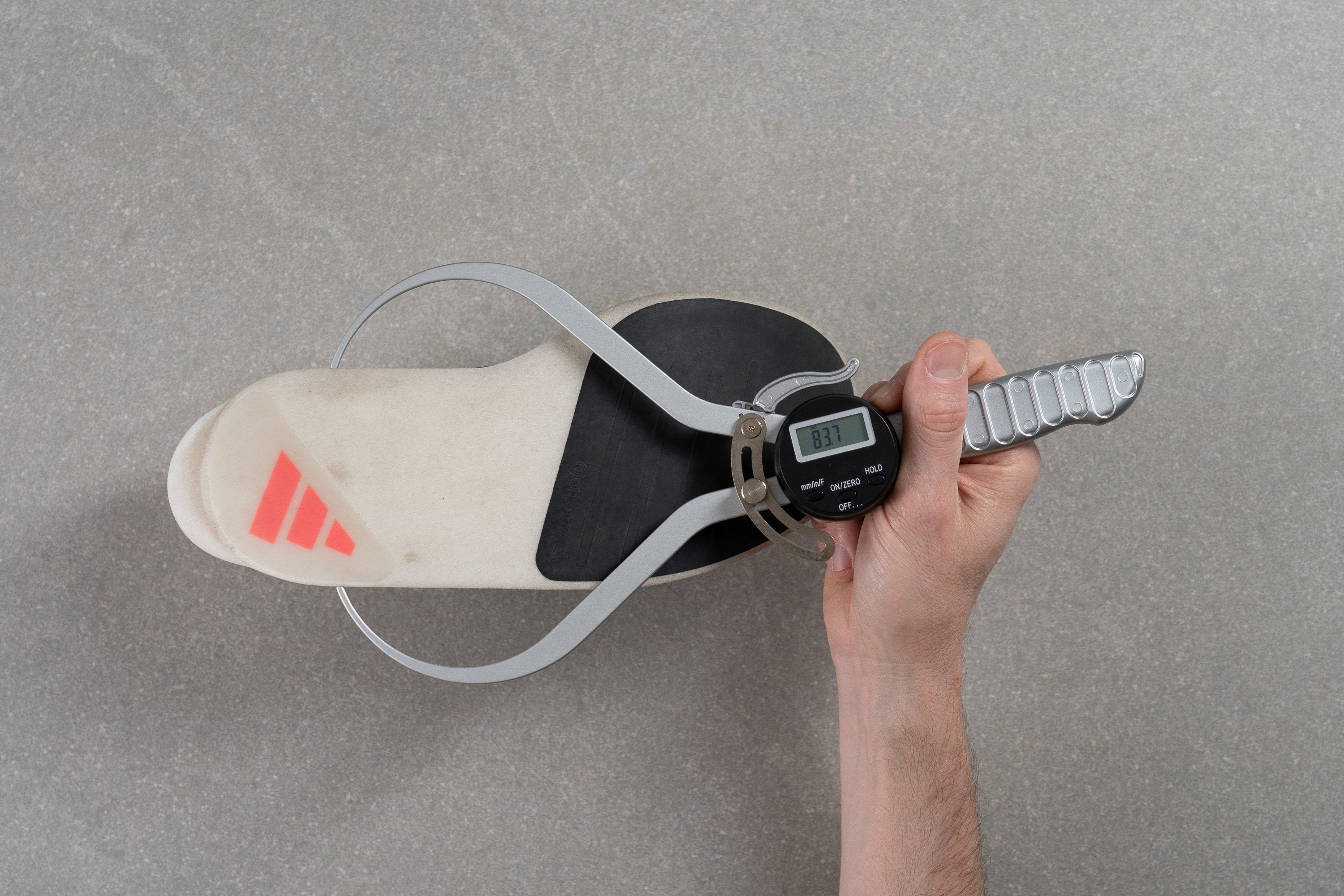
| Adizero Adios Pro Evo 3 | 83.7 mm |
| Average | 91.1 mm |
Durability
Toebox durability
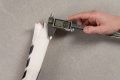
The upper is so thin and light that hoping for anything better than a 2/5 in this test was naive. And of course, we got a 1/5.
| Adizero Adios Pro Evo 3 | 1 |
| Average | 2.6 |
Heel padding durability
The heel padding did a bit better with a 3/5, which was a bit of a relief. But anyway, we don't think long-term upper durability will be a problem, as the outsole will be destroyed long before that.
| Adizero Adios Pro Evo 3 | 3 |
| Average | 3.4 |
Outsole durability
We tested the outsole durability like we do on every shoe, in the heel area. There, we found that our Dremel broke through that first barrier easily and quickly reached the foam with a result of 6.3 mm. Another reason why heel strikers should stay away.
But we also tested the Continental rubber, as we think many of you wanted to know that score. In this case, we found 1.8 mm, much better and well aligned with other competition shoes.
| Adizero Adios Pro Evo 3 | 6.3 mm |
| Average | 1.1 mm |
Outsole thickness
The heel piece has a thickness of 1.0 mm and is very soft too, which quickly explains why it gave in so fast during our durability test.
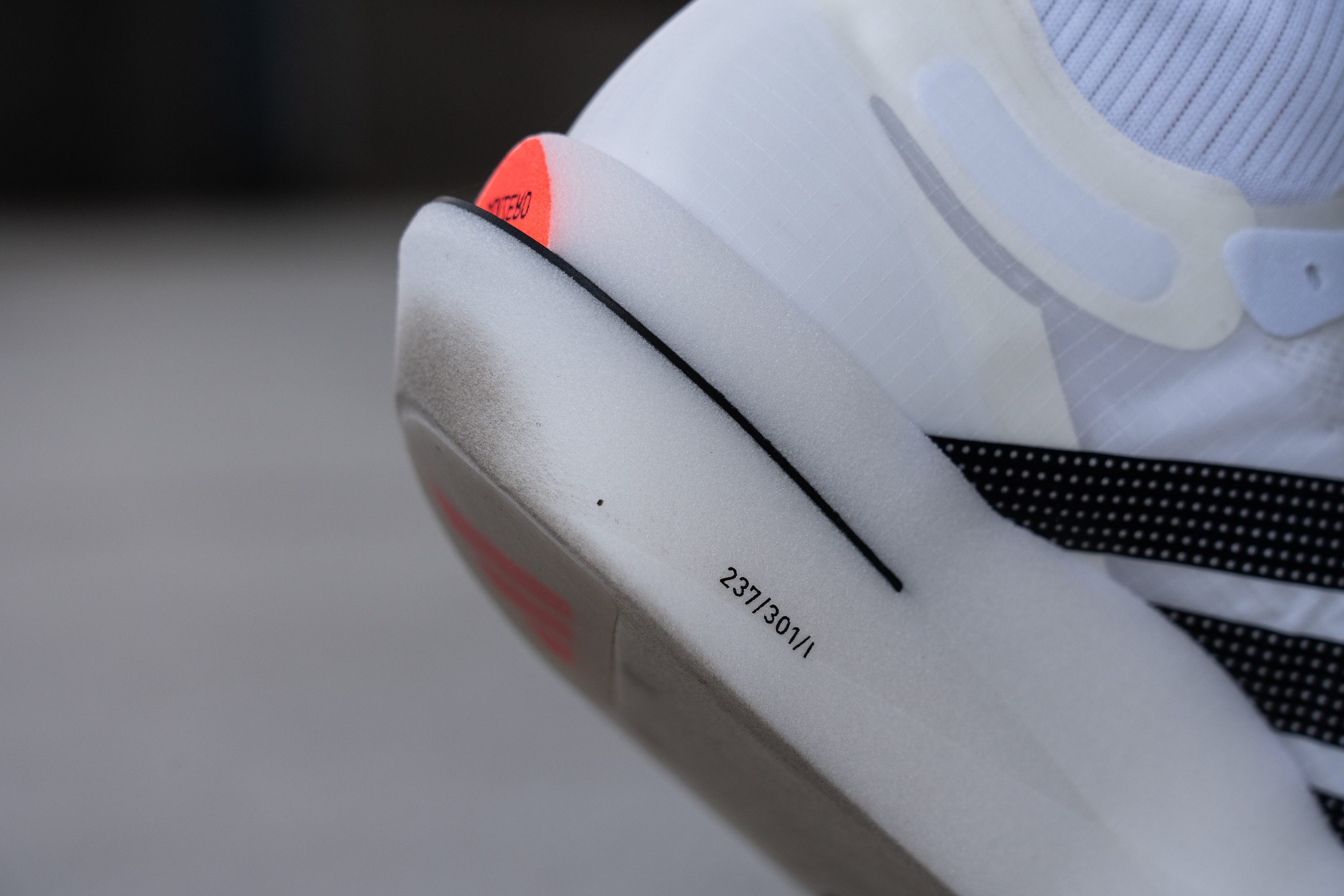
The photo above also shows the design of the midsole in the heel, with the extended lower section and the pair that we got: the 237th shoe from the first batch of 301 shoes. There will be many more batches to come, like with the Evo 2, but expect very limited production anyway.
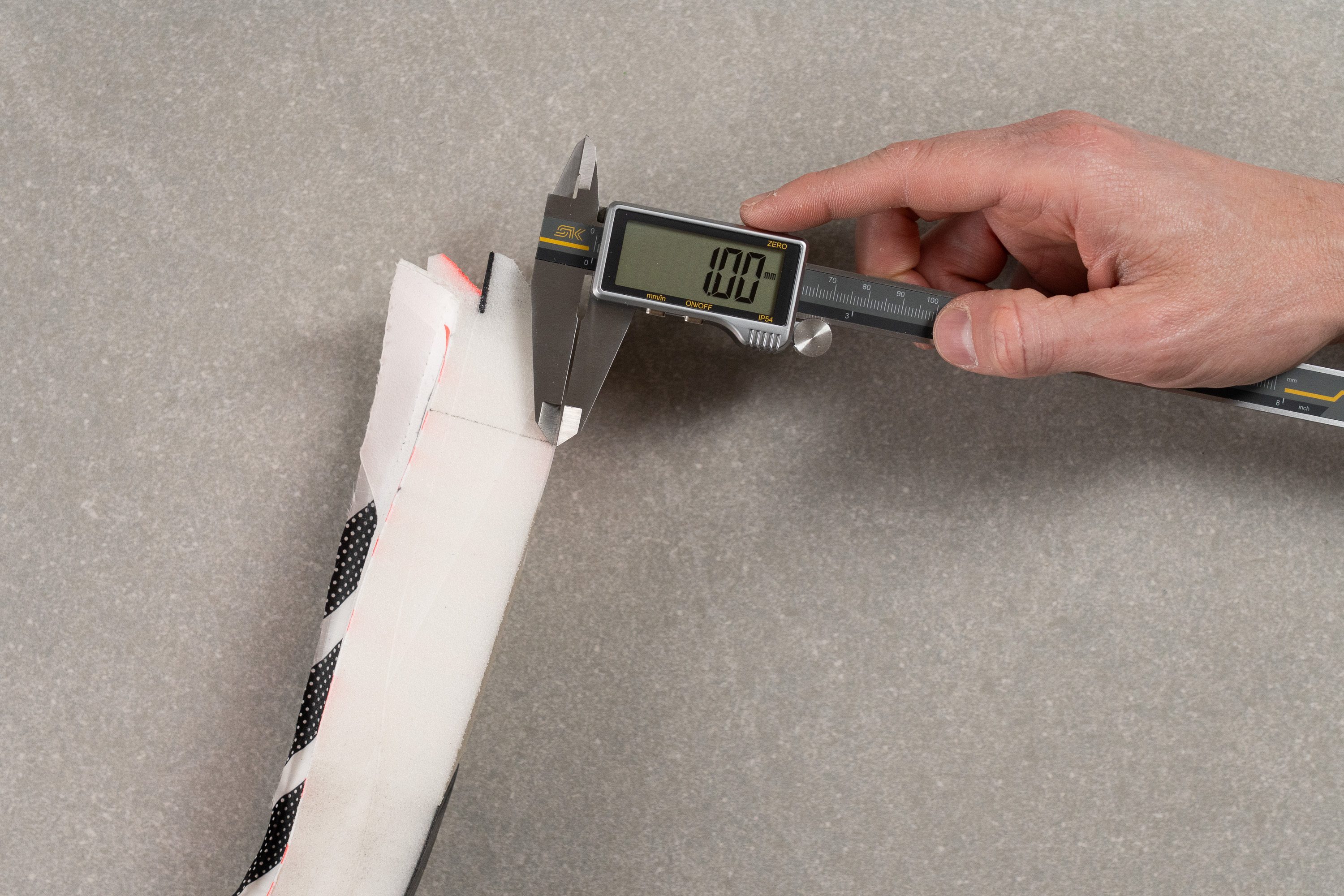
| Adizero Adios Pro Evo 3 | 1.0 mm |
| Average | 3.1 mm |
Misc
Removable insole
It's impossible to remove the insole of the adidas Adizero Adios Pro Evo 3 because... there is no insole!
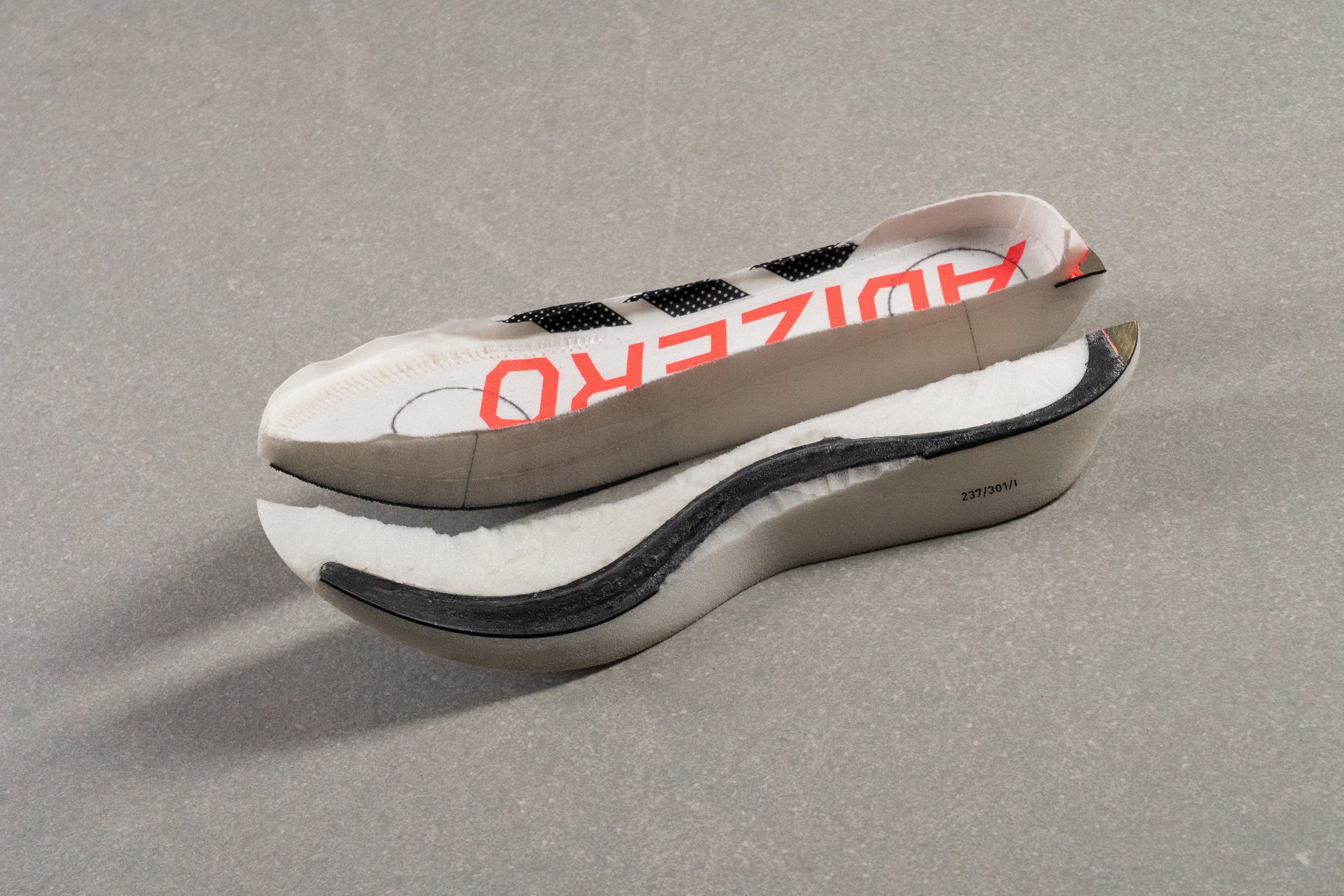
| Adizero Adios Pro Evo 3 | No |
Reflective elements
We didn't find any reflective elements in the adidas Adizero Adios Pro Evo 3, but that's also the case with most super shoes.
| Adizero Adios Pro Evo 3 | No |
Tongue padding
The lacing system of the Evo 3 follows a similar design to previous Evo models, with nothing unusual to report except for one small detail: there are two loops on the tongue, with the usual one centered on top and another on the lower right side (left in the photo) to prevent lateral shifting.
We guess that adidas got feedback during testing with elite athletes and solved it this way. The laces are flat again, likely because they are lighter, but we'd love to see something that feels more premium in such an expensive shoe.
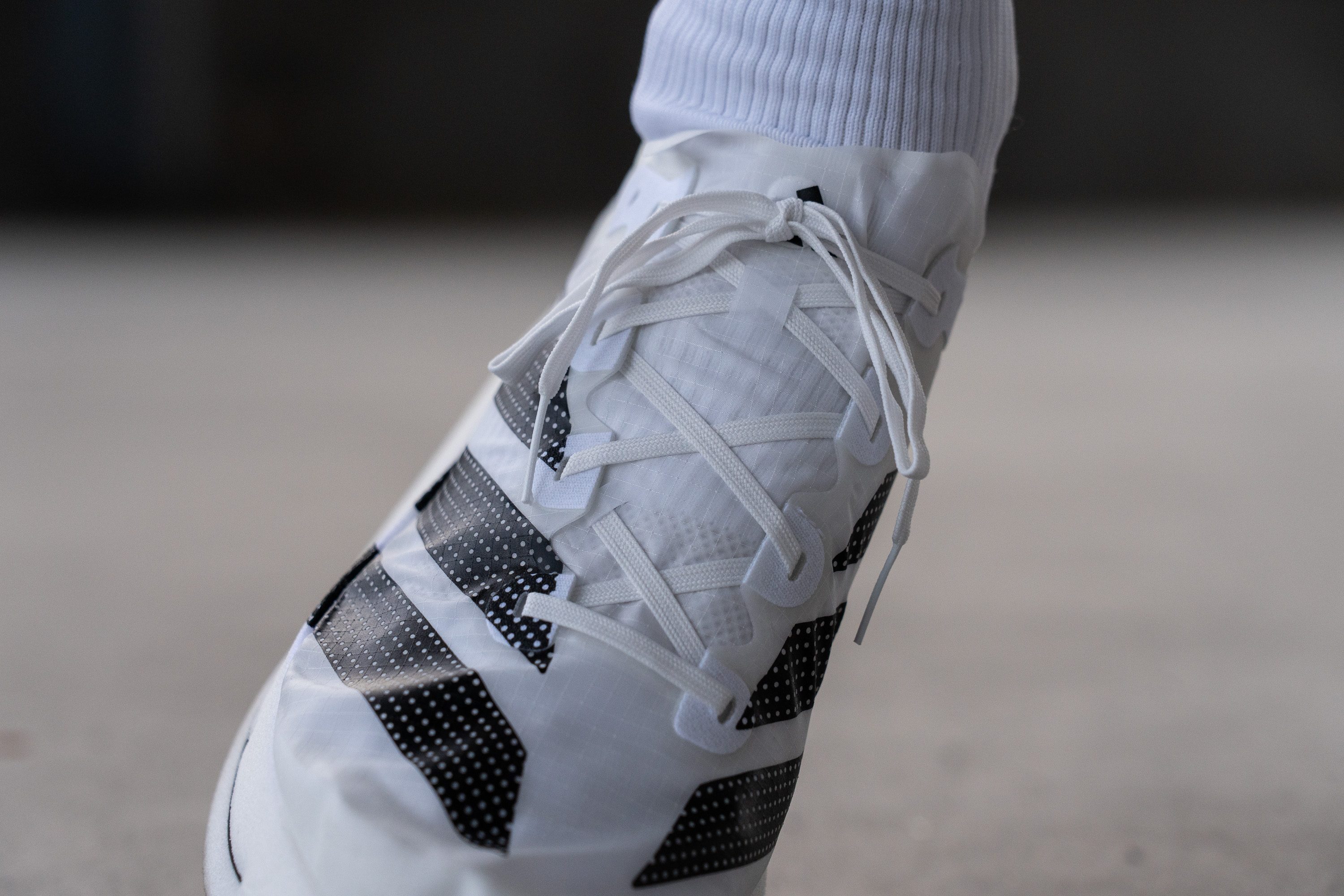
As for the tongue, it's all about marginal gains so expect little comfort. It's extremely thin at 1.8 mm, so it requires a bit of care when tightening the laces, but nothing we aren't already used to, as most super shoes offer a similar experience.
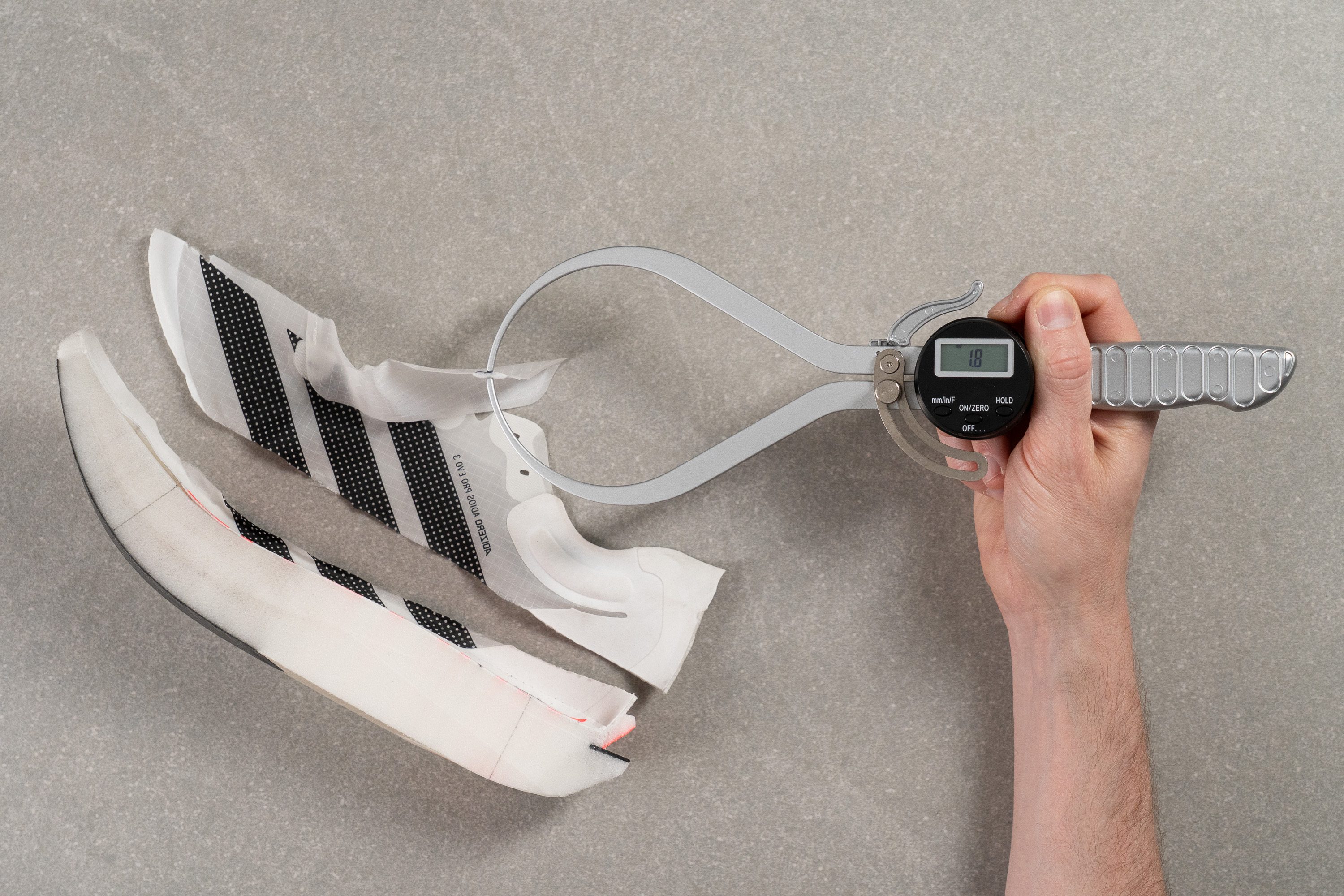
| Adizero Adios Pro Evo 3 | 1.8 mm |
| Average | 5.8 mm |
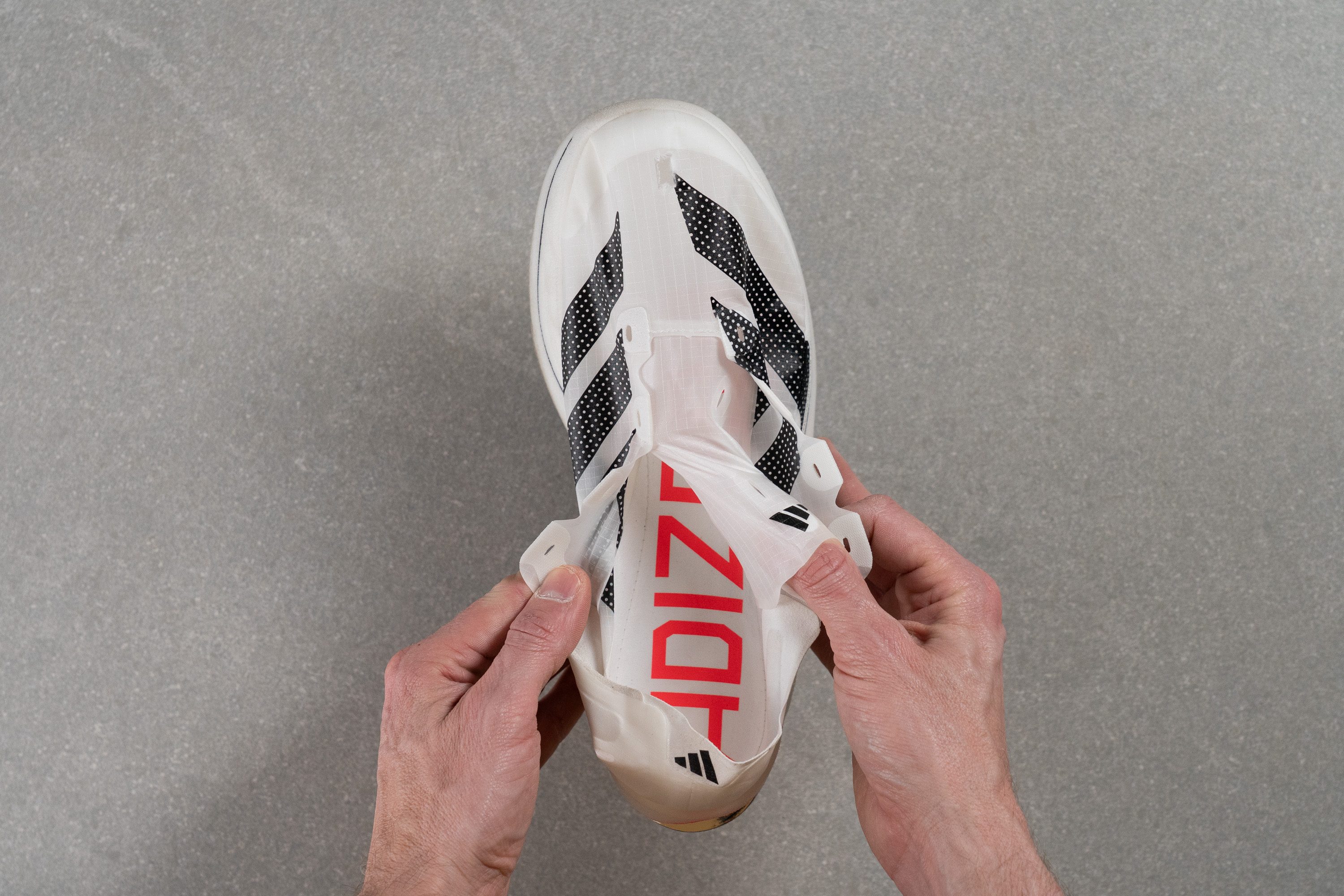
Tongue: gusset type
The tongue is not fixed to the sides in the top section, which is a change compared to the surprising Adios Pro 4 design. However, it is attached on one side lower down, which also helps explain the secondary tongue loop that we found in the other side of the tongue.
| Adizero Adios Pro Evo 3 | None |
Heel tab
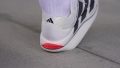
The heel design obviously skips any kind of tab because that would have added weight, and pushing the shoe to 100g would be a disaster. Of course, we couldn't resist taking another photo of the tiny mirror.
| Adizero Adios Pro Evo 3 | None |
Price
There are two ways to look at the price of the Evo 3. On the positive side, for the same MSRP as the Evo 1 and Evo 2, you get a super shoe that's 29% lighter... and clearly faster. On the other hand, it still carries an insane price tag that is hard to justify for most amateur athletes, given its low durability and unstable ride.
| Adizero Adios Pro Evo 3 | $500 |
| Average | $158 |