


Our verdict
- Urban 86
- Speed 84
- Day hiking 90
- Backpacking 70
Pros
- Abundant shock absorption
- Springy and responsive ride
- Excellent grip on wet surfaces
- Weighs much lighter than v2
- Great stability for moderate terrain
- Double-collar makes lockdown more secure
- Highly durable outsole
- True to size and medium width
Cons
- Feels disconnected form the trail
- Not for technical terrain
Awards
- Top pick in best waterproof hiking shoes
- Top pick in best lightweight waterproof hiking shoes
- Top 22% in hiking shoes
- Top 28% in waterproof hiking shoes
- Top 7% most popular hiking shoes
Comparison
The most similar hiking shoes compared
+ + Add a shoe | |||||
|---|---|---|---|---|---|
| Our score | 87 Great | 88 Superb | 84 Great | 80 Good | |
| Price | $180 | $220 | $150 | $85 | |
| Trail terrain | Light terrainVersatile / Moderate terrain | Light terrainVersatile / Moderate terrain | Light terrainVersatile / Moderate terrain | Light terrainVersatile / Moderate terrain | |
| Shock absorption | High | High | High | Low | |
| Energy return heel | Moderate | High | Moderate | Moderate | |
| Traction | High | High | Moderate | Moderate | |
| Weight lab Weight brand | 13.1 oz / 371g | 12.9 oz / 366g | 11.9 oz / 337g | 12.7 oz / 360g | |
| Lightweight | ✓ | ✓ | ✓ | ✓ | |
| Use | Day HikingSpeed HikingUrban hiking | Day HikingSpeed HikingUrban hiking | Day HikingSpeed HikingUrban hiking | Day HikingSpeed HikingUrban hikingBeginners | |
| Orthotic friendly | ✓ | ✓ | ✓ | ✓ | |
| Drop lab | 14.4 mm | 12.7 mm | 11.2 mm | 8.7 mm | |
| Size | True to size | Slightly small | True to size | True to size | |
| Midsole softness | Balanced | Balanced | Soft | Firm | |
| Difference in midsole softness in cold | Normal | Normal | Small | Small | |
| Torsional rigidity | Stiff | Stiff | Stiff | Stiff | |
| Heel counter stiffness | Stiff | Flexible | Flexible | Stiff | |
| Stiffness | Stiff | Stiff | Stiff | Stiff | |
| Waterproofing | Waterproof | Waterproof | Waterproof | Waterproof | |
| Material | Mesh | Mesh | Mesh | - | |
| Toebox durability | Decent | Decent | Decent | Good | |
| Heel padding durability | Decent | Good | Good | Decent | |
| Outsole durability | Good | Good | Good | Decent | |
| Width / fit | Medium | Medium | Medium | Wide | |
| Toebox width | Medium | Medium | Narrow | Narrow | |
| Lug depth | 3.7 mm | 3.9 mm | 3.0 mm | 3.3 mm | |
| Heel stack lab | 41.8 mm | 39.4 mm | 40.4 mm | 30.2 mm | |
| Forefoot | 27.4 mm | 26.7 mm | 29.2 mm | 21.5 mm | |
| Widths available | Normal | NormalWide | Normal | NormalWide | |
| Technology | Gore-Tex | Gore-Tex | Gore-TexOrtholite | - | |
| Heel tab | Finger loop | Finger loop | Finger loop | Finger loop | |
| Removable insole | ✓ | ✓ | ✓ | ✓ | |
| Ranking | #10 Top 22% | #6 Top 14% | #19 Top 42% | #32 Bottom 30% | |
| Popularity | #3 Top 7% | #2 Top 5% | #41 Bottom 10% | #21 Top 46% |

Who should buy
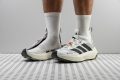
We believe that the adidas Terrex Freehiker 3 Low GTX is well worth the investment if:
- you prioritize comfort and impact protection on the trail
- you mostly hike on light-to-moderate terrain
- you don't want an overly technical hiking shoe

Who should NOT buy
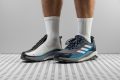
If you frequent rock-heavy trails with lots of obstacles and unpredictable areas, you may want to consider the adidas Terrex Skychaser GTX instead. It's a much more planted, robust, and aggressive option.
If you have concerns about the shoe's low-cut collar, the Freehiker 3 Ultra GTX features a raised, sock-like sleeve that serves as a gaiter, providing more coverage and protection. This version also features a more advanced Hyperboost Pro midsloe foam that makes the experrience softer and cushier.
And if you're looking for a more budget-friendly option, the Terrex Freehiker SL GTX is an excellent alternative. It lacks some of the brand's advanced materials but offers a solid overall performance.

Cushioning
Shock absorption
The Freehiker 3 Low GTX inherits its predecessor's Boost foam but blends it with a more advanced PEBA-based Dreamstrike+ foam in the rearfoot. This helps deliver the same level of impact protection in a notably lighter package.
Our shock absorption test recorded a high reading of 124 SA at the Freehiker 3's heel, confirming its status as one of the best-cushioned hiking shoes yet again!

| Terrex Freehiker 3 Low GTX | 124 SA |
| Average | 108 SA |
Energy return
Even though its updated midsole design resulted in a 12% drop in the new Freehiker's energy return, the shoe still ranks among the springiest at 53.6%!
The added responsiveness helps maintain a brisk pace and fight fatigue over long distances and thru-hikes.
| Terrex Freehiker 3 Low GTX | 53.6% |
| Average | 49.6% |
Heel stack
Our caliper showed that the Freehiker 3 Low GTX's platform grew even taller, reaching one of the highest heel stacks we've measured at 41.8 mm.
That makes it less than ideal for hikers who prefer more grounded and maneuverable profiles. Yet, it offers the benefit of almost complete isolation from the trail and abundant cushioning on predictable, hard-packed ground.

| Terrex Freehiker 3 Low GTX | 41.8 mm |
| Average | 34.0 mm |
Forefoot stack
The shoe's forefoot stack height of 27.4 mm also exceeds the average by quite a bit.
While it offers comfort and protection by devouring rocks, roots, and other obstacles, it surely feels clumsier on uneven ground and makes it harder to quickly correct a misstep on technical trails.

| Terrex Freehiker 3 Low GTX | 27.4 mm |
| Average | 22.9 mm |
Drop
The shoe's heel-to-toe drop also landed in the upper range at 14.4 mm. It is notably steeper than the traditional hiking shoe offset, but more comfort-oriented in return.
The raised heel eases the strain on the Achilles and calves, which is particularly beneficial on long-distance endeavors.

| Terrex Freehiker 3 Low GTX | 14.4 mm |
| Average | 11.2 mm |
Midsole softness
A significant portion of the Freehiker 3 Low's midsole is made of a moderately soft Dreamstrike+ foam. It serves as the shoe's carrier foam and also dominates the rearfoot section, offering comfortable heel landings.
With a durometer reading of 33.0 AC, it is much softer than the average hiking shoe foam.
However, a firm Boost foam at the heart of the midsole prevents this adidas shoe from feeling squishy or floppy. At 50.7 AC, it is actually 54% firmer than the Dreamstrike+!
The blend of these foams helps create a well-balanced, cushioned yet sufficiently steady ride.
And it stays that way even in cold weather. After keeping the shoe in the freezer for 20 minutes, we recorded a modest 16% change in the Dreamstrike's softness. This compound showed a rather good resistance to low temperatures.

| Terrex Freehiker 3 Low GTX | 33.0 AC |
| Average | 43.9 AC |
Size and fit
Size
adidas Terrex Freehiker 3 Low GTX fits true to size (10 votes).
Internal length

| Terrex Freehiker 3 Low GTX | 269.5 mm |
| Average | 268.9 mm |
Width / Fit
The Terrex Freehiker 3 Low GTX treated us to a predictable, perfectly medium fit in a men's US size 9. And the gel cast of its interior confirmed it!
Measuring the replica in the widest part (ball-of-the-foot area), our caliper recorded a solid 94.9 mm. It falls squarely into the hiking shoe average, true to a medium width.

| Terrex Freehiker 3 Low GTX | 94.9 mm |
| Average | 94.0 mm |
Toebox width
Upfront, our toes never felt squeezed or crowded thanks to the shoe's non-tapered toebox shape. It also showed a perfectly medium width of 71.2 mm in the big toe area.

| Terrex Freehiker 3 Low GTX | 71.2 mm |
| Average | 71.9 mm |
Toebox height
A sufficient amount of vertical space complements the Freehiker 3's comfortable in-shoe feel.
Our caliper measured its toebox height at a standard 28.2 mm.

| Terrex Freehiker 3 Low GTX | 28.2 mm |
| Average | 27.5 mm |
Traction / Grip
Traction test
Adidas' Continental rubber is one of the most reliable blends we've encountered in the lab! And it boasts excellent grip on the Freehiker 3 Low GTX as well.
With the shoe's friction coefficient at an above-average 0.83, we are confident in its bite on wet and smooth surfaces such as roots, rocks, and stones.
| Terrex Freehiker 3 Low GTX | 0.83 |
| Average | 0.68 |
Lug depth
A moderate lug depth of 3.7 mm helps this adidas shoe transition seamlessly from concrete streets to gravel and mixed terrain. There is enough depth to dig into light dirt and grass, but not enough for any serious mud and boggy areas.

| Terrex Freehiker 3 Low GTX | 3.7 mm |
| Average | 3.9 mm |
Outsole design
Examining the new Freehiker 3's lug shape and placement, we found that it is more adaptable than aggressive. The large triangular chevron treads have been replaced with asymmetrical ones to help the foot land safely at different angles on uneven terrain.

Flexibility / Stiffness
Inheriting its predecessor's chunky platform, the Freehiker 3 Low GTX got neither stiffer nor bendier in the forefoot.

It still requires 17.1N to bend by 30 degrees, which is on par with most hiking shoes we've tested. This moderate rigidity makes the ride feel sufficiently stable and doesn't overwork the foot on long adventures.

| Terrex Freehiker 3 Low GTX | 17.1N |
| Average | 18.8N |
Weight
Its lighter weight is one of the Freehiker 3 Low GTX's most notable and immediately noticeable updates. The new materials helped shave as much as 2.6 oz (74g) off the new version, putting it in the lightweight category of hiking shoes.
Not to mention the impressive cushioning-to-weight ratio that makes the new Freehiker even easier on the legs and body.

| Terrex Freehiker 3 Low GTX | 13.1 oz (371g) |
| Average | 13.2 oz (375g) |
Stability
Lateral stability test
Its tall, rather soft platform can raise concerns about the Freehiker 3 Low GTX's stability, especially on technical terrain.
And it is for a good reason.

Although the shoe's raised midsole topline and firm foam make it structured enough to keep the foot steady on uneven ground, the lack of plantedness or additional stabilizing components, such as shanks, makes it less ideal for demanding trails.
Torsional rigidity
But if you set out on an all-day adventure over moderate, fairly predictable terrain, the adidas Terrex Freehiker 3 Low GTX will deliver a highly supportive experience.
With an above-average torsional rigidity of 20.6 Nm, it is highly resistant to twisting and helps prevent the foot from spilling over, even if you overpronate.

| Terrex Freehiker 3 Low GTX | 20.6 Nm |
| Average | 19.1 Nm |
Heel counter stiffness
The shoe's exceptionally sturdy heel counter further reinforces that lockdown. It proved so unforgiving during our manual test that we immediately gave it the highest stiffness score of 5 out of 5.
One feature that deserves special mention is, of course, the shoe's double-collar design. A stiffer external piece is complemented by a softer, padded layer to create an exceptionally adaptable fit around the heel and ankle.
We are happy to confirm that it's far from gimmicky, as it offers a truly foot-hugging experience.
| Terrex Freehiker 3 Low GTX | 5 |
| Average | 3.7 |
Midsole width - forefoot
As the Freehiker 3 Low GTX grew taller vertically, its platform also expanded horizontally to ensure stability.
Our caliper measured the widest part of its forefoot at an above-average reading of 119.1 mm. That's notably wider than the average hiking shoe platform.

| Terrex Freehiker 3 Low GTX | 119.1 mm |
| Average | 112.6 mm |
Midsole width - heel
The shoe's heel also proved rather broad at 91.2 mm, providing a solid surface area for stable footing without being overly chunky.

| Terrex Freehiker 3 Low GTX | 91.2 mm |
| Average | 88.6 mm |
Durability
Toebox durability
As delicate as its semi-transparent mesh appears, it proved to be sufficiently wear-resistant for moderate hiking conditions. Its perimeter is also reinforced with a synthetic rand, which helped keep the shoe's toebox durability score at a solid 3 out of 5.
| Terrex Freehiker 3 Low GTX | 3 |
| Average | 3.6 |
Heel padding durability
The shoe's interior is lined with a fine-ribbed textile that showed decent durability in our Dremel test, earning a middle-range score of 3 out of 5.
| Terrex Freehiker 3 Low GTX | 3 |
| Average | 3 |
Outsole durability
In addition to fantastic grip, the shoe's Continental rubber also showed its strength in our durability test. With a dent depth of merely 0.7 mm, it performed better than many other hiking shoe outsoles.
| Terrex Freehiker 3 Low GTX | 0.7 mm |
| Average | 0.9 mm |
Outsole thickness
The hard-wearing nature of this blend allowed adidas to use a thinner outsole layer, reducing the Freehiker 3's overall weight. So even though our caliper showed a below-average thickness of 1.4 mm (excluding the lug depth), we have no concerns about this outsole's long-term service.

| Terrex Freehiker 3 Low GTX | 1.4 mm |
| Average | 2.3 mm |
Misc
Insole thickness
We measured the shoe's insole thickness at a standard 5.0 mm. It's a good amount of underfoot padding that complements the already abundant midsole cushioning.

| Terrex Freehiker 3 Low GTX | 5.0 mm |
| Average | 5.3 mm |
Removable insole
The insole can also be removed in favor of an alternative insert or a custom orthotic, if needed. Gladly, the shoe's true-to-size fit allows sufficient room for it.

| Terrex Freehiker 3 Low GTX | Yes |
Reflective elements
None of the shoe's elements reflected light in our test. But if that's an important feature for you, you might as well consider the Freehiker 3 Ultra GTX.

| Terrex Freehiker 3 Low GTX | No |
Tongue padding
Adidas hardly reduced the amount of tongue padding on the Freehiker 3 Low GTX. At 11.2 mm, it remains on the plush side, enhancing in-shoe comfort but detracting from breathability.

| Terrex Freehiker 3 Low GTX | 11.2 mm |
| Average | 9.8 mm |
Tongue: gusset type
A waterproof shoe wouldn't be complete without a gusseted tongue, and luckily, the Freehiker 3 features one to prevent water and splashes from seeping inside.

| Terrex Freehiker 3 Low GTX | Both sides (full) |
Heel tab
Because its fully gusseted tongue makes the shoe opening narrower, a large finger loop at the back makes it easier to slide the Freehiker 3 on.

| Terrex Freehiker 3 Low GTX | Finger loop |
Price
We appreciate the fact that the new Freehiker stayed at the same price point as its predecessor. It is slightly higher than the average retail price for hiking shoes, but reasonably so given the more advanced components it features (i.e., PEBA-based foam and Continental rubber).
The Terrex Freehiker 3 Low GTX is also priced on par with another generously cushioned hiker, the HOKA Anacapa 2 Low GTX.

| Terrex Freehiker 3 Low GTX | $180 |
| Average | $157 |