








Our verdict
- Daily running 82
- Tempo 87
- Race 78
- Stability 75
Pros
- Bouncy Hyperboost Pro foam
- Massive shock absorption
- A real state-of-the-art super trainer
- Superior traction + full-length coverage
- Excellent durability overall
- Comfortable Primeweave upper
- Feels agile compared to most competitors
- Lightweight for its size
- Ideal for long runs and even marathons!
Cons
- Limited breathability
- Aesthetics may not appeal to everyone
- Late forefoot rocker may feel awkward for some
- Potential ankle rubbing from stiff upper
Awards
- Top pick in best long distance running shoes
- Top pick in best running shoes for men
- Top 11% most popular running shoes
Comparison
The most similar running shoes compared
+ + Add a shoe | |||||
|---|---|---|---|---|---|
| Our score | 83 Great | 91 Superb | 79 Good | 86 Great | |
| Price | £170 | £155 | £130 | £180 | |
| Pace | Daily runningTempo | Daily running | Daily running | Daily running | |
| Shock absorption | High | High | High | High | |
| Energy return | High | High | Low | Low | |
| Traction | High | High | High | High | |
| Arch support | Neutral | Neutral | Neutral | Neutral | |
| Weight lab Weight brand | 8.7 oz / 247g | 10.2 oz / 289g 10.1 oz / 285g | 8.4 oz / 237g 8.5 oz / 241g | 9.8 oz / 278g 10 oz / 283g | |
| Lightweight | ✓ | ✗ | ✓ | ✗ | |
| Drop lab Drop brand | 6.5 mm 6.0 mm | 9.6 mm 10.0 mm | 5.0 mm 6.0 mm | 5.2 mm 8.0 mm | |
| Strike pattern | Mid/forefoot | HeelMid/forefoot | Mid/forefoot | Mid/forefoot | |
| Size | True to size | True to size | True to size | True to size | |
| Midsole softness | Soft | Soft | Soft | Balanced | |
| Difference in midsole softness in cold | Small | Small | Small | Small | |
| Toebox durability | Decent | Decent | Bad | Decent | |
| Heel padding durability | Good | Good | Bad | Decent | |
| Outsole durability | Good | Good | Good | Good | |
| Breathability | Warm | Moderate | Moderate | Moderate | |
| Width / fit | Medium | Medium | Narrow | Medium | |
| Toebox width | Medium | Medium | Narrow | Medium | |
| Stiffness | Stiff | Stiff | Moderate | Stiff | |
| Torsional rigidity | Moderate | Moderate | Flexible | Stiff | |
| Heel counter stiffness | Flexible | Moderate | Moderate | Stiff | |
| Rocker | ✓ | ✗ | ✓ | ✓ | |
| Heel lab Heel brand | 44.6 mm 45.0 mm | 42.3 mm 45.0 mm | 39.9 mm 40.0 mm | 39.5 mm 43.5 mm | |
| Forefoot lab Forefoot brand | 38.1 mm 39.0 mm | 32.7 mm 35.0 mm | 34.9 mm 34.0 mm | 34.3 mm 35.5 mm | |
| Widths available | NormalWide | NarrowNormalWideX-Wide | NormalWide | NormalWideX-Wide | |
| Orthotic friendly | ✓ | ✓ | ✓ | ✓ | |
| Season | All seasons | All seasons | All seasons | All seasons | |
| Removable insole | ✓ | ✓ | ✓ | ✓ | |
| Ranking | #152 Top 38% | #18 Top 5% | #240 Bottom 40% | #82 Top 21% | |
| Popularity | #43 Top 11% | #2 Top 1% | #154 Top 39% | #28 Top 8% |


Who should buy
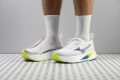
Based on our lab tests and runs, we can recommend the adidas Hyperboost Edge to runners that:
- Want massive cushioning with strong energy return for long runs.
- Worry about outsole durability in super trainers and prefer full-length rubber coverage.
- Love the Ultraboost line and are ready for the next step.
- Prefer one versatile shoe for everything: short runs, long efforts, and even race day.

Who should NOT buy
The price of the Hyperboost Edge may feel high for many runners, and we think it’s not the best choice if you’re looking for strong value for the money. In our lab tests, we found that the adidas Adizero EVO SL offers a similar energetic ride (with some obvious compromises) at a lower MSRP, while the Under Armour Infinite Elite 2 is an interesting off-the-radar alternative.
We also do not recommend this shoe for runners who need extra toe space. We found in the lab that its tapered toebox creates a race-snug fit that won’t suit wider feet. Staying a step below in the Boost line with the Ultraboost 5X probably makes more sense for a more comfortable fit.

Cushioning
Shock absorption
At RunRepeat, we like to keep things honest and focus on real results rather than marketing buzz. So when adidas made big claims about this shoe, we were eager to test it in the lab and see how it truly performs.
The good news is that the first claim checks out. Adidas presents the Hyperboost Edge as a max-cushioned shoe, and our lab data supports that. It scored 154 SA in the heel and a very impressive 145 SA in the forefoot.

| Hyperboost Edge | 154 SA |
| Average | 131 SA |
Energy return
The second claim from adidas is that they created a breakthrough training foam with outstanding energy return. It’s a PEBA-based foam called Hyperboost Pro, and we were ready to put that promise to the test too.
After completing the ASTM F1976 procedure, we were genuinely impressed. A result of 73.6% means the Hyperboost Edge outperforms nearly every other super trainer, and even surpasses the model many of us see as the benchmark in this category: the ASICS Megablast.
| Hyperboost Edge | 72.8% |
| Average | 61.4% |
Heel stack
If there’s one thing you won’t miss with the Hyperboost Edge, it’s foam. There’s a massive amount underfoot, reaching 44.6 mm in the heel.
And that translates into a ride that’s predictably ultra-cushioned and almost completely lacking ground feel. The Hyperboost Pro foam keeps you protected and makes this shoe ideal for those who, for whatever reason, need as much protection as possible.

| Hyperboost Edge | 44.6 mm |
| Average | 35.6 mm |
Forefoot stack
If the heel measurement impressed you, the forefoot figure is even more striking when compared to the average running shoe.

Not long ago, it was rare for a training shoe to reach 38.1 mm in the heel. This one delivers that kind of stack height in the forefoot.

| Hyperboost Edge | 38.1 mm |
| Average | 27.1 mm |
Drop
Adidas states a 6 mm drop for the Hyperboost Edge, and we measured 6.5 mm. That’s practically identical and doesn’t change the overall feel: it will suit midfoot strikers best, while still accommodating all footstrike patterns, including heel strikers, thanks to its geometry.

| Hyperboost Edge | 6.5 mm |
| Average | 8.4 mm |
Midsole softness
The Hyperboost Pro foam that adidas introduces with this shoe has a clearly soft feel. It may not reach the ultra-plush territory of foams like Saucony’s IncrediRUN, but it still delivers a noticeably cushioned sensation underfoot.
We confirmed that softness with our Asker C durometer, which measured 32.5 AC. That’s well below average, and considering the thick slab of foam and the thin outsole material, it feels slightly softer than the number alone would suggest.

| Hyperboost Edge | 32.5 AC |
| Average | 35.5 AC |
Rocker
The adidas Hyperboost Edge features a late-stage forefoot rocker that feels different from most other adidas models. It engages very late and promotes a more aggressive toe-off phase.
We also appreciated that adidas kept the heel relatively balanced, adding a noticeable flare to support the high stack while avoiding excessive curvature. That’s a familiar design approach from adidas, even though the brand occasionally goes wild, like in the Terrex Agravic Speed Ultra.

Size and fit
Size
adidas Hyperboost Edge fits true to size (56 votes).
Internal length

| Hyperboost Edge | 271.1 mm |
| Average | 269.3 mm |
Width / Fit
One trend we’ve noticed from adidas over the past two years is a wider-than-average result in this test, and the Hyperboost Edge continues that pattern.
After letting the gel mould set in the fridge, we measured 97.4 mm.

| Hyperboost Edge | 97.4 mm |
| Average | 95.2 mm |
Toebox width
However, it’s important to point out that the Hyperboost Edge features a classic tapered toebox design.

For that reason, we don’t consider it ideal for wide feet despite the earlier width measurement, as the 71.4 mm reading leans more toward a performance-oriented fit that won’t suit runners who need generous room for toe splay.

| Hyperboost Edge | 71.4 mm |
| Average | 73.2 mm |
Toebox height
Our third and final measurement related to fit focused on the toebox height.
At 24.8 mm, there isn’t much vertical space for the toes. Still, the Primeweave upper feels comfortable, and for faster efforts, this snug design likely makes sense.

| Hyperboost Edge | 24.8 mm |
| Average | 27.0 mm |
Traction / Grip
Traction test
Adidas is gradually moving away from Continental, and this shoe proves that. Although they will likely keep it in certain models (like the small rubber pod in the Adios Pro 4) the shift toward their new GCPU-based LIGHTTRAXION compound is evident, as we’ve also seen in the Supernova Rise 3.
In our wet concrete lab test, it delivered an outstanding 0.79. We’ve tested hundreds of shoes under the same conditions, and reaching such a strong result is truly rare. So while moving away from Continental in top-tier shoes may have seemed questionable at first, we have to admit that LIGHTTRAXION has proven to be truly impressive.
| Hyperboost Edge | 0.79 |
| Average | 0.53 |
Outsole design
One of the key advantages of polyurethane-based outsoles like LIGHTTRAXION is their lower weight compared to the traditional rubber used for decades in running shoes. That brings a major benefit: adidas can provide full-length outsole coverage without adding extra weight.
This can be a deciding factor for runners who are hard on outsoles, since many super trainers expose large areas of foam to save a few grammes.

Flexibility / Stiffness
Even without a carbon or plastic plate in the midsole, the Hyperboost Edge delivers noticeable stiffness thanks to its large slab of Hyperboost Pro foam. To be precise, we measured 19.8N in our 30-degree bend test.

| Hyperboost Edge | 19.8N |
| Average | 15.5N |
Weight
At the start of this lab review, we mentioned that adidas announced real breakthroughs with this shoe. There were three: energy return, cushioning, and weight.
And yes, 8.7 oz or 247g is seriously impressive for a shoe of this size. However, the ASICS Megablast, arguably its closest rival, comes in at 7.7 oz or 218g. Even so, it's absolutely true that the Hyperboost Edge remains remarkably a lightweight super trainer and, for context, it’s 32% lighter than the Nike Vomero Premium.

| Hyperboost Edge | 8.7 oz (247g) |
| Average | 9.2 oz (261g) |
Breathability
Breathability test
UpdatedThe Hyperboost Edge has an unconventional look that may even remind some of you of the iconic T-Mac basketball shoes launched more than 20 years ago, partly due to the lack of visible ventilation holes in most of the Primeweave mesh. Because of that, we weren't particularly optimistic before testing it for breathability.
Our machine confirmed those concerns. With a score of 62 BR, the Hyperboost Edge falls below the current running shoe average, showing that the upper struggles to pull sweat away from the foot efficiently. As a result, moisture builds up more quickly than desired inside the shoe, making it a less suitable option for summer runs.
| Hyperboost Edge | 62 BR |
| Average | 75 BR |
Drying potential
NewFollowing the breathability test, we kept the Hyperboost Edge inside the same machine for another 3 hours to evaluate its drying potential. By the end of the test, just 47% of the artificial sweat had evaporated from the upper, another below-average result.
We think the Hyperboost Edge would benefit from a more running-focused upper with improved moisture management, making it a more versatile choice for hot-weather training or even rainy days.

| Hyperboost Edge | 47% |
| Average | 53% |
Stability
Lateral stability test
The lateral stability of the Hyperboost Edge aligns with other shoes that share a similar stack height and foam softness. It’s clearly a neutral model, so it’s not ideal for runners who need added support, but it doesn’t feel unstable either.
The upper plays a key role here, offering more structure than many competitors, though that added support comes at the expense of breathability, as we observed earlier.
Torsional rigidity
Without any type of plate, the Hyperboost Edge delivered a moderate torsional rigidity result of 14.5 Nm. This outcome further reinforces its versatile nature for all kinds of training runs.
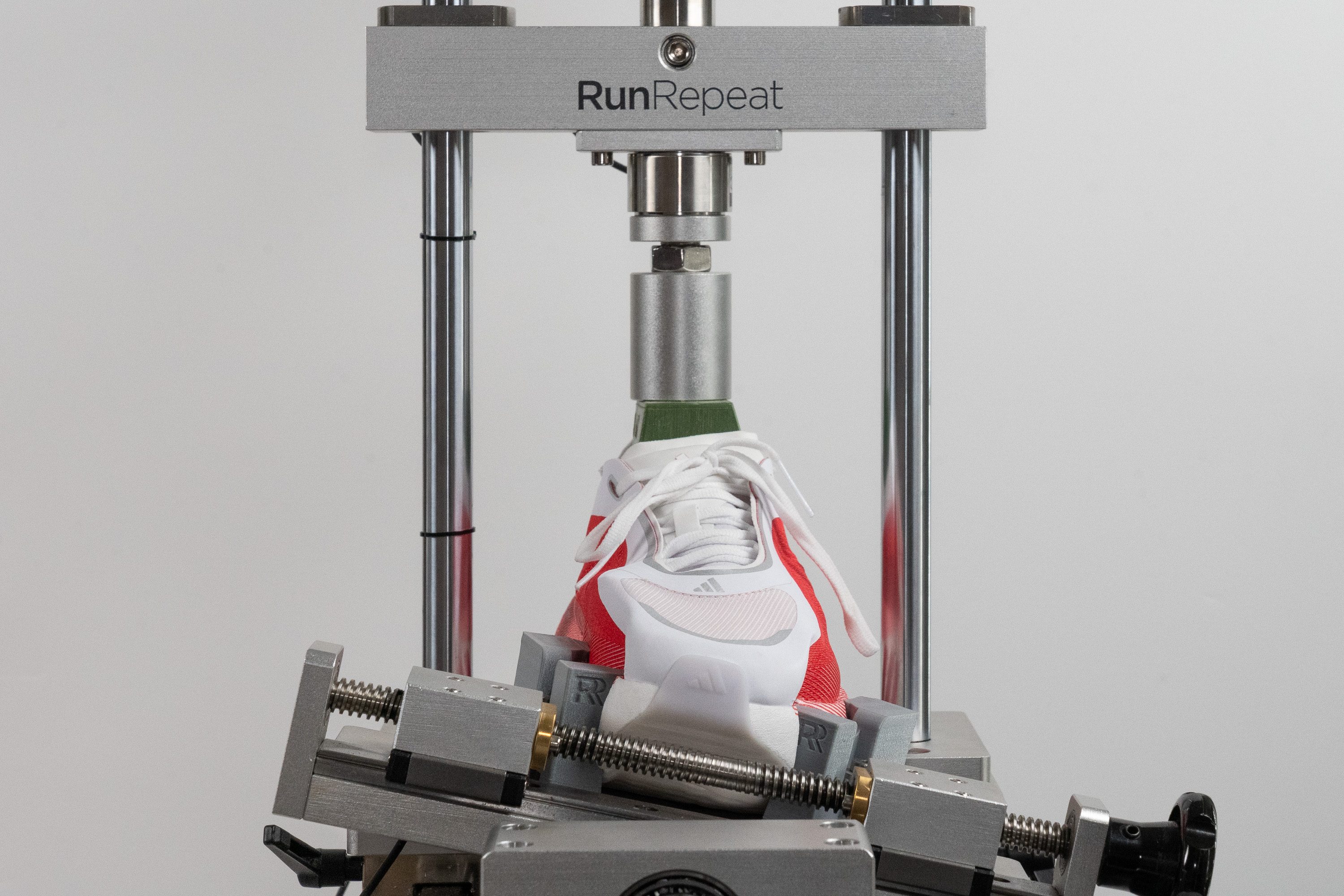
| Hyperboost Edge | 14.5 Nm |
| Average | 14.3 Nm |
Heel counter stiffness
On the other hand, the heel counter lacks structure and collapsed easily, partly due to its super shoe-style design with two foam pads on the sides. We rated it 2/5 in this test.
However, the heel collar itself feels slightly stiff, and we believe it is best to pair this shoe with socks that have extra padding in the heel area to help avoid potential rubbing.
| Hyperboost Edge | 2 |
| Average | 3 |
Midsole width - forefoot
One area where the Hyperboost Edge stands apart from many competitors is its midsole width. While most super trainers now feature very wide platforms, this shoe feels more contained underfoot.
In the forefoot, we measured 117.7 mm, which sits just a few millimetres below our current lab average.

| Hyperboost Edge | 117.7 mm |
| Average | 115.1 mm |
Midsole width - heel
The heel measures 91.6 mm, which sits very close to our lab average. So if you’re looking for a super-cushioned super trainer that doesn’t feel overly wide, this could be a solid choice. On the other hand, runners who typically rely on extra heel support may find this setup a bit limiting.

| Hyperboost Edge | 91.6 mm |
| Average | 91.1 mm |
Durability
Toebox durability
The upper of the Hyperboost Edge combines several materials. We targeted the weaker area in the toebox, it still achieved a solid 3 out of 5 for durability.
We’re definitely satisfied with that result, so let's move on into the heel area.
| Hyperboost Edge | 3 |
| Average | 2.6 |
Heel padding durability
We really liked how adidas stepped away from the usual design to deliver heel padding with targeted cushioning and strong durability. We rated it 5/5.
| Hyperboost Edge | 5 |
| Average | 3.4 |
Outsole durability
The LIGHTTRAXION compound checks every box: excellent grip, low weight, and impressive durability. After completing the Dremel test, we measured the wear with our tyre tread gauge and recorded only 0.6 mm of material loss.
| Hyperboost Edge | 0.6 mm |
| Average | 1.1 mm |
Outsole thickness
Given our lab results, it was no surprise to measure just 2.0 mm of outsole thickness. This thin layer helps keep weight down while delivering a more direct and less filtered ride.

| Hyperboost Edge | 2.0 mm |
| Average | 3.1 mm |
Misc
Insole thickness
At 2.7 mm thick, the insole makes it clear that adidas prioritised maximising the amount of Hyperboost Pro foam underfoot.

| Hyperboost Edge | 2.7 mm |
| Average | 4.4 mm |
Removable insole
The insole of the Hyperboost Edge is removable, although finding a third-party replacement that fits properly may be challenging. There is limited vertical space in the toebox, and the stock insole itself is very thin.

| Hyperboost Edge | Yes |
Reflective elements
With such a bold design, the absence of strong reflective elements feels like a missed opportunity. Especially when adding a few reflective details would likely cost... only a few cents per pair?

| Hyperboost Edge | No |
Tongue padding
One of the standout details of this shoe is its lacing system. Adidas cleverly hides it inside the upper, where the lace loops sit internally. This gives the shoe a love-or-hate look, but it works very well in practice, as the upper wraps the foot securely and creates a snug, dialled-in fit.

As for the tongue, adidas placed a focused 6.5 mm foam pad right where they think lace pressure is highest. The rest of the tongue stays thin to reduce weight and try to improve breathability.

| Hyperboost Edge | 6.5 mm |
| Average | 5.8 mm |
Tongue: gusset type
The tongue is partially gusseted to the sides, just as we would expect from a shoe at this premium price point.

| Hyperboost Edge | Both sides (semi) |
Heel tab
The heel design of the Hyperboost Edge is simple and clean, yet refined. It includes a padded panel that conceals the stitching and enhances the overall premium feel.

| Hyperboost Edge | None |
Price
The adidas Hyperboost Edge sits at the higher end of the price range for a training shoe, but after seeing its lab performance, we believe the cost makes sense for a true super trainer.
Given its strong cushioning and energy return numbers, we think the pricing is justified—especially since it's slightly more affordable than some of its direct competitors like the Vomero Premium or the Megablast.
| Hyperboost Edge | $200 |