


Our verdict
- Urban 70
- Speed 76
- Day hiking 85
- Backpacking 65
Pros
- Excellet stability for uneven terrain
- Solid grip on hard and rocky terrain
- Lighter than average
- Good impact protection
- Responsive dynamic ride
- Comfortably padded inside
- Clean visually appealing silhouette
Cons
- Muted ground feel
- Tapered toebox
- Upper could be more durable
- Pricey for day hiking
Awards
- Top 1% in On hiking boots
Comparison
The most similar hiking boots compared
+ + Add a shoe | |||||
|---|---|---|---|---|---|
| Our score | 85 Great | 87 Great | 89 Great | 88 Great | |
| Price | $240 | $185 | $235 | $249 | |
| Trail terrain | Rocky / Technical terrainVersatile / Moderate terrain | Rocky / Technical terrainVersatile / Moderate terrain | Snow / Icy terrainRocky / Technical terrainVersatile / Moderate terrain | Snow / Icy terrainRocky / Technical terrainVersatile / Moderate terrain | |
| Shock absorption | High | Moderate | Low | - | |
| Energy return | High | Moderate | High | - | |
| Traction | Moderate | Low | - | - | |
| Weight lab Weight brand | 15.6 oz / 442g | 15.4 oz / 437g 15.5 oz / 440g | 21.2 oz / 601g 19.4 oz / 550g | 20.3 oz / 575g 19 oz / 539g | |
| Lightweight | ✓ | ✓ | ✗ | ✗ | |
| Breathability | - | Warm | Warm | Warm | |
| Use | Day Hiking | BackpackingDay Hiking | BackpackingDay Hiking | Day Hiking | |
| Orthotic friendly | ✓ | ✓ | ✓ | ✓ | |
| Drop lab | 11.0 mm | 12.7 mm | 12.6 mm | 15.1 mm | |
| Size | - | True to size | Slightly small | True to size | |
| Midsole softness | Firm | Firm | Firm | Firm | |
| Difference in midsole softness in cold | Small | Small | Normal | Small | |
| Heel counter stiffness | Stiff | Flexible | Moderate | Moderate | |
| Stiffness | Stiff | Stiff | Stiff | - | |
| Outsole hardness | - | - | Very soft | Hard | |
| Waterproofing | Waterproof | Waterproof | Waterproof | Waterproof | |
| Material | Textile | Textile | Leather | Leather | |
| Season | - | Winter | Winter | Winter | |
| Toebox durability | Bad | Decent | Good | Good | |
| Heel padding durability | Decent | Decent | Decent | Good | |
| Outsole durability | Decent | Bad | Decent | Decent | |
| Width / fit | Medium | Medium | Medium | Medium | |
| Toebox width | Narrow | Medium | Medium | Narrow | |
| Lug depth | 2.7 mm | 3.5 mm | 4.7 mm | 4.0 mm | |
| Heel stack lab | 39.3 mm | 32.5 mm | 36.3 mm | 32.1 mm | |
| Forefoot | 28.3 mm | 19.8 mm | 23.7 mm | 17.0 mm | |
| Widths available | Normal | NormalWide | NarrowNormal | NormalWide | |
| Technology | - | Gore-Tex | Gore-Tex | Gore-TexVibram | |
| Cut | Mid cut | Mid cut | Mid cut | High cut | |
| Removable insole | ✓ | ✓ | ✓ | ✓ | |
| Ranking | #22 Top 50% | #14 Top 32% | #10 Top 23% | #12 Top 28% | |
| Popularity | #23 Bottom 47% | #1 Top 3% | #28 Bottom 36% | #26 Bottom 40% |


Who should buy
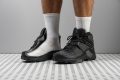
In our opinion, the Cloudrock Mid Waterproof can be a nice match for people who:
- need a sturdy but not overbuilt boot for shorter day hikes on mixed and rocky terrain
- have medium-to-narrow fet and prefer a snugger fit in their boots
- are willing to pay a premium for the signature clean silhouette of On footwear

Who should NOT buy
You don't have to pay $240 to get a fully functional boot for one-day hikes and weekend escapades. We've tested a wide array of boots that showed equally strong, if not better, results as the Cloudrock Mid Waterproof for the same hiking purpose.
Here are the alternative options we could highly recommend:
- Salomon X Ultra 5 Mid GTX: one of the top performers on technical terrain
- Merrell Moab 3 Mid GTX: a long-standing classic catering to most hikers
- Merrell Moab Speed 2 Mid GTX: a lighter boot for brisk paces

Cushioning
Shock absorption
With a shock absorption of 107 SA, the Cloudrock Mid Waterproof hits a sweet spot between ruggedness and comfort. It softens the blow on rocks, boulders, and hard-packed terrain without feeling too cushy to compromise stability.
Falling slightly above the category average, it is comparable to the impact protection offered by the Merrell Moab Speed 2 Mid GTX (108.5 SA).

| Cloudrock Mid Waterproof | 107 SA |
| Average | 94 SA |
Energy return
We also recorded an above-average energy return of 55.2% in this On boot, revealing its more responsive nature. It's not a springy experience, but it feels less static than a traditional hiking boot.
| Cloudrock Mid Waterproof | 55.2% |
| Average | 50.4% |
Heel stack
The Cloudrock Mid Waterproof features a rather substantial platform with a 39.3 mm heel stack, placing it on the taller side of the category, close to backpacking boots.

| Cloudrock Mid Waterproof | 39.3 mm |
| Average | 36.0 mm |
Forefoot stack
Its forefoot stack also exceeds the average by quite a margin, at 28.3 mm.
That's a benefit for hikers who want their boots to devour all the rocks, roots, and other sharp obstacles. But on the downside, you get virtually no ground feedback, which makes it harder to maneuver and correct your step.

| Cloudrock Mid Waterproof | 28.3 mm |
| Average | 23.5 mm |
Drop
The boot's heel-to-toe drop, therefore, comes in at 11.0 mm, which is a standard offset for hiking boots.

| Cloudrock Mid Waterproof | 11.0 mm |
| Average | 12.4 mm |
Midsole softness
Despite being described as 'plush,' the boot's Helion foam didn’t feel particularly forgiving underfoot. With a durometer reading of 45.3 AC, it falls squarely into the firm range.
And as you can see from the video, its CloudTec pods have limited compression.
But if you're choosing this waterproof boot for the colder season, you'll be pleased to know that its Helion foam hardly gets any firmer in cold temperatures. We recorded a modest 11% difference in softness after keeping the boot in the freezer for 20 minutes.

| Cloudrock Mid Waterproof | 45.3 AC |
| Average | 45.9 AC |
Size and fit
Size
Internal length

| Cloudrock Mid Waterproof | 271.5 mm |
| Average | 270.8 mm |
Width / Fit
Built on the same last as its low-cut counterpart, the On Cloudrock Mid GTX provides a regular medium fit but has a pronounced taper angle towards the toes.
However, measuring the boot's cast at the widest point, we got a standard caliper reading of 94.2 mm.

| Cloudrock Mid Waterproof | 94.2 mm |
| Average | 94.2 mm |
Toebox width
But in the big toe area, the Cloudrock is notably narrower than average, measuring 69.3 mm. This makes the boot less than ideal for wide feet and for long-distance hikes when some foot swelling occurs.

| Cloudrock Mid Waterproof | 69.3 mm |
| Average | 71.8 mm |
Toebox height
We also found the boot's vertical space slightly limited with a toebox height of 25.3 mm.
Paired with a tapered toebox, it can leave the toes more crammed than desired.

| Cloudrock Mid Waterproof | 25.3 mm |
| Average | 27.6 mm |
Traction / Grip
Traction test
Relying on the brand's proprietary Missiongrip outsole rather than the commonly used Vibram rubber, the Cloudrock Mid GTX provides solid, though not particularly sticky, traction.
With a friction coefficient of 0.60, we found its grip close to the category average. It feels surefooted on smooth, wet surfaces but a little underwhelming on mossy roots, rocks, and slicker coastal areas.
| Cloudrock Mid Waterproof | 0.60 |
| Average | 0.63 |
Lug depth
At only 2.7 mm, the Cloudrock's lugs turned out to be more modest than we expected for an all-terrain hiking boot. It is toothy enough to dig into dry dirt, gravel, forest paths, and other types of hard-packed terrain but lacks the depth needed for loose dirt, mud, grass, etc.

| Cloudrock Mid Waterproof | 2.7 mm |
| Average | 4.2 mm |
Outsole design
Further inspection of this On boot's tread pattern confirms that it is designed for hard, dry ground. Its lugs are flat, blocky, wide, and rather closely spaced. Perfect for rock-hopping and navigating gravel but not bogs.

Flexibility / Stiffness
Its combination of a thick forefoot stack and firm foam limits the Cloudrock Mid Waterproof's forefoot range of motion. But as our lab test showed, it's no stiffer than the average hiking boot at 27.9N.

It's not as rigid as some alpine boots but features a reasonable amount of stiffness for an even pressure distribution, efficient power transfer (especially when you are carrying a heavier pack), and potentially less foot fatigue on longer hikes.

| Cloudrock Mid Waterproof | 27.9N |
| Average | 28.3N |
Weight
Even though it doesn't skimp on stack height, the Cloudrock Mid Waterproof's weight stays far below the average for hiking boots.
At 15.5 (442g) in a men's US size 9, it doesn't feel like a drag and is on par with the popular Salomon X Ultra 5 Mid GTX.

| Cloudrock Mid Waterproof | 15.6 oz (442g) |
| Average | 18.2 oz (517g) |
Stability
Lateral stability test
It may not be as structured or as heavy-duty as backpacking boots, but the Cloudrock Mid Waterproof offers highly reliable support for day hiking.
Torsional rigidity
With an X-shaped Speedboard plate embedded in its firm, thick midsole, this On boot exhibited solid torsional rigidity in our lab test.
At 22.8 Nm, it required the same torque to twist as the average hiking boot, making it equally rigid as the Salomon X Ultra 5 Mid GTX. This stiffness helps eliminate excessive foot movement on uneven terrain, preventing it from overworking and developing fatigue too soon.

| Cloudrock Mid Waterproof | 22.8 Nm |
| Average | 23.6 Nm |
Heel counter stiffness
The foot is further locked in place with an unyielding yet well-padded heel counter. Not being able to bend it in our manual test, we rated its stiffness at a maximum of 5 out of 5.
| Cloudrock Mid Waterproof | 5 |
| Average | 3.7 |
Midsole width - forefoot
Even though it doesn't look particularly chunky, the On Cloudrock Mid Waterproof showed above-average midsole dimensions on our caliper.
In the widest part of the forefoot, it exceeded the average only slightly at 116.1 mm.

| Cloudrock Mid Waterproof | 116.1 mm |
| Average | 112.3 mm |
Midsole width - heel
Its heel, on the other hand, offers a good 10 mm of additional surface area, bringing the total to 97.7 mm, for safer, more confident landings.

| Cloudrock Mid Waterproof | 97.7 mm |
| Average | 88.0 mm |
Durability
Toebox durability
A textile upper on a hiking boot will always lose out to leather and suede in terms of durability. And even though its perimeter is protected with a TPU mudguard, the Cloudrock Mid Waterproof's toebox durability scored just a moderate 3 out of 5.
We expected better from a hiking boot built for rocky terrain, especially at this price point.
| Cloudrock Mid Waterproof | 3 |
| Average | 4.2 |
Heel padding durability
The textile inside this On boot doesn't look any more reassuring. As our Dremel left some visible damage on the fabric, we had to lower the heel padding durability score to 3 out of 5.
| Cloudrock Mid Waterproof | 3 |
| Average | 3.5 |
Outsole durability
Fortunately, the boot's rubber outsole lived up to its premium price tag much better than the upper materials did. After a rigorous 18-second drilling session, the dent ended up as shallow as 0.6 mm. That's a reassuring result for a hiking boot meant for abrasive trail surfaces.
| Cloudrock Mid Waterproof | 0.6 mm |
| Average | 0.8 mm |
Outsole thickness
At 2.1 mm, the Cloudrock Mid's base outsole layer is slightly thinner than average, but it's a decent trade-off for a day-hiking boot.

| Cloudrock Mid Waterproof | 2.1 mm |
| Average | 2.7 mm |
Misc
Insole thickness
An abundantly padded insole offers a comfortable buffer between the foot and the boot's firm platform. It is notably thicker than average, measuring 7.1 mm in the heel.

| Cloudrock Mid Waterproof | 7.1 mm |
| Average | 5.9 mm |
Removable insole
If a custom orthotic is preferred, the boot's insole can be easily removed.

| Cloudrock Mid Waterproof | Yes |
Reflective elements
We found only one reflective element on the Cloudrock Mid, and it's the 'Waterproof' tag near the eyestay.
| Cloudrock Mid Waterproof | Yes |
Tongue padding
The Cloudrock Mid's tongue padding is consistently thick from top to bottom. It's not overly plush but has enough foam to protect the foot from lace bites.

| Cloudrock Mid Waterproof | 7.9 mm |
| Average | 10.8 mm |
Tongue: gusset type
With its fully gusseted tongue and raised collar, the Cloudrock Mid Waterproof offers a notably higher waterproofing coverage than its low-cut counterpart.

| Cloudrock Mid Waterproof | Both sides (full) |
Heel tab
A large finger loop at the back makes it easier to pull the boot on.

| Cloudrock Mid Waterproof | Finger loop |
Price
The On Cloudrock Mid Waterproof carries the same price tag as the rugged Salomon Quest 5 GTX and the HOKA Kaha 3 GTX multi-day backpacking boot but is designed for less demanding hiking endeavors. And because its closest competition is more accessible in price, the Cloudrock may not feel like a worthwhile investment for some people.

| Cloudrock Mid Waterproof | $240 |
| Average | $212 |