


Nuestra conclusión
- Grava 94
- Versátiles 55
- Técnico 27
Pros
- Excellent energy return
- Softer midsole delivers more comfort
- Lightweight build supports faster workouts
- Improved upper durability
- Fantastic option as everyday gravel shoe
- Works for all footstrikes
- Foam maintains softness during winter
- Improved impact protection
- Keeps the same reasonable price
- Now featuring Quicklace neo system
Contras
- Lower breathability than before
- Still lacks a bit of grip
- Not for wide feet
- Hit-or-miss lacing system
Comparativa
Las zapatillas de running más parecidas
+ + Añadir unas zapatillas | |||||
|---|---|---|---|---|---|
| Nuestra puntuación | 88 Magníficas | 79 Buenas | 79 Buenas | 88 Magníficas | |
| Precio | 140 € | 150 € | 250 € | 160 € | |
| Terreno de trail | Grava / Trail y asfalto | Grava / Trail y asfaltoVersátiles / Terreno de dificultad moderada | Grava / Trail y asfalto | Grava / Trail y asfalto | |
| Absorción de impactos | Alta | Moderada | Moderada | Alta | |
| Retorno de energía | Alto | Moderado | Moderado | Alto | |
| Tracción | Alta | Alta | Alta | Alta | |
| Sujeción arco del pié | Neutral | Neutral | Neutral | Neutral | |
| Peso laboratorio Peso marca | 9.1 oz / 258g 9 oz / 254g | 10.9 oz / 309g 10.9 oz / 309g | 10.8 oz / 305g 10.2 oz / 290g | 9.7 oz / 275g 9.7 oz / 276g | |
| Drop laboratorio Drop marca | 8.9 mm 8.0 mm | 8.8 mm 6.0 mm | 7.2 mm 6.0 mm | 9.2 mm 8.0 mm | |
| Técnica de carrera | TalónMedio/antepié | TalónMedio/antepié | Medio/antepié | TalónMedio/antepié | |
| Talla | - | Tallan bien | - | Tallan un poquito pequeño | |
| Rigidez de la mediasuela | Equilibrada | Equilibrada | Equilibrada | Equilibrada | |
| Diferencia de la rigidez de la mediasuela en frío | Pequeña | Grande | Pequeña | Pequeña | |
| Durabilidad de la parte delantera | Buena | Mala | Buena | Decente | |
| Durabilidad del acolchado del talón | Media | Alta | Alta | Media | |
| Durabilidad de la suela exterior | Decente | Decente | Buena | Buena | |
| Transpirabilidad | Baja | Media | Baja | Baja | |
| Anchura / ajuste | Media | Media | Estrecha | Media | |
| Anchura de la parte delantera | Media | Media | Media | Media | |
| Flexibilidad | Moderada | RígidaModerada | Rígida | Moderada | |
| Rigidez torsional | Moderadas | Rígidas | Moderadas | Rígidas | |
| Rigidez del contrafuerte del talón | Flexible | Rígido | Moderado | Moderado | |
| Profundidad del dibujo de la suela | 2.2 mm | 3.6 mm | 3.2 mm | 2.3 mm | |
| Altura de la suela en la zona del talón laboratorio Altura de la suela en la zona del talón marca | 35.2 mm 37.0 mm | 36.7 mm 39.0 mm | 41.0 mm 41.0 mm | 40.9 mm 41.0 mm | |
| Antepié laboratorio Antepié marca | 26.3 mm 29.0 mm | 27.9 mm 33.0 mm | 33.8 mm 35.0 mm | 31.7 mm 33.0 mm | |
| Anchuras disponibles | Estándar | Estándar | EstrechoEstándarAncho | Estándar | |
| Para corredores pesados | ✗ | ✓ | ✗ | ✓ | |
| Estación | Todas las estaciones | Todas las estaciones | Todas las estaciones | Invierno | |
| Plantilla extraíble | ✓ | ✓ | ✓ | ✓ | |
| Compatibles con plantillas personalizadas | ✓ | ✓ | ✓ | ✓ | |
| Clasificación | #404 1% inferior | #248 38% inferior | #268 33% inferior | #53 Top 14% | |
| Popularidad | #404 1% inferior | #182 Top 46% | #397 1% inferior | #125 Top 31% |

Who should buy
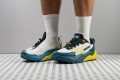
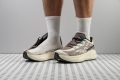
After testing the Salomon Aero Blaze 4 GRVL, we strongly recommend it for:
- Runners seeking a bouncy, high-energy ride in a versatile gravel shoe.
- Those who want just one shoe for road and gravel training.
- Anyone logging miles on dirt roads, city parks, and smooth gravel paths.

Who should NOT buy
Our lab tests revealed that the Aero Blaze 4 GRVL isn't a good match for runners who need or prefer extra room for their toes. Instead, we recommend checking out the adidas Adizero EVO SL ATR, which offers a more accommodating fit.
We also believe that runners looking for a high-stack shoe may find the Aero Blaze 4 GRVL disappointing. Fortunately, Salomon offers exactly what they're looking for in the Aero Glide 4 GRVL.

Amortiguación
Shock absorption
The Aero Blaze 4 GRVL takes a clear step forward in impact protection. We measured 145 SA in the heel and 109 SA in the forefoot, with a particularly strong result at the rear.
Compared to the previous version, heel shock absorption improves by 10%. We see this as one of the most worthwhile changes in the update, especially for heavier runners who found the predecessor a little harsh over longer distances.

| Aero Blaze 4 GRVL | 145 SA |
| Average | 122 SA |
Energy return
Salomon already impressed us with the previous version's energy return, and the optiFOAM² midsole raises the bar again. We measured an incredible 73.5% in the forefoot and 71.5% in the heel, both excellent results especially at this price.
Whether you land on the heel or farther forward, there's plenty of energy coming back from the midsole.
| Aero Blaze 4 GRVL | 73.5% |
| Average | 59.7% |
Altura de la suela en la zona del talón
We measured a heel stack of 35.2 mm, putting the Aero Blaze 4 GRVL in familiar road daily-trainer territory. It offers substantial material underfoot without joining the tallest shoes in Salomon's gravel lineup.

Our result is also almost identical to its predecessor's and remains far from maximalist territory. Therefore, we have to give credit to the outstanding foam, which delivers excellent shock absorption despite the shoe's moderate stack height.

| Aero Blaze 4 GRVL | 35.2 mm |
| Average | 32.9 mm |
Altura de la suela en el antepié
The forefoot came in at 26.3 mm, below Salomon's advertised 29 mm. However, we believe this moderate stack height is an excellent design choice for daily runs, giving the shoe a more versatile, do-it-all character.

| Aero Blaze 4 GRVL | 26.3 mm |
| Average | 25.7 mm |
Drop
Subtracting our forefoot measurement from the heel gives an 8.9 mm drop, slightly higher than Salomon's stated 8 mm.
The difference is small, and the shoe retains the elevated-heel geometry common in road daily trainers. We also see it as an easy fit for heel strikers who prefer that setup when moving between asphalt and gravel.

| Aero Blaze 4 GRVL | 8.9 mm |
| Average | 7.2 mm |
Dureza de la mediasuela
The previous version's firm midsole was one of its more divisive features. We found a clearly softer formulation this time, measuring 38.8 AC with our Asker C durometer. That's close to average and moves the cushioning toward a more balanced feel, while our energy-return test proved that the excellent rebound remains.
Another positive came after 20 minutes in the freezer. The foam became just 4% firmer, maintaining nearly the same softness in our cold test. What an excellent foam!

| Aero Blaze 4 GRVL | 38.8 AC |
| Average | 38.1 AC |
Rocker
Our side-profile photo show curvature at both ends, with the forefoot sweeping upward and a extremely rounded heel entry. The shape follows Salomon's ski-inspired Reverse Camber approach, which uses a curved sole to guide the transition through the stride.

Tallaje y ajuste
Talla
Longitud interna

| Aero Blaze 4 GRVL | 270.1 mm |
| Average | 269.2 mm |
Anchura / Ajuste
After creating a gel replica of the interior, we measured 93.5 mm at the widest part of the forefoot. That's slightly narrower than average and keeps the close-fitting character of most Salomon shoes.
After using the shoe, we wouldn't describe this as a spacious fit at all. Runners with narrow feet have a better starting point here, while those who need extra room across the ball of the foot should be cautious.

| Aero Blaze 4 GRVL | 93.5 mm |
| Average | 95.7 mm |
Anchura de la parte delantera
The toebox narrows to 71.5 mm near the big toe, giving the Aero Blaze 4 GRVL a distinctly tapered shape. This measurement is almost unchanged from the predecessor, so anyone hoping for a wider front end will be disappointed.

| Aero Blaze 4 GRVL | 71.5 mm |
| Average | 74.3 mm |
Altura de la parte delantera
Vertical room is limited too. We measured 25.3 mm of toebox height, placing the upper closer to the tops of the toes than in the average trail shoe.
Combined with the tapered shape, this is a fit that favors lower-volume feet.

| Aero Blaze 4 GRVL | 25.3 mm |
| Average | 27.0 mm |
Tracción / Agarre
Traction test
We tested the Gravel contaGRIP outsole on wet concrete and recorded a coefficient of friction of 0.56. That's a decent result, but it still falls below the average for trail shoes we've tested and doesn't come close to the top-performing outsoles from Vibram or Continental.
| Aero Blaze 4 GRVL | 0.56 |
| Average | 0.68 |
Profundidad del dibujo de la suela
At just 2.2 mm, the lugs (and the shoe name!) make this shoe's priorities clear. They're shallow enough to suit paved sections and firm gravel paths, with little of the deep tread found on more aggressive trail shoes.

Salomon advertises 2.5 mm, but our measurement came in lower. Either way, we would keep this design away from deep mud and soft, steep trails.

| Aero Blaze 4 GRVL | 2.2 mm |
| Average | 3.5 mm |
Diseño de la suela exterior
We found the familiar combination of larger chevron lugs around the perimeter and small hexagonal lugs beneath the forefoot. A channel of exposed foam helps to keep weight down and separates the central patch from the surrounding rubber.

Flexibilidad / Rigidez
We needed 15.2N to bend the shoe through 30 degrees, a result very close to average. It takes 8% less force than the previous version, bringing a small improvement in longitudinal flexibility for those that prefer a less stiff shoe.

| Aero Blaze 4 GRVL | 15.2N |
| Average | 14.8N |
Peso
The new version weighed 9.1 oz (258g) in our men's US 9, keeping it lighter than the average trail shoe. We believe that this relatively low weight, combined with its incredible bounce, makes it a versatile option for everything from daily runs on gravel to faster workouts like fartleks.

| Aero Blaze 4 GRVL | 9.1 oz (258g) |
| Average | 10.1 oz (285g) |
Estabilidad
Prueba de estabilidad lateral
This shoe comes with the usual raised midsole sidewalls around the rearfoot, but the outsole maintains a compact footprint. Without a particularly wide heel base, we think that the design stays closer to a conventional neutral daily trainer.
In our view, this makes it a shoe best suited for neutral runners.
Rigidez torsional
Twisting the shoe in our custom machine required 16.9 Nm of torque, giving it slightly more resistance than average. That adds some structure when the heel and forefoot rotate in opposite directions.

| Aero Blaze 4 GRVL | 16.9 Nm |
| Average | 15.7 Nm |
Rigidez del contrafuerte del talón
We rated the heel counter 2/5 in our manual assessment, matching the previous version. It bends easily under pressure and provides less rigid support around the rearfoot than a heavily reinforced counter.
| Aero Blaze 4 GRVL | 2 |
| Average | 2.9 |
Anchura de la mediasuela - antepié
Salomon has kept the base slightly narrower than average with 112.5 mm, avoiding the large lateral extensions found on many modern trainers and delivering a shoe that feels agile at faster paces.
On the other hand, runners who prefer a broad landing platform won't find here what they're looking for.

| Aero Blaze 4 GRVL | 112.5 mm |
| Average | 114.2 mm |
Anchura de la mediasuela - talón
The heel platform measured 89.3 mm, staying close to average and almost identical to the predecessor. We found no move toward a wider rearfoot here, and it's clear that Salomon follows a tried-and-true design approach with the Blaze series.

| Aero Blaze 4 GRVL | 89.3 mm |
| Average | 90.4 mm |
Durabilidad
Durabilidad de la parte delantera
The redesigned upper handled our Dremel test well, earning a 4/5 for toebox durability. That's a step up from the previous version and a meaningful positive for a shoe that spends time around gravel and trail debris.
| Aero Blaze 4 GRVL | 4 |
| Average | 3.1 |
Durabilidad del acolchado del talón
Inside the heel, we found a less impressive result. The lining earned 3/5 in our Dremel test, dropping one point from the predecessor.
| Aero Blaze 4 GRVL | 3 |
| Average | 3.1 |
Durabilidad de la suela
After applying the Dremel to the outsole, we measured a 1.1 mm dent. That's 0.2-mm more than what we found in the previous version, so we can't call this an improvement in rubber wear resistance.
| Aero Blaze 4 GRVL | 1.1 mm |
| Average | 0.9 mm |
Grosor de la suela
We measured 1.5 mm of outsole rubber beneath the lugs, making this layer 35% thinner than in the previous version. That's a substantial reduction in the rubber available to wear through, especially when our abrasion test also left a deeper dent.

For runners planning plenty of asphalt mileage, this is one of the update's less appealing changes.

| Aero Blaze 4 GRVL | 1.5 mm |
| Average | 1.9 mm |
Comodidad
Breathability
The upper's durability improvement comes alongside a disappointing ventilation result. We rated the shoe just 2/5 in our smoke test, a major step back from the predecessor's 5/5. That puts summer airflow firmly on our list of concerns.
Our microscope photos show densely packed fibers with small gaps between them, matching the limited ventilation we measured and marking a big change from version 3.

| Aero Blaze 4 GRVL | 2 |
| Average | 3.3 |
Acolchado de la lengüeta
Salomon replaces the predecessor's traditional laces with Quicklace neo, using a thicker round cord, a sliding lock and fabric loops rather than punched eyelets. One pull adjusts the closure, and a tongue band keeps Quicklace neo quiet as we demonstrate in our video. There's no lace garage, though.
Beneath it, we measured 4.7 mm of tongue padding. That's less than in the previous version, but still a useful layer between the cord and the instep.

| Aero Blaze 4 GRVL | 4.7 mm |
| Average | 6.3 mm |
Lengüeta: tipo de refuerzo
Despite the new Quicklace Neo system, we found no tongue gusset. The tongue remains unattached along both sides, leaving more opportunity for it to move and for fine debris to enter through the gaps.
For a gravel-focused shoe, we would have liked Salomon to address this issue carried over from the previous version. However, we also understand that reaching this price point requires some compromises, and this appears to be one of them.

| Aero Blaze 4 GRVL | Ninguno |
Grosor de la plantilla
We measured the molded Ortholite insole at 4.7 mm, giving the foot a thicker layer than in the previous version.

| Aero Blaze 4 GRVL | 4.7 mm |
| Average | 4.6 mm |
Plantilla extraíble
We removed the insole without difficulty, so replacing it is straightforward. The bigger consideration is the limited space inside the upper: a thicker replacement takes away room from an already low, tapered toebox. We would compare the shape and thickness carefully before adding a personal orthotic.

| Aero Blaze 4 GRVL | Sí |
Tirador del talón
There's no heel tab on this version. We found a simple collar without a finger loop, so loosening the Quicklace neo system is the main step when putting the shoe on.

| Aero Blaze 4 GRVL | Ninguno |
Varios
Elementos reflectantes
We confirmed that the upper includes reflective elements at the front and rear of the Blaze, making it more visible when light hits the material.
| Aero Blaze 4 GRVL | Sí |
Precio
The Aero Blaze 4 GRVL keeps the same US MSRP as its predecessor. We think the excellent energy return and strong heel shock absorption make that price particularly appealing, especially for runners who want one daily trainer for roads and gravel.
| Aero Blaze 4 GRVL | $140 |