


Our verdict
- Daily running 94
- Tempo 83
- Race 68
- Stability 80
Pros
- Exceptional foam technology
- Lightweight for its size
- Excellent traction across all surfaces
- Comfortable upper
- Secure fit with zero heel slippage
- Premium materials
- Smooth rocker for heel strikers
- Incredible cushion for long runs
- Superb value for its top-tier tech
- Handles slow and fast paces with ease
- Ideal for heavier runners
Cons
- Less stable than v23
- Fit could be too snug for some
- Wide footprint feels less agile than others
Awards
- Top pick in best Saucony running shoes
- Top pick in best Saucony walking shoes
- Top 5% in road running shoes
- Top 14% in Saucony running shoes
- Top 16% most popular running shoes
Comparison
The most similar running shoes compared
+ + Add a shoe | |||||
|---|---|---|---|---|---|
| Our score | 92 Superb | 88 Superb | 84 Great | 94 Superb | |
| Price | £160 | £140 | £160 | £180 | |
| Pace | Daily runningTempo | Daily running | Daily running | Tempo | |
| Shock absorption | High | High | High | High | |
| Energy return | High | High | Moderate | High | |
| Traction | High | High | High | High | |
| Arch support | Neutral | Neutral | Neutral | Neutral | |
| Weight lab Weight brand | 9.1 oz / 258g 8.8 oz / 250g | 9.8 oz / 278g 9 oz / 255g | 9.6 oz / 272g 9.2 oz / 260g | 8.5 oz / 241g 8.4 oz / 238g | |
| Lightweight | ✗ | ✗ | ✗ | ✓ | |
| Drop lab Drop brand | 8.0 mm 10.0 mm | 8.5 mm 8.0 mm | 7.5 mm 6.0 mm | 10.6 mm 8.0 mm | |
| Strike pattern | HeelMid/forefoot | HeelMid/forefoot | Mid/forefoot | Heel | |
| Size | True to size | True to size | True to size | Slightly small | |
| Midsole softness | Balanced | Balanced | Soft | Firm | |
| Difference in midsole softness in cold | Small | Small | Small | Normal | |
| Toebox durability | Decent | Decent | Decent | Decent | |
| Heel padding durability | Good | Good | Good | Good | |
| Outsole durability | Good | Good | Good | Good | |
| Breathability | - | Breathable | Moderate | Breathable | |
| Width / fit | Medium | Medium | Wide | Medium | |
| Toebox width | Medium | Medium | Medium | Medium | |
| Stiffness | Moderate | Stiff | Stiff | Moderate | |
| Torsional rigidity | Flexible | Moderate | Moderate | Moderate | |
| Heel counter stiffness | Stiff | Stiff | Stiff | Stiff | |
| Rocker | ✓ | ✓ | ✓ | ✓ | |
| Heel lab Heel brand | 41.6 mm 43.0 mm | 38.7 mm 36.0 mm | 40.7 mm 42.0 mm | 37.4 mm 36.0 mm | |
| Forefoot lab Forefoot brand | 33.6 mm 33.0 mm | 30.2 mm 28.0 mm | 33.2 mm 36.0 mm | 26.8 mm 28.0 mm | |
| Widths available | NormalWide | NarrowNormalWide | NormalWide | NormalWide | |
| Orthotic friendly | ✓ | ✓ | ✓ | ✓ | |
| Season | - | SummerAll seasons | All seasons | SummerAll seasons | |
| Removable insole | ✓ | ✓ | ✓ | ✓ | |
| Ranking | #12 Top 3% | #48 Top 12% | #131 Top 33% | #4 Top 1% | |
| Popularity | #62 Top 16% | #56 Top 15% | #78 Top 20% | #21 Top 6% |
Who should buy
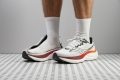
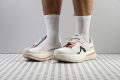
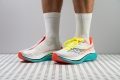
We tested everything on the Saucony Triumph 24 and found it ideal for:
- Runners addicted to the Triumph. This is the best version yet.
- Long-distance runners looking for a super trainer without spending £180 or more.
- Those who love the Endorphin Elite 3 and want a highly-capable training companion for daily miles.
- Anyone who want the latest foam technology in a daily-training shoe.

Who should NOT buy
The usual snug-fitting upper from Saucony is present here, which may be a problem for runners who prefer more room in the forefoot. Instead, we suggest the Topo Spectre 2 or the adidas Ultraboost 5.
We also think the new foam makes this Triumph slightly less stable than its predecessor. If you loved the exceptional stability of the previous version, we'd suggest going straight for the Saucony Hurricane 26. It's very similar to the Triumph 24 and also uses incrediLUX, but it's designed with a stronger focus on support.

Cushioning
Shock absorption
The Saucony Triumph 24 delivers an exceptional result in shock absorption, recording 152 SA reading in the heel and a whopping 138 SA in the forefoot.
With a shoe like this, it simply doesn't matter how much you weigh or how long your long runs are, you're fully covered.

| Triumph 24 | 152 SA |
| Average | 131 SA |
Energy return
If shock absorption is impressive, we found that energy return is even better. The new incrediLUX once again shows that Saucony is at the forefront of foam technology with this A-TPU compound, something they already proved with incrediRUN.
We found a super-shoe-like 78.5% in the forefoot, making the Triumph 24 an excellent choice for anyone seeking incredible bounce in a training shoe. Meanwhile, the heel delivered a slightly lower 72.0%, but that's still an excellent result by any measure.
| Triumph 24 | 78.5% |
| Average | 61.4% |
Heel stack
As we already noted, we consider the Saucony Triumph 24 a super trainer. Saucony may avoid marketing it as such to prevent cannibalising sales from other models, but it clearly fits into this category, and its stack height further reinforces that positioning.

We measured a very high 41.6 mm in the heel, which makes perfect sense given the impressive shock absorption values we recorded earlier.

| Triumph 24 | 41.6 mm |
| Average | 35.5 mm |
Forefoot stack
The forefoot also ticks the box for maximalism, with a sky-high 33.6 mm of stack that forefoot strikers will appreciate on long runs.

| Triumph 24 | 33.6 mm |
| Average | 27.1 mm |
Drop
It's not common for us to find a lower drop than the one stated by the brand, as the opposite is usually the case. However, the Saucony Triumph 24 is listed with a 10.0 mm drop, while we measured 8.0 mm.
In our view, that's good news. A 10-mm drop can start to feel too steep for many runners, and we believe that, for the vast majority, a geometry between 6 and 8 mm works better than a higher drop.

| Triumph 24 | 8.0 mm |
| Average | 8.4 mm |
Midsole softness
We already found that the incrediLUX foam is a beast when it comes to bounce. But how does it feel in terms of softness?
Pressing our Asker C durometer directly into the foam revealed a balanced underfoot feel, neither too firm nor too soft, with a 37.5 AC reading. Moreover, like most premium foams, it barely changes in cold weather. After 20 minutes in our freezer, we found only a minor 7% variation.

| Triumph 24 | 37.5 AC |
| Average | 35.5 AC |
Rocker
Like most modern max-stack shoes, the Triumph 24 features a heavily curved midsole geometry.
The forefoot has a late-start rocker, but the heel is what felt most dramatic to us, thanks to its extreme curvature. Heel strikers will certainly notice it during runs, and if you like shoes that roll you forward, this is one to consider.

Size and fit
Size
Saucony Triumph 24 fits true to size (27 votes).
Internal length

| Triumph 24 | 274.2 mm |
| Average | 269.4 mm |
Width / Fit
When we tried the Saucony Triumph 24, we felt that the fit was very consistent with the previous version, which means a somewhat snug upper. Let's see if our measurements confirm that.
After the gel cooled in our fridge and we took a well-deserved break, we measured a width of 93.4 mm. That's below average and just 0.4 mm narrower than the Triumph 23.

| Triumph 24 | 93.4 mm |
| Average | 95.2 mm |
Toebox width
As we always do, we also checked the Triumph 24's toebox width, and the snug trend continued with a 71.4 mm measurement. Interestingly, that's exactly the same reading we got from its predecessor.
That said, Saucony also offers a wide version in some markets and limited colorways, providing an option if you need a few extra millimetres of room.

| Triumph 24 | 71.4 mm |
| Average | 73.2 mm |
Toebox height
The toebox height is our third measurement when assessing fit, and it came in at 26.1 mm. This isn't surprising, as it's in line with Saucony's usual fit, prioritising a secure foot lockdown that can also boost stability.
That said, runners with wide feet may be better off exploring other options.

| Triumph 24 | 26.1 mm |
| Average | 27.0 mm |
Traction / Grip
Traction test
Last year, we already saw a good improvement in the Triumph's traction, but Saucony has taken another huge leap forward with this update. The needle moved from 0.43 in version 22 to 0.63 in version 23, and now to an excellent CoF of 0.86 in the 24th version.
This is what progress looks like, and other brands could perhaps take a closer look at what Saucony is doing with its foams and outsoles.
| Triumph 24 | 0.86 |
| Average | 0.53 |
Outsole design
The outsole keeps the same design principles as previous models, with moderate rubber coverage and several full-length grooves that help maintain flexibility.
However, Saucony has changed both the rubber compound and the tread pattern, replacing the previous layout with a more segmented design featuring directional lugs for improved traction.

Flexibility / Stiffness
Saucony keeps the Triumph 24 comfortable at easy paces by keeping its stiffness in check, with our 16.6N result in the 30-degree bend test landing very close to the current lab average.

| Triumph 24 | 16.6N |
| Average | 15.5N |
Weight
Another area where we were truly impressed by the Triumph 24 is its weight.
The switch to incrediLUX comes with the added benefit of a much lighter foam. At 9.1 oz (258g), the Triumph 24 has an excellent weight-to-stack ratio, which is another reason we consider it a super trainer. This low weight also makes it feel far more nimble during tempo runs than most other max-stack shoes.

| Triumph 24 | 9.1 oz (258g) |
| Average | 9.2 oz (261g) |
Stability
Lateral stability test
The new incrediLUX foam is clearly softer than the PWRRUN PB it replaces, and that softness comes at the expense of some stability.
The ride now feels less controlled, although we still believe the shoe provides plenty of support for neutral runners, which is the group this shoe is designed for.
Torsional rigidity
Another reason why the Triumph 24 may feel less stable than other super trainers is its moderate torsional rigidity. This makes the ride pleasant at slow paces and far from harsh, but the shoe twists relatively easily, which inevitably compromises lateral support.
We recorded a below-average reading of 12.0 Nm in our lab test.

| Triumph 24 | 12.0 Nm |
| Average | 14.4 Nm |
Heel counter stiffness
The heel counter is stiff at 4/5, as we expected from a shoe like this. This adds some extra lateral support around the heel, and we think it's a smart design choice, as Saucony added plenty of foam around the collar to keep it comfortable.
| Triumph 24 | 4 |
| Average | 3 |
Midsole width - forefoot
The new trend in max-stack running shoes is to use ultra-wide midsole platforms, and the Triumph 24 is no exception. In fact, this is the widest Triumph to date, measuring a whooping 126.5 mm in the forefoot.
If you dislike bulky shoes, this Saucony probably won't be for you, given its massive footprint and substantial overall size.

| Triumph 24 | 126.5 mm |
| Average | 115.1 mm |
Midsole width - heel
The heel is also extremely broad, reminiscent of shoes designed for stability. Given the explosive ride and over-40 mm stack height, however, we can't blame Saucony for going with such a substantial platform.

| Triumph 24 | 101.6 mm |
| Average | 91.1 mm |
Durability
Toebox durability
The upper has changed too, and we had no complaints when it came to comfort. The Triumph has always been a comfortable shoe, and this version continues that tradition. But how does the new upper hold up to abrasion?
In our first durability test, we recorded a solid 3/5, which left us satisfied.
| Triumph 24 | 3 |
| Average | 2.6 |
Heel padding durability
The cosy heel padding performed even better, earning our maximum score of 5/5.
| Triumph 24 | 5 |
| Average | 3.4 |
Outsole durability
The XT-900 rubber proved that it's not only grippy but also extremely durable. After lifting the Dremel, we found just 0.6 mm of wear, which is almost half the current average.
| Triumph 24 | 0.6 mm |
| Average | 1.1 mm |
Outsole thickness
We have absolutely no concerns about outsole wear, as the 3.3 mm thickness is also quite reassuring. It's true that the outsole coverage isn't particularly generous, but the areas that matter most are well protected.

| Triumph 24 | 3.3 mm |
| Average | 3.1 mm |
Misc
Insole thickness
The insole follows Saucony's usual design, with a thicker construction (6.3 mm) than what we typically see from other brands.
Moreover, the foam used here is impressive, far from the dull EVA compounds found in many daily trainers, and it makes a significant contribution to the shoe's excellent energy return.

| Triumph 24 | 6.3 mm |
| Average | 4.4 mm |
Removable insole
Saucony made it clear with the insole that this shoe is designed for neutral runners. That said, if you prefer to swap it out for a third-party insole, you can do it too.

| Triumph 24 | Yes |
Reflective elements
The iconic three circles from the brand are reflective, which is a nice touch.
By the way, here's a little bit of history. These three circles represent the three boulders next to Saucony Creek, where the brand got its name in Kutztown, Pennsylvania.
| Triumph 24 | Yes |
Tongue padding
The lacing system provides a secure fit without making things overly complicated. It's a classic setup with punched eyelets and padded laces that add a touch of extra comfort.

And comfort is something this shoe really delivers. The tongue has 8.3 mm of foam on the inside, which eliminates any risk of instep pressure or discomfort, even during long runs.

| Triumph 24 | 8.3 mm |
| Average | 5.8 mm |
Tongue: gusset type
The tongue uses a semi-gusseted design that we find ideal for this shoe. It allows for good ventilation, thanks in part to its perforated fabric, while keeping the tongue securely centred at all times.

| Triumph 24 | Both sides (semi) |
Heel tab
The Triumph 24 features an extended heel collar that helps reduce pressure on the Achilles tendon.

| Triumph 24 | Extended heel collar |
Price
The Triumph 24 sits in the premium section of daily trainers, which is exactly where this shoe is expected to land. However, with its upgraded foam and lower weight, it can also double as a versatile super trainer, and at this price, it's actually a very good price compared with most rivals in this segment.
| Triumph 24 | $170 |