


Our verdict
- Cushioning 60
- Stability 93
- Durability 87
Pros
- Nostalgic oversized Y2K vibe
- Exaggerated puffy tongue
- Affordable price
- Highly stable and supportive build
- Excellent outsole grip
- Hard-wearing nubuck upper
- Durable rubber outsole
Cons
- Firm sole with limited cushioning
- Much heavier than average
- Frail interior lining
- Tapered toebox
Awards
- Top 26% most popular trainers
Comparison
The most similar trainers compared
+ + Add a shoe | |||||
|---|---|---|---|---|---|
| Our score | 83 Good | 81 Good | 87 Great | 83 Good | |
| Price | £70 | £65 | £100 | £80 | |
| Style | RetroSportyChunky | ClassicSportyMinimalist | Business casualClassicRetroSporty | ClassicSportyMinimalist | |
| Shock absorption | Low | Low | Moderate | Low | |
| Energy return heel | High | Low | Moderate | High | |
| Traction | High | High | High | High | |
| Weight lab | 17.4 oz / 493g | 12.8 oz / 363g | 15.7 oz / 445g | 13.9 oz / 394g | |
| Size | - | True to size | True to size | True to size | |
| Midsole softness | Firm | Firm | Firm | Firm | |
| Material | Cup SoleLeatherSuede | CanvasSuedeVulc Sole | Cup SoleLeather | Leather | |
| Inspired from | Skate | Skate | Skate | Tennis | |
| Width / fit | Wide | Medium | Medium | Medium | |
| Toebox width | Medium | Medium | Medium | Medium | |
| Leather/suede quality | Real suede | Real suede | Real leather | Real leather | |
| Toebox durability | Decent | Decent | Decent | Decent | |
| Heel padding durability | Bad | Decent | Decent | Good | |
| Outsole durability | Good | Bad | Decent | Decent | |
| Heel stack lab | 25.3 mm | 18.7 mm | 27.1 mm | 23.1 mm | |
| Stiffness | Stiff | Flexible | Stiff | Moderate | |
| Tongue padding | Very thick | Thin | Average | Thin | |
| Drop lab | 9.0 mm | 6.0 mm | 8.0 mm | 7.9 mm | |
| Forefoot | 16.3 mm | 12.7 mm | 19.1 mm | 15.2 mm | |
| Removable insole | ✓ | ✗ | ✓ | ✓ | |
| Heel tab | None | None | None | None | |
| Torsional rigidity | Stiff | Flexible | Stiff | Flexible | |
| Heel counter stiffness | Stiff | Flexible | Moderate | Flexible | |
| Closure | Laces | Laces | Laces | Laces | |
| Top | Low top | Low top | Low top | Low top | |
| Ranking | #80 Bottom 27% | #93 Bottom 15% | #50 Top 46% | #81 Bottom 26% | |
| Popularity | #28 Top 26% | #18 Top 17% | #79 Bottom 28% | #36 Top 33% |
Who should buy
Having evaluated the DC Court Graffik's pros and cons, we think it's a solid option for people who:
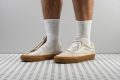
- want a chunky Y2K skate sneaker to complement baggy jeans and oversized hoodies
- are shopping for a cheap kick with a bold vibe
- prefer a firm, flat platform with dependable lateral support
- appreciate a heavily padded upper and an exaggerated, puffy tongue

Who should NOT buy
Flat, stiff, and minimally cushioned, the Court Graffik hardly makes a dream shoe for long hours of walking and standing.
The adidas Samba XLG could be a great alternative as it still channels skate shoe vibes with its cupsole and puffy tongue but offers better impact protection and weighs less than the DC.
And if you are not specifically looking for a skate shoe silhouette, there are plenty of affordable trainers like the New Balance 997H offering lighter and more comfortable construction.

Cushioning
Shock absorption
Just because it has a puffy exterior doesn't mean that the DC Court Graffik feels equally cushioned underfoot. In fact, its rubber cupsole and total absence of EVA foam provide limited shock absorption, with a below-average SA rating of 72 in the heel. That makes it less than ideal for prolonged, all-day wear.

| Court Graffik | 72 SA |
| Average | 87 SA |
Energy return
And yet, its foam insole and rubber cupsole showed some elasticity in our energy return test, measuring 55.3% in the heel. It's not high enough to describe the shoe's ride as bouncy, but it does have some decent responsiveness.
| Court Graffik | 55.3% |
| Average | 50.1% |
Heel stack
Like most traditional skate shoes, the Court Graffik is built on a low-profile platform, registering a moderate heel stack of 25.3 mm. By keeping the foot closer to the ground, this construction promotes better board feel and control.

| Court Graffik | 25.3 mm |
| Average | 30.4 mm |
Forefoot stack
Its forefoot stack also sits well below the category average at 16.3 mm. Again, great for the original skateboarding intent but can feel too bare-bones for daily walking.

| Court Graffik | 16.3 mm |
| Average | 19.5 mm |
Drop
To our surprise, the kick's heel-to-toe drop clocked in at 9.0 mm, which is slightly higher than the typical skate shoe range (below 8 mm).
For skateboarding, an elevated heel can be a drawback, as it results in a less consistent foot-to-board connection from heel to toe. On the other hand, this offset makes the Court Graffik more walking-friendly, as it helps prevent strain on the Achilles and offers a bit more impact protection in the rearfoot.

| Court Graffik | 9.0 mm |
| Average | 11.0 mm |
Midsole softness
In a world of cushy trainers, the Court Graffik retains its heritage design, featuring nothing but rubber in its midsole. There is no EVA foam to create compression and soften the ride in this DC kick.
No wonder our durometer recorded an exceptionally high reading of 81.1 AC when pressed against the shoe's sole.

| Court Graffik | 81.1 AC |
| Average | 51.2 AC |
Rocker
As expected from a skate shoe, the Court Graffik has zero upward curvature in its sole, neither towards the heel nor towards the toes. Flat as it can be, this setup is meant to help with balance and control on the board.

Size and fit
Size
Internal length

| Court Graffik | 274.7 mm |
| Average | 272.2 mm |
Width / Fit
With oversized silhouettes like the DC Court Graffik, it can be hard to tell what its fit is like from the inside. But that's where our gel casting process comes into play.
Once the gel had solidified in the freezer, we measured the widest part of the cast to be 99.3 mm. This is significantly roomier than what trainers normally provide in the ball of the foot area.

| Court Graffik | 99.3 mm |
| Average | 92.4 mm |
Toebox width
However, we wouldn't categorise this DC kick as wide-foot friendly because its toebox gets notably narrower and pointier towards the toes. At 67.5 mm in the big toe area, it even falls below the category average!

| Court Graffik | 67.5 mm |
| Average | 68.7 mm |
Toebox height
At least the shoe's vertical space remains on par with the average at 27.6 mm.
This is important because its dense suede (or leather, depending on the colorway) upper has absolutely no give.

| Court Graffik | 27.6 mm |
| Average | 27.7 mm |
Traction / Grip
Traction test
The brand's product page mentions the Court Graffik's outsole grip on the board, describing it as 'precise and controlled.' However, in our lab, we can only test and evaluate the shoe's performance for walking on city streets.
As we brushed the shoe's heel against wet concrete, mimicking heel landing, our machine recorded a solid friction coefficient of 0.68. Better than the category average, it helps maintain surefooted strides even on slicker post-rain pavements.
| Court Graffik | 0.68 |
| Average | 0.49 |
Outsole design
With its design remaining largely unchanged since its 1999 debut, the Court Graffik still features DC's signature Pill Pattern outsole. The name refers to the flat, rounded treads, which resemble pills cut in half.
Even though this setup is optimised for traction on a skateboard, we found that it is perfectly suitable for concrete, asphalt, and other common city surfaces.

Flexibility / Stiffness
With its sole entirely made of rubber and its upper made of dense nubuck, the shoe has pretty limited space to bend freely.

And that stiffness instantly showed in our flexibility test, where the Court Graffik required significantly more force to bend than the average sneaker at 17.3N.
It's not as rigid as the Nike Air Force 1 07 (22.6N), for example, but it is 30% stiffer than the category average. And because natural foot bending is restricted and there is no rocker to help with heel-to-toe transitions, this DC kick may not feel particularly comfortable for all-day wear, forcing your feet and ankles to work a bit harder.

| Court Graffik | 17.3N |
| Average | 13.5N |
Weight
Unfortunately, all of that visual bulk was also reflected in a higher number on our scale. At 17.4 oz (493g), the DC Court Graffik turned out to be one of the heaviest lifestyle trainers in our lab, next to the Jordan Spizike Low and the Vans Half Cab.
Unless you specifically prefer chunky, heavy trainers, you may find it quite cumbersome on the foot.

| Court Graffik | 17.4 oz (493g) |
| Average | 13.7 oz (387g) |
Stability
Lateral stability test
Stability is the last thing we would worry about in the DC Court Graffik, as its sturdy rubber cupsole creates a highly planted base for the foot. And the stout, heavily padded upper further contributes to that supportive experience.
Torsional rigidity
This DC kick also proved to be notably harder to twist than the average sneaker, showing an above-average torsional rigidity of 18.1 Nm. That translates to a sense of solid side-to-side support, particularly in the shoe's midfoot area.

| Court Graffik | 18.1 Nm |
| Average | 15.8 Nm |
Heel counter stiffness
A stiff heel counter also plays a major role in how stable the foot feels inside the Court Graffik. Requiring some tangible force to fold and bend, it earned a high stiffness score of 4 out of 5 in our manual test.
| Court Graffik | 4 |
| Average | 3.2 |
Midsole width - forefoot
We also found that this kick relies on extended contact points in the forefoot, reaching 112.9 mm at the broadest area and reducing the risk of foot rollovers.

| Court Graffik | 112.9 mm |
| Average | 109.0 mm |
Midsole width - heel
At the heel, the shoe's midsole width is similar to that of most other trainers, measuring 82.7 mm. And as you can see from the photo, the platform remains just about as wide throughout the midfoot, which also contributes to stability.

| Court Graffik | 82.7 mm |
| Average | 83.8 mm |
Durability
Leather/Suede quality
Depending on the colour option, the DC Court Graffik is offered in nubuck, leather, or suede uppers. However, at this price point, we didn't expect to see any high-quality materials and were even surprised to find real nubuck on our tested pair.

But here is the caveat: the layer of that real nubuck is rather thin, almost cosmetic, and the thick material beneath it is nothing more than foam padding.
| Court Graffik | Real suede |
Toebox durability
Although the quality of the Court Graffik's nubuck raises some concerns, its abrasion resistance is hard to question. The material withstood 12 seconds of grinding with our Dremel, earning an impressive durability score of 4 out of 5.
Additionally, its ollie area is well reinforced by a rubber cupsole for extra wear resistance.
| Court Graffik | 4 |
| Average | 3.7 |
Heel padding durability
Sadly, the same praise doesn't extend to the shoe's inner lining. The textile tore almost immediately under our Dremel, lowering the shoe's heel padding durability score to the minimum 1 out of 5.
| Court Graffik | 1 |
| Average | 3.2 |
Outsole durability
But on a positive note, the shoe's rubber outsole resisted abrasion brilliantly, leaving it with just a moderate dent of 0.9 mm. This is a promising result for long-term outsole durability in a lifestyle sneaker.
| Court Graffik | 0.9 mm |
| Average | 1.0 mm |
Outsole thickness
And the generous 4.6 mm of outsole rubber further boosted our confidence in this DC kick's durability.

| Court Graffik | 4.6 mm |
| Average | 5.1 mm |
Misc
Insole thickness
A 5.0 mm insole is essentially the only padding that prevents the Court Graffik from feeling too harsh underfoot.

| Court Graffik | 5.0 mm |
| Average | 4.9 mm |
Removable insole
But if you're planning to wear this DC sneaker for extended periods, we highly recommend getting an over-the-counter insole to enhance comfort and impact protection.

| Court Graffik | Yes |
Reflective elements
Checking the sneaker for reflective elements in a dark room, we found none. That means no added visibility in low-light conditions.

| Court Graffik | No |
Tongue padding
The Court Graffik's comically oversized tongue is probably the shoe's most defining feature. Measuring its thickness with a calliper, we got a mind-blowing 35.4 mm! Originally designed to protect the top of the foot during tricks, this heavily padded tongue now serves more of an aesthetic purpose, channelling the exaggerated vibe of old-school skate shoes.
In our lab, it ranks only second to the Vans Knu Skool (38.4 mm).

| Court Graffik | 35.4 mm |
| Average | 9.7 mm |
Tongue: gusset type
The tongue isn't gusseted, but that's hardly a concern as the generous padding keeps it securely in place, preventing any bunching or sliding.

| Court Graffik | None |
Heel tab
A finger loop at the back of this DC shoe helps put it on without unlacing.

| Court Graffik | None |
Price
The DC Court Graffik remains one of the most affordable skate shoes on the market, boosting its popularity among the younger generation.

| Court Graffik | $70 |