


Our verdict
- Cushioning 77
- Stability 96
- Durability 95
Pros
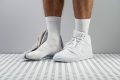
- Iconic Jordan silhouette
- Stability and support of a hiking boot
- Secure heel and midfoot lockdown
- Excellent outsole traction
- Fantastic wear resistance and durability
- Well-padded and gusseted tongue
- Real nubuck upper
Cons
- Lacks comfort for all-day wear
- Can feel too stiff and firm
- Too heavy
Comparison
The most similar trainers compared
+ + Add a shoe | |||||
|---|---|---|---|---|---|
| Our score | 84 Good | 83 Good | 81 Good | 82 Good | |
| Price | £200 | £130 | £180 | £100 | |
| Style | RetroSporty | ClassicRetroSporty | RetroSporty | ClassicSportyMinimalist | |
| Shock absorption | Moderate | - | Moderate | - | |
| Energy return | Moderate | - | High | - | |
| Traction | High | - | High | - | |
| Breathability | - | Warm | Warm | Warm | |
| Weight lab | 19.5 oz / 553g | 15.1 oz / 427g | 16.3 oz / 462g | 14.7 oz / 418g | |
| Size | True to size | True to size | True to size | True to size | |
| Midsole softness | Firm | - | - | - | |
| Material | Leather | Cup SoleLeather | LeatherSuedeTextile | CanvasLeatherSuede | |
| Season | - | Winter | SpringFallAll seasons | Winter | |
| Inspired from | Basketball | Basketball | Basketball | Basketball | |
| Width / fit | Medium | Medium | Medium | Narrow | |
| Toebox width | Medium | Medium | Medium | Narrow | |
| Leather/suede quality | Real leather | Real leather | Real suede | Real leather | |
| Toebox durability | Decent | Decent | Good | Good | |
| Heel padding durability | Good | Good | Good | Decent | |
| Outsole durability | Good | Good | Good | Decent | |
| Heel stack lab | 31.3 mm | 22.2 mm | 25.5 mm | 17.5 mm | |
| Stiffness | Stiff | - | Stiff | - | |
| Tongue padding | Average | Average | Average | Average | |
| Drop lab | 11.2 mm | 11.0 mm | 8.5 mm | 6.0 mm | |
| Forefoot | 20.1 mm | 11.2 mm | 17.0 mm | 11.5 mm | |
| Removable insole | ✓ | ✓ | ✓ | ✓ | |
| Heel tab | Pull tab | None | Finger loop | None | |
| Torsional rigidity | Stiff | Moderate | Stiff | Flexible | |
| Heel counter stiffness | Stiff | Stiff | Moderate | Flexible | |
| Closure | Laces | Laces | LacesVelcro | Laces | |
| Top | Mid top | Mid top | Mid top | Mid top | |
| Ranking | #110 Bottom 1% | #83 Bottom 25% | #94 Bottom 15% | #90 Bottom 18% | |
| Popularity | #110 Bottom 1% | #68 Bottom 38% | #38 Top 35% | #51 Top 46% |

Who should buy
In our opinion, the Air Jordan 4 Retro appeals to people who:
- want one of Tinker Hatfield's iconic trainers as their statement piece
- prefer structured mid-top trainers with strong lateral support
- mostly wear trainers for shorter outings rather than long walking days

Who should NOT buy
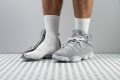
The AJ4 Retro's hefty build and premium price tag can make it a no-go for many potential buyers. Thus, we would also consider the Jordan Spizike Low and the Air Jordan 4 RM, as both kicks are notably lighter on the feet and the wallet.
All three of these Jordan trainers share the same platform design with Air units, and the Spizike even features the same lace wings.

Cushioning
Shock absorption
The line between retro and dated can be blurry, and our lab tests suggest that the AJ4 may be leaning toward the latter. The shoe features a basic PU foam midsole that houses the signature Nike Air units (a small one in the forefoot and a large one in the heel), though only the heel unit is visible.
Recording the shoe's shock absorption at 92 SA in the heel, we found it similar to that of the Nike Air Max 1 (88 SA). This implies a decent level of impact protection for short walks but not sufficient for a comfortable sneaker that could accommodate all-day wear.

| Air 4 Retro | 92 SA |
| Average | 87 SA |
Energy return
As innovative as it appeared decades ago, the Air technology can no longer compete with today's advanced cushioning technologies. We wouldn't expect any tangible rebound here, as the shoe registered just a moderate energy return of 45.8%
Its ride can feel flat and underwhelming compared to most contemporary trainers.
| Air 4 Retro | 45.8% |
| Average | 49.9% |
Heel stack
At 31.3 mm, the Air Jordan 4 Retro's heel stack turned out to be perfectly average. It is neither too platformy nor too low to the ground.

| Air 4 Retro | 31.3 mm |
| Average | 30.4 mm |
Forefoot stack
And a forefoot stack of 20.1 mm further confirms the shoe's average platform dimensions.

| Air 4 Retro | 20.1 mm |
| Average | 19.4 mm |
Drop
As a result, this Jordan shoe's heel-to-toe drop also falls squarely within the average at 11.2 mm.
It has a moderate heel elevation to prevent the Achilles from overworking and offers a more relaxed ankle position for walking.

| Air 4 Retro | 11.2 mm |
| Average | 10.9 mm |
Midsole softness
The AJ4 Retro's ride feels firm, planted, and barely compressible but not necessarily brick-like.
Even though its PU foam showed a slightly softer-than-average durometer reading of 42.1 AC, it still qualifies as firm by our standards.

| Air 4 Retro | 42.1 AC |
| Average | 50.8 AC |
Size and fit
Size
Air Jordan 4 Retro fits true to size (45 votes).
Internal length

| Air 4 Retro | 275.0 mm |
| Average | 272.2 mm |
Width / Fit
Over the decades, the Air Jordan 4 Retro has earned a reputation as a 'pinky toe killer,' with many wearers complaining about it putting pressure on the lateral side of the forefoot.
However, as the sneaker has undergone multiple iterations, its fit has also been altered, and we are here to assess the dimensions of the most recent releases.
Once the shoe's gel cast solidified, we used a digital calliper to measure its widest area, precisely where the pinky toe issue is most likely to occur.
At 93.7 mm, we found it no tighter than average and, in fact, slightly wider than the category average!

| Air 4 Retro | 93.7 mm |
| Average | 92.4 mm |
Toebox width
Taking another measurement in the shoe's big toe area, our calliper showed a width of 70.3 mm. This is yet another confirmation that the shoe's toebox space and shape don't deviate much from those of the average men's US size 9 sneaker.
For reference, we found its interior dimensions to be almost identical to those of the Nike Dunk Low.

| Air 4 Retro | 70.3 mm |
| Average | 68.7 mm |
Toebox height
The AJ4 Retro doesn't seem to pose much risk of vertical pressure on the toes.
We measured its toebox height at a genrous 28.9 mm, which means ample wiggle room above the toes. This is particularly reassuring given the complete lack of stretch in its leather upper.

| Air 4 Retro | 28.9 mm |
| Average | 27.7 mm |
Traction / Grip
Traction test
Basketball DNA is still very much alive in this heritage Air Jordan kick, as the shoe's outsole showed an impressive friction coefficient of 0.66 in our traction test.
Originally designed to grip the hardwood, the AJ4's outsole now provides reliable traction on slick urban surfaces and wet pavement.
| Air 4 Retro | 0.66 |
| Average | 0.49 |
Outsole design
A herringbone traction pattern throughout its outsole also reflects this sneaker's past incarnation as a basketball shoe. But in the toe area, it gives way to the star-shaped treads that add texture and styling to the silhouette.
Meanwhile, its midfoot area is recessed, which helps reduce unnecessary rubber and shave off a few ounces.

Flexibility / Stiffness
Despite all the flex grooves crossing its forefoot, the Air Jordan 4 Retro remains one of the stiffest trainers we've ever tested!

With a whopping 28.3N, it takes 110% more force to bend this kick than the average lifestyle sneaker!
Paired with the shoe's firm and flat platform, this rigidity can make longer walks feel more demanding on the feet as the shoe resists their natural bending motion and offers little assistance in rolling smoothly from heel to toe.

| Air 4 Retro | 28.3N |
| Average | 13.6N |
Weight
This is yet another problematic characteristic of the AJ4 Retro. Its substantial build and sturdy mid-top leather upper create an almost boot-like experience, reflecting in an unusually heavy weight of 19.5 oz (553g).
Crazy to think that a pair of trainers can add over 1 kg of weight to your feet!

| Air 4 Retro | 19.5 oz (553g) |
| Average | 13.7 oz (388g) |
Stability
Lateral stability test
With stability and lateral support worthy of a hiking boot, the Air Jordan 4 Retro is built like a tank. Its firm and grounded platform and raised sidewalls ensure a solid footing, while a stout leather upper adds structure and side-to-side support.

And the shoe's signature TPU lace wings deserve a special mention here. Aside from giving this Jordan sneaker its distinctive look, their purpose is far from merely decorative. Once the laces are cinched, these wings help tighten the midfoot lockdown for a more secure fit. And you have the option to customise lacing by using any of the available apertures.
Torsional rigidity
As it turns out, our comparison of the AJ4 Retro to a hiking boot wasn't entirely figurative. When measuring the torque required to twist this stout sneaker by 10 degrees, we recorded one of the highest readings at 22.9 Nm!
Its torsional rigidity is nearly twice that of the average casual sneaker, which provides a reassuringly stable platform for everyday wear and prevents the foot from collapsing easily.

| Air 4 Retro | 22.9 Nm |
| Average | 15.8 Nm |
Heel counter stiffness
Our manual test also revealed significant resistance in the shoe's heel counter. Refusing to fold or bend, it earned a high stiffness score of 4 out of 5.
This further contributes to stability by limiting side-to-side movement of the heel and keeping it securely contained.
| Air 4 Retro | 4 |
| Average | 3.2 |
Midsole width - forefoot
Sturdy and structured, this Jordan sneaker doesn't need a bulky platform to enhance stability. It feels perfectly planted even with a standard width of 106.5 mm in the widest part of the forefoot.

| Air 4 Retro | 106.5 mm |
| Average | 108.7 mm |
Midsole width - heel
The broadest part of its heel doesn't extend beyond the average either, measuring just 81.4 mm.

| Air 4 Retro | 81.4 mm |
| Average | 83.6 mm |
Durability
Leather/Suede quality
Because this Jordan classic is regularly updated and released in new variations, the type and quality of its upper material can vary depending on the given shoe's release.
In this review, we are looking at the 2026 Topo Bravo edition featuring a nubuck upper.

We first subjected the AJ4 Retro's tongue to our butane torch test and watched its surface melt almost instantly. Even if genuine nubuck is present, it appears to be covered by a substantial synthetic finish.
After that, we tested the shoe's quarter area and got a more reassuring result. Although some surface melting occurred, it was relatively minor, suggesting that we were dealing with a thin synthetic coating over genuine leather rather than an entirely synthetic material.
But even so, we don't think that this iteration's upper looks nearly as premium as its price tag would suggest.
| Air 4 Retro | Real leather |
Toebox durability
On a positive note, that nubuck upper proved to be a tough nut to crack, remaining practically unscathed after 12 seconds of Dremel drilling. That fairly deserves a high toebox durability score of 4 out of 5.
| Air 4 Retro | 4 |
| Average | 3.7 |
Heel padding durability
The felt-like textile inside the shoe's collar surprised us even more, as it shrugged off the Dremel abuse entirely! Without hesitation, we rated the shoe's heel padding durability at a maximum of 5 out of 5!
| Air 4 Retro | 5 |
| Average | 3.2 |
Outsole durability
The outsole rubber on this Air Jordan sneaker didn't let us down either, showing excellent abrasion resistance. Measuring the dent left by our Dremel's sanding tip, we recorded a shallow depth of just 0.8 mm.
| Air 4 Retro | 0.8 mm |
| Average | 1.0 mm |
Outsole thickness
And the fact that the shoe's outsole thickness measures a solid 4.8 mm makes us even more confident in its long-term durability.

| Air 4 Retro | 4.8 mm |
| Average | 5.1 mm |
Misc
Insole thickness
A moderately padded insole of this Air Jordan kick measured 3.9 mm on our calliper. While it takes the edge off the shoe's firm sole, the initial step-in feel remains quite firm.

| Air 4 Retro | 3.9 mm |
| Average | 4.9 mm |
Removable insole
But there is an option to swap the shoe's removable insole for an alternative one or even a custom orthotic.

| Air 4 Retro | Yes |
Reflective elements
Reflectivity is not a standard feature for the Air Jordan 4 Retro, so we didn't expect to see any reflective elements in our dark room test.

| Air 4 Retro | No |
Tongue padding
With a caliper reading of 15.1 mm, the AJ4 Retro's tongue proved to be generously padded and comfortable on top of the foot. We also found that it buffers the pressure from the shoe's stiff nubuck panels and TPU lace wings rather well.

| Air 4 Retro | 15.1 mm |
| Average | 9.7 mm |
Tongue: gusset type
We don't normally see tongue gussets on a sneaker, let alone on a retro silhouette. But we appreciate this Jordan shoe's semi-gusseted design for preventing the tongue from sliding sideways or bunching.

| Air 4 Retro | Both sides (semi) |
Heel tab
A large synthetic pull tab adorns the back of the shoe. It echoes the distinctive shape of the AJ4's TPU lace wings.

| Air 4 Retro | Pull tab |
Price
As one of the most expensive trainers in our catalogue, the Air Jordan 4 Retro naturally raises the question of whether it's worth the money. While we can't deny this kick's unbeatable stability and durability, we're not so sure about its practical comfort for all-day wear. This leads us to believe that a significant portion of the price comes down to the shoe's heritage and cultural significance.

| Air 4 Retro | $220 |