7 Best Cross Country Shoes in 2026

We buy shoes ourselves. We earn commissions when you buy through us, at no extra cost. Why trust us
Cross country can be wild. It poses plenty of challenges for athletes and their footwear. Muddy areas, knee-deep puddles, obstacles to jump over, steep hills, twisty trails — all in one course. But what helps you get through the race with a higher chance of having fun is the right pair of cross-country (XC) shoes.
When should you use XC spikes and when is it OK to choose waffles? Can you also use regular running shoes for cross country? Which pair has the most durable toebox? Yes, we cover all of that here. We also highlight the pairs that have outperformed the rest, both on the trails and in the lab.
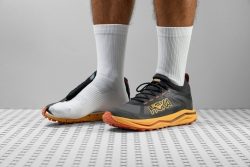
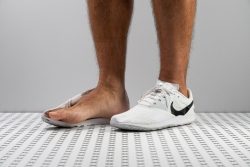
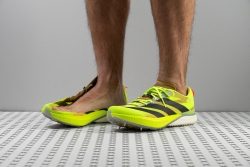
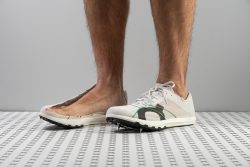
How we test cross country shoes
Although it’s a rather small category and not many produce models specifically for cross-country, we still want to get the cream of that crop. Here is our method:
- We buy the shoes with our own money to make sure we deliver a bias-free review.
- We test all the XC shoes on varying terrain and in different weather conditions.
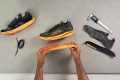
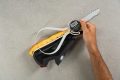
- We slice them open to see what's inside and which materials were used. Our lab tests reveal over 30 parameters that describe the shoe's performance, durability, and fit. We also compare the measured values to the averages to provide a more contextual explanation and analysis.
Best cross-country shoes overall





























What makes it the best?
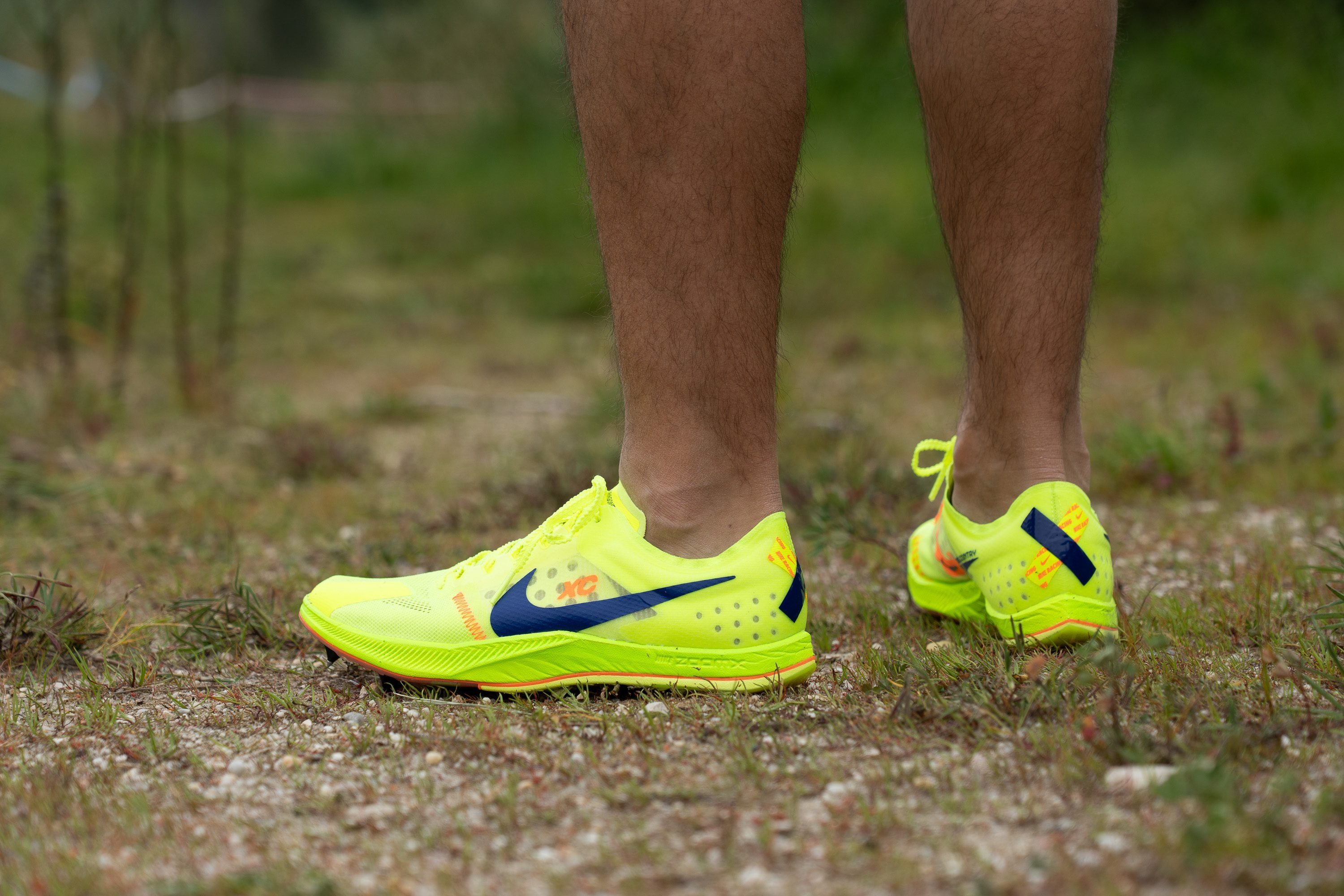
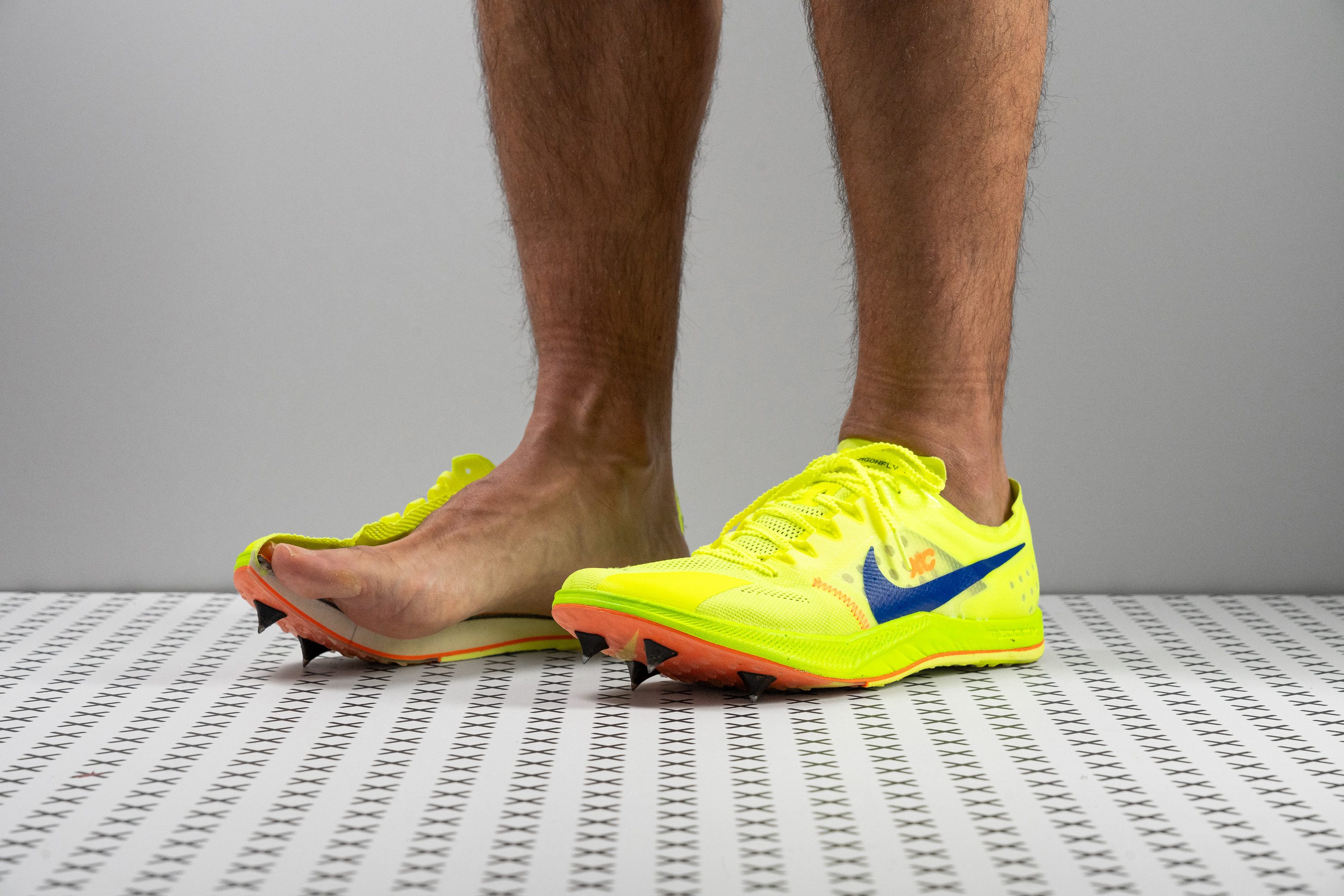
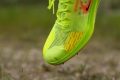
With its plush yet propulsive ZoomX midsole and a grippy outsole you can tailor to the terrain, the Nike ZoomX Dragonfly XC delivers a smooth, confident ride across any distance or course. Despite its thick stack, lab results show it maintains flexibility, which enhances comfort and adaptability. Our feet agree with what the numbers suggest: it’s the best cross-country shoe out there.
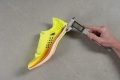
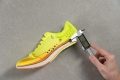
We measured the tall stack height at 19.6/19.2 mm, saving our legs until the final minutes of our run. It’s composed of the energetic ZoomX midsole, which made the ride much more enjoyable, with the Pebax plate adding snappiness to our strides.
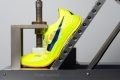
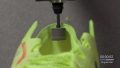
Thankfully, the thick stack and the plate don’t compromise the shoe’s pliability. Our bend test shows it’s 40.2% more flexible than average, making it easy to manoeuvre on uneven terrains.
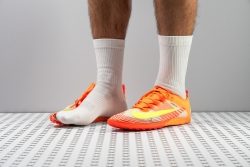
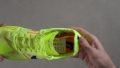
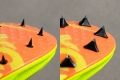
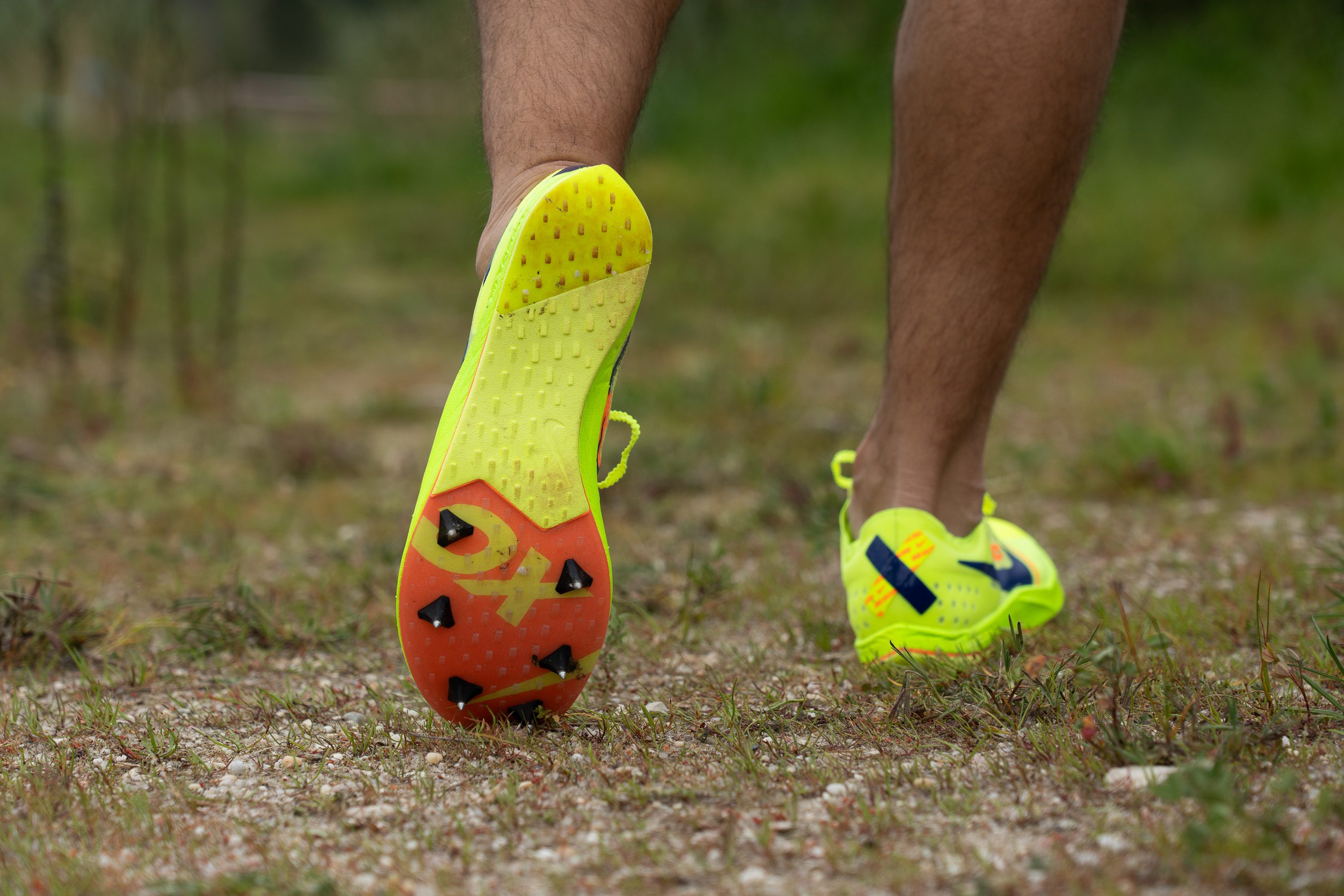
Underfoot, we measured the rugged and protective outsole with a hardness of 80.0 HC, 7.5% above average. Meanwhile, the forefoot has two sets of removable pins depending on the course. The first set includes sharp pins for hard-packed ground, while the second set includes pyramid-shaped pins for better movement in mud or grass.
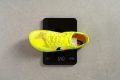
However, all the comfort and protection brought its weight down to 6.4 oz (181g). If a lightweight shoe is a must, we suggest looking elsewhere.
Pros
- Made to dominate XC events
- Rugged-built upper
- Bouncy ZoomX midsole
- Includes two sets of removable pins
- Fast and stable ride
- Works great on cinder and dirt tracks
- Superior, race-ready fit
- Airy upper
- Perfect for long distance events
Cons
- Heavier than the Dragonfly 2
- Pricey
- Not ideal for beginners
Best road shoes for cross country































What makes it the best?
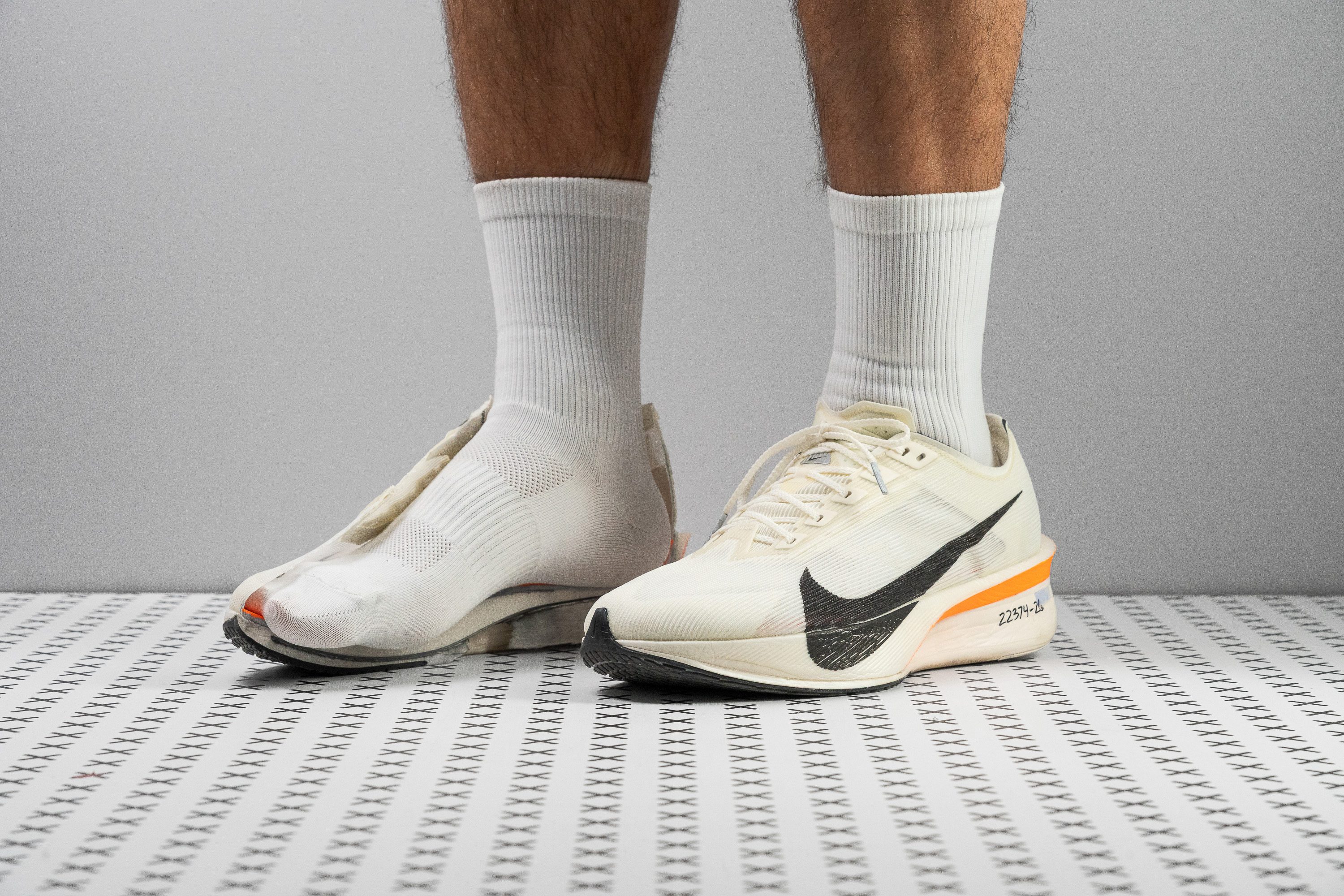
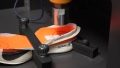
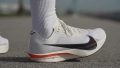
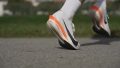
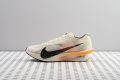
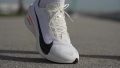
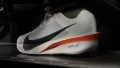
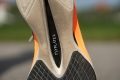
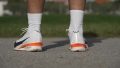
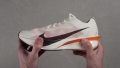
Repeatedly pounding hard-packed terrain calls for a well-cushioned, spikeless shoe. We discovered through lab tests and runs that the Nike Vaporfly 4 not only meets these demands, but exceeds them with an exceptionally fast, responsive ride. Therefore, it’s our top cross-country shoe for roads.
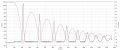
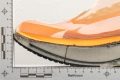
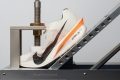
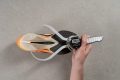
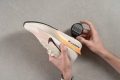
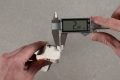
Impact on solid ground takes a toll on our bodies, but Vaporfly 4 prevents fatigue with its highly cushioned base. We measured the stack at 34.1/25.5 mm, which is way taller than the 16.0/15.3 mm average XC shoe. Moreover, the foam itself dampens impact with great shock absorption scores of 137 SA in the rear and 94 SA up front.
When we want to surge ahead and break away from the pack, this speedy shoe lets us do so. We credit the ZoomX cushioning for its high energy return, backed up with strong scores of 78.1% in the heel and 74.5% in the forefoot.
Its carbon-fibre Flyplate also adds snappiness to our strides, keeping our forward momentum strong. Moreover, this shoe weighs only 5.9 oz (166g), which is impressive for the comfort it offers.
Unfortunately, constant friction against abrasive surfaces like asphalt and cement will wear out the shoe quickly. With its disappointing performance in our Dremel test, we believe the Vaporfly isn’t a good match for those seeking a durable shoe.
Pros
- 13% lighter than the Vaporfly 3
- Awesome for 5K, 10K and 21K races
- Full ZoomX midsole
- Spring-loaded carbon-fibre Flyplate
- Fantastic lockdown with premium laces
- Moderate rocker for a more natural ride
- Improved perforated, removable insole
- Better rubber coverage in the forefoot
- Gets improvements from the Alphafly 3
- Great upper featuring breathability and durability
Cons
- Less ideal for marathon racing
- Still lacks the snappy feel of the Vaporfly 1&2
- Narrow midfoot and heel limit stability
Best trail shoes for dry and flat XC terrain









What makes it the best?
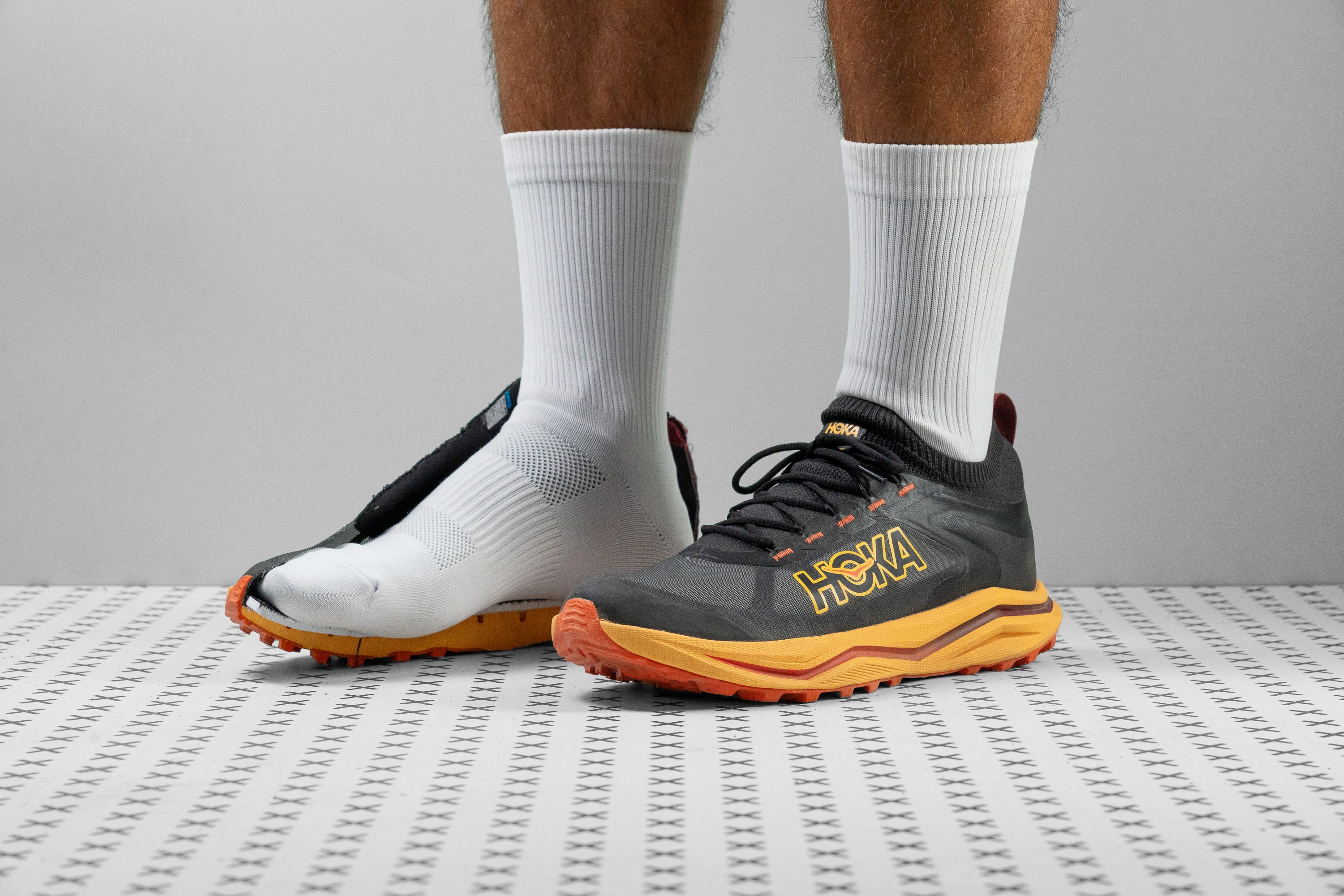
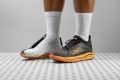
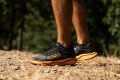
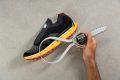
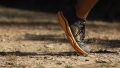
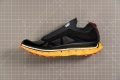
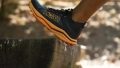
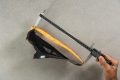
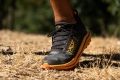
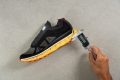
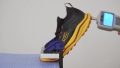
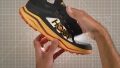
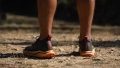
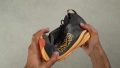
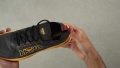
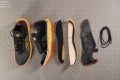
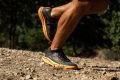
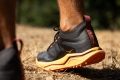
The HOKA Zinal 2 delivers unwavering traction and lasting comfort that make it our best cross-country shoe for dry and flat trails. Its Vibram outsole delivers the control we need without needing spikes. It has generous cushioning for muscle protection and feels great to be in for long hours because of its delightful ventilation.
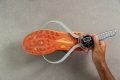
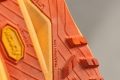
Instead of using spikes, the Vibram Megagrip Litebase features Traction Lugs with varied patterns to prevent slips. We measured the lugs at 3.7 mm, which are perfect for flat trails as they evenly distribute the pressure on our feet.
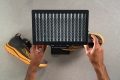
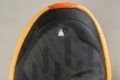
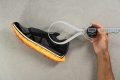
Testing the upper, it visually looks dense and warm, yet our runs tell a different story. We never found ourselves gasping for air, and its 5/5 breathability result in our smoke test confirms our experience.
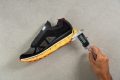
The midsole offers tonnes of cushioning and impact protection, as we measured a stack height of 29.8/22.6 mm. At this level, it comfortably exceeds the average 16.0/15.3 mm XC shoe. However, since Zinal 2 is intended as a trail shoe, it exceeds the race-legal limit for cross-country shoes. Therefore, participating in a race would require a different pair.
Pros
- Crazy lightweight
- Exceptionally fast
- Cushioned for its low weight
- Nice ankle gaiter combined with a sock-like upper
- Race-ready fit
- Handles technical trails and turns with top speed
- Features a Vibram Megagrip Litebase outsole
Cons
- Upper durability may be compromised
- Really narrow
- The CMEVA midsole isn't reflective of its $180 pricing.
Best budget cross-country shoes

























What makes it the best?
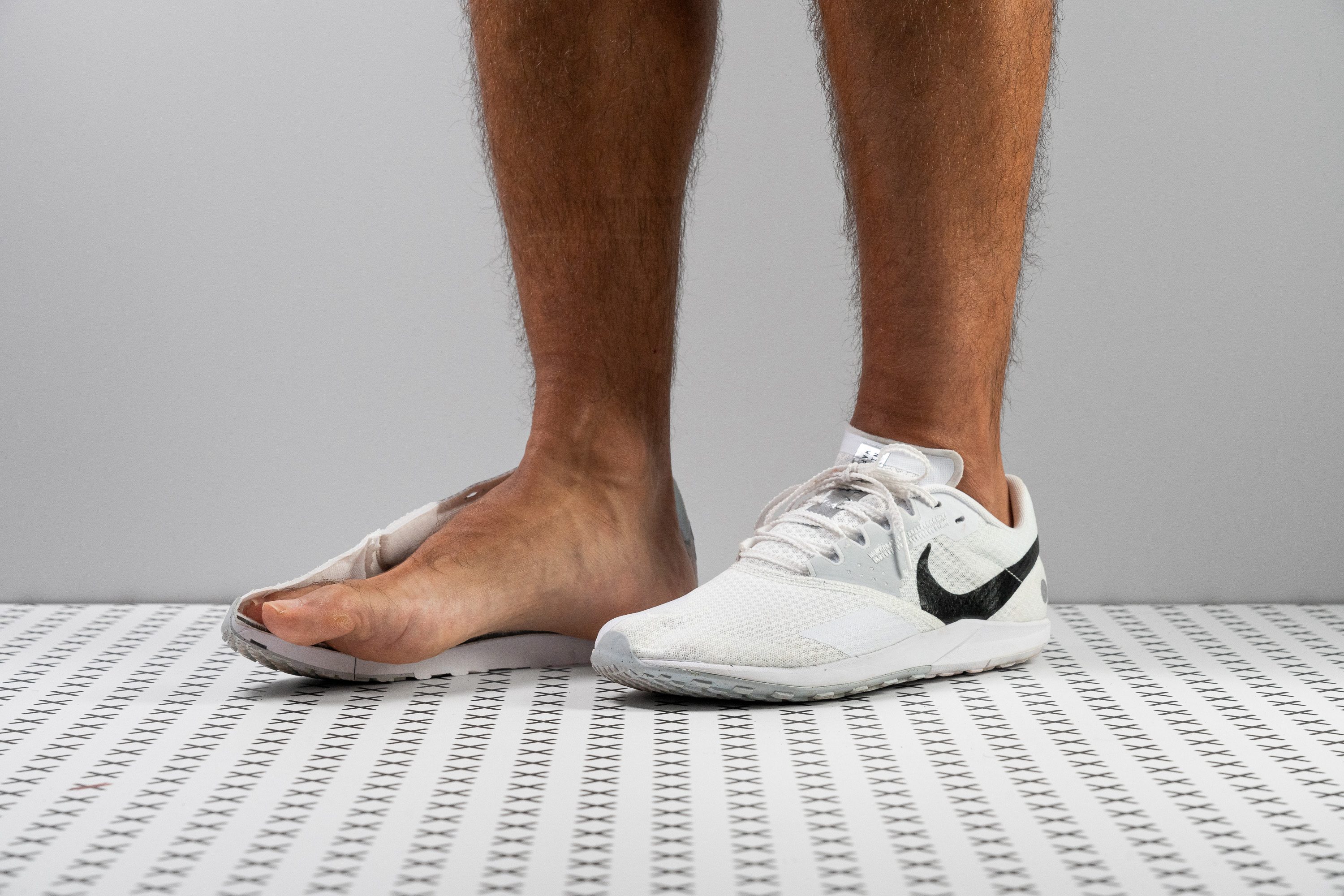
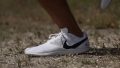
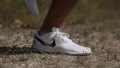
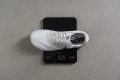
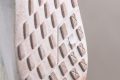
With its pliable build, stable base, and seamless ventilation, the Nike Rival Waffle 6 has a lot to offer for its very accessible £60 price. Staying way under the £90 range, it’s our best budget cross-country shoe, offering a great deal of support and comfort on course.
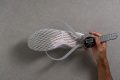
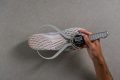
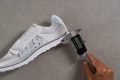
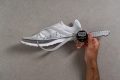
We tackled uneven paths without having a hard time manoeuvring the midsole. It bends easily with our feet, as our lab test shows a flexibility score 39.4% above average. It kept the ride natural, allowing us to enjoy the views in our cross-country runs.
The midsole is comprised of a cushioned 17.6 mm heel and a lower 14.8 mm forefoot. The resulting offset is steep at 2.8 mm, which feels more forgiving and beginner-friendly. Moreover, we measured a broad platform of 110.5/72.1 mm, which naturally boosts our surefootedness and stability.
The engineered mesh upper feels so refreshing that we could even wear it sockless. It promotes strong airflow, proven by its 5/5 breathability score.
However, the lower price comes at the expense of responsiveness. Those seeking a high-performance shoe should invest in stronger alternatives.
Pros
- Exceptional value
- Premium notched laces
- Highly durable
- Works for track too
- Waffle outsole!
- Superb stability
- Secure fit
- Breathability
Cons
- Noticeably heavy
- Lacks energy return
Best wide cross-country shoes

























What makes it the best?
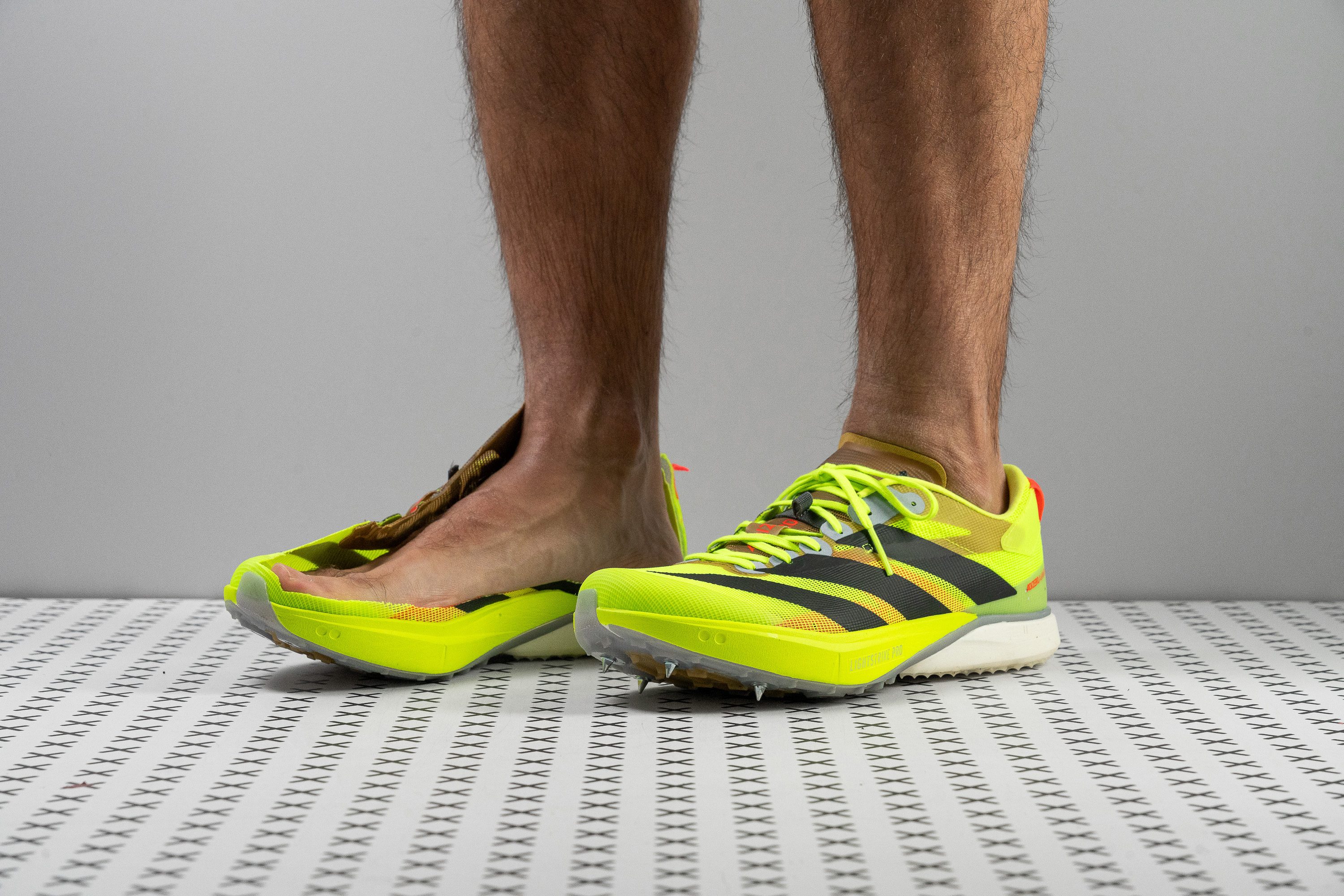
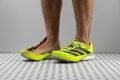
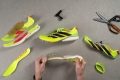
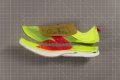
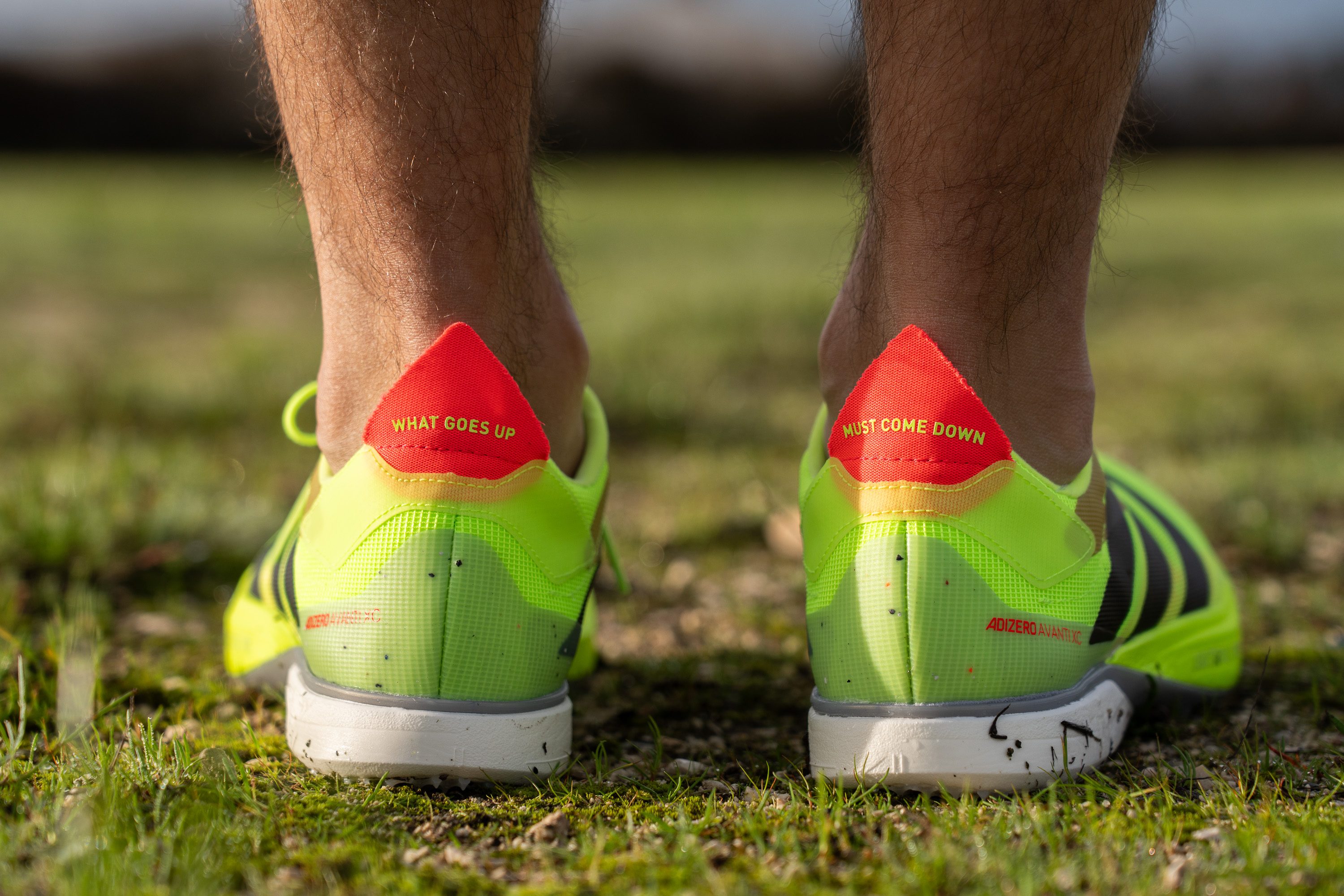
The adidas Adizero Avanti XC feels fast yet highly forgiving, with its cushioned yet stable and flexible base allowing us to go the distance. Besides its pliability, it provides generous room for broader foot shapes, and an expanded base that keeps us surefooted throughout our runs. Among cross-country shoes, it’s our top wide pick.
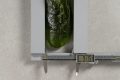
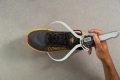
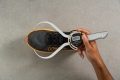
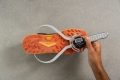
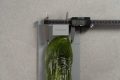
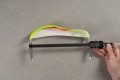
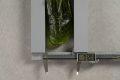
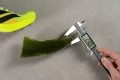
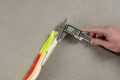
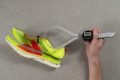
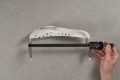
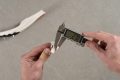
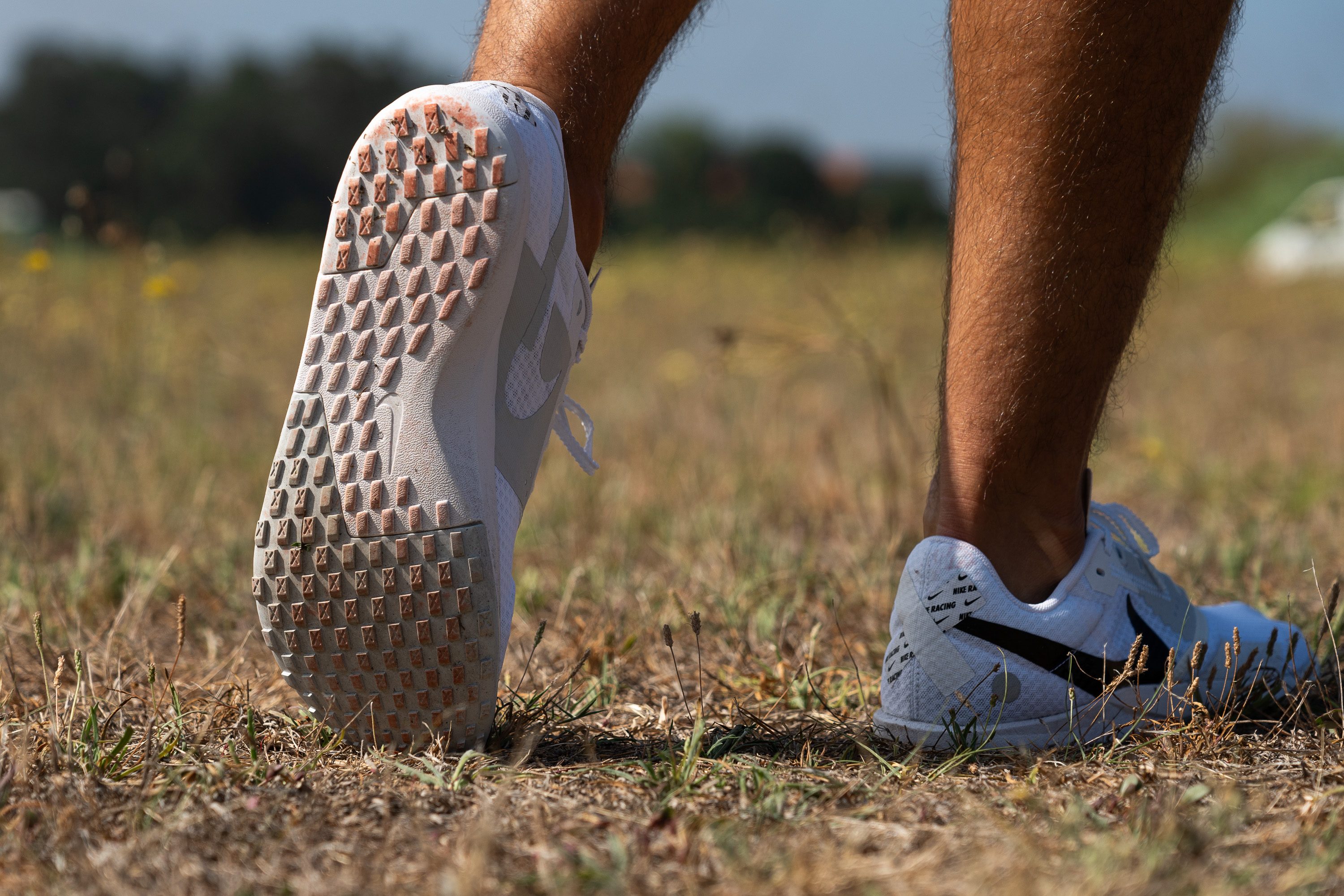
Using our gel mould, we measured the interiors of this shoe. Our calliper returned a massive 91.2 mm max width and a 74.1 mm toebox, both figures exceeding their respective averages by a mile. Even with thick socks or swollen feet, we didn’t have pressure points.
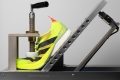
Moreover, the forefoot and heel are also wide at 103.6/68.1 mm. The extra space not only accommodates voluminous feet but also enhances stability. Despite its size, this shoe feels responsive with the combination of the Lightstrike Pro foam and the glass fibre plate. Unlike typical stiff carbon plates, this shoe remains 6.8% more flexible than average.
To sustain prolonged comfort, the midsole maxed out the legal limits for cross-country races, reaching 19.2/19.3 mm. With a -0.1 mm drop, it’s meant for fast paces with forefoot to midfoot landings.
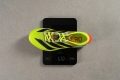
However, its wide footprint brought its weight down to 6.7 oz (190g). Runners who prefer top agility should go for a less bulky pair.
Pros
- Maxed-out stack height
- Bouncy Lightstrike Pro foam
- Wider-than-average toebox
- Stable platform for a XC spike
- Excellent ventilation and water drainage
- Recycled materials
- Generous heel rubber coverage
- Clever tongue elastic band
Cons
- Heavier than its main rivals
- Poor toebox durability
Cross-country shoes with the best durability





















What makes it the best?
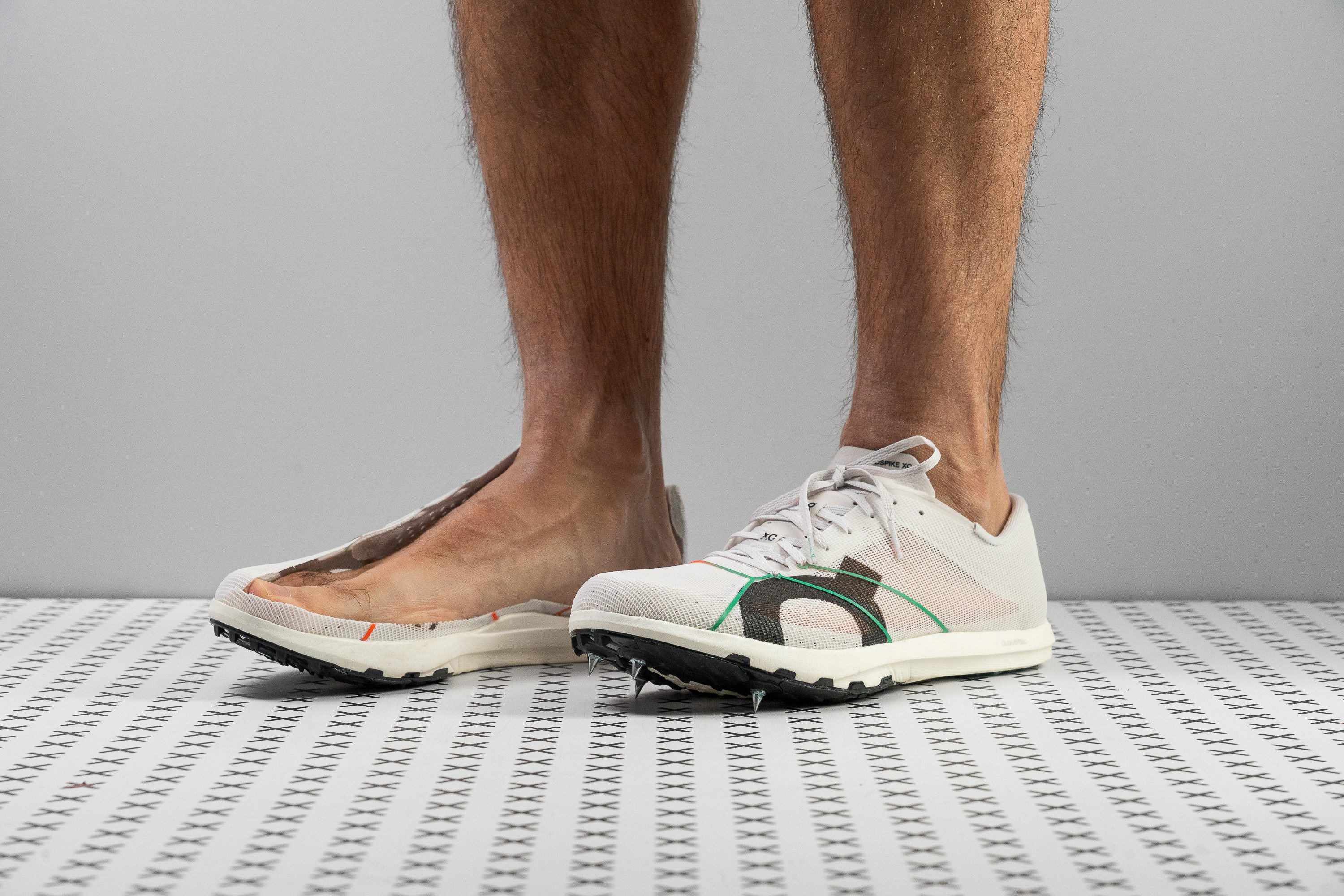
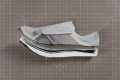
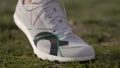
The On Cloudspike XC impressed us with its raw speed and ground contact, which lab tests show through its snappy Speedboard plate, low profile, and light build. It enhanced comfort through its strong ventilation, yet it stays protective and wear-resistant, proving to be the best durable cross-country shoe we’ve tested.
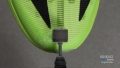
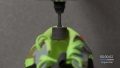
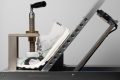
The upper is cleverly designed to keep water and mud out while allowing air to come in. We pressed our Dremel against the toebox, and it stayed intact, earning the maximum 5/5 durability score. In terms of airflow, whatever smoke we pumped in could easily escape, also earning the top 5/5 breathability score. Smashing both tests is very rare in the lab!
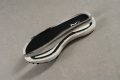
Cloudspike XC has a race-ready figure, weighing just below the average at 5.4 oz (153g). At top speed, it pretty much melts away on foot. The midsole also features the nylon-fibreglass Speedboard plate, which adds propulsion to our strides. We verified its snappiness when the midsole emerged 22.7% stiffer than average in our bend test.
We measured its stack at 16.6/19.3 mm, with a resulting -2.7 mm drop that explains its strong ground connection. This setup allows us to adapt quickly to various surfaces, but requires strong leg muscles. Therefore, we cannot recommend this aggressive shoe to heel strikers and amateur runners.
Pros
- Lightweight and fast
- Bouncy Helion HF foam
- Outstanding durability
- Forefoot stack pushed close to WA limits
- Aggressive ride
- Removable pins for versatility
- Solid build quality
- Excellent breathability and water drainage
Cons
- Not for beginners
- High price for occasional use
- Needs more colour options
Best lightweight cross-country shoes























What makes it the best?
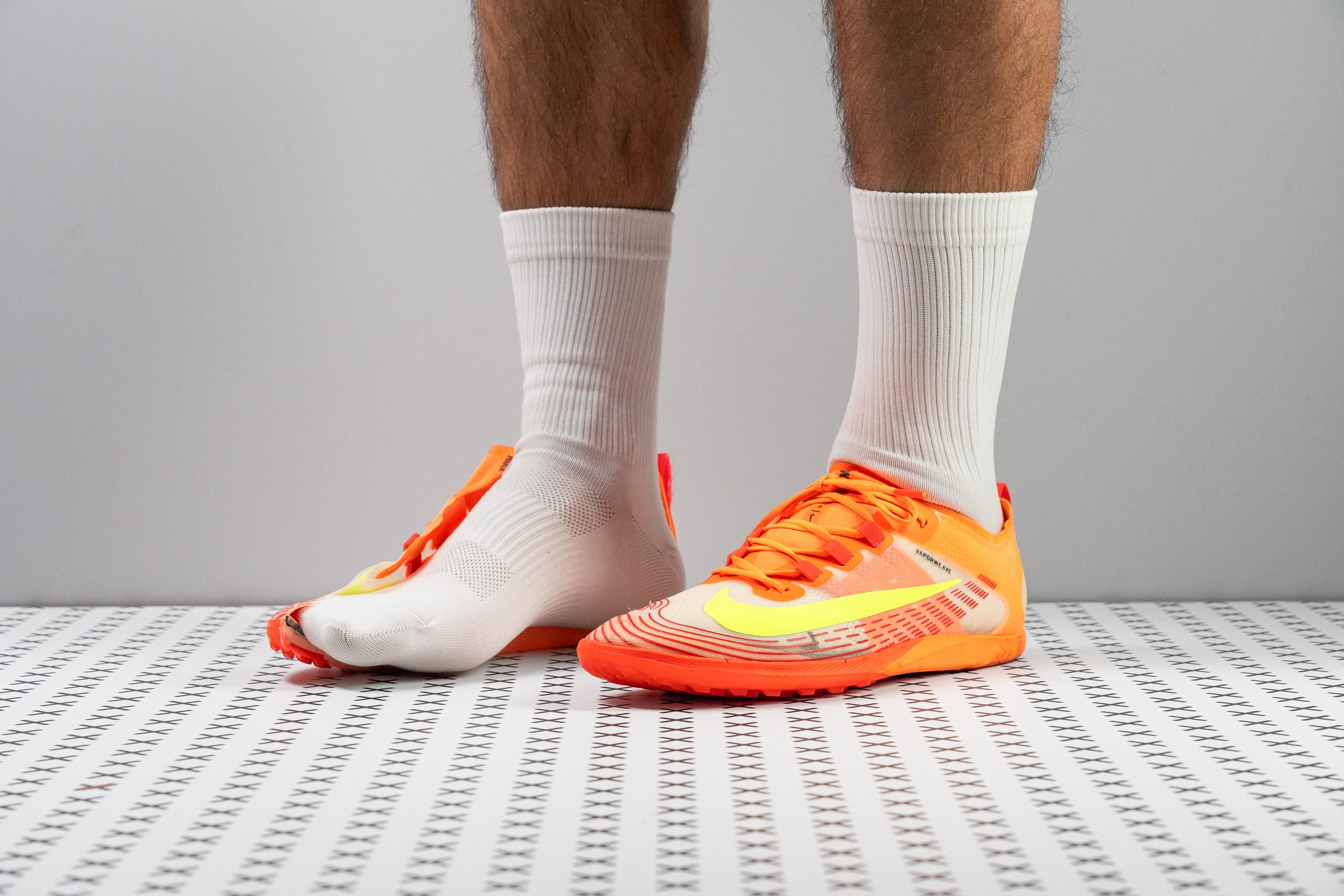
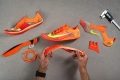
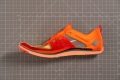
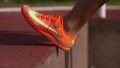
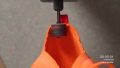
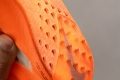
Nike Zoom Victory Waffle 5 is all about speed and agility, with its slim dimensions and close ground contact. Amidst all its snappiness, it feels so comfortable and easy on the foot, supported by lab tests showing it's the best lightweight cross-country shoe.
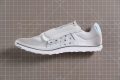
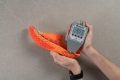
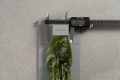
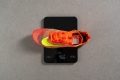
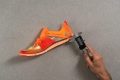
Zoom Victory Waffle 5 is meant to go fast with its snug fit and airy build. Our scales reflect what our feet knew. This shoe is exceptionally light at 4.6 oz (130g), making it 21.5% below average. We found narrow dimensions everywhere, from its 85.9 mm width to its 91.5/60.5 mm midsole.
We measured the stack height at 15.8/14.2 mm, which is ideal for cross-country shoes. It features a 1.6 mm offset, which offers strong surface feedback, allowing us to adapt to various surfaces quickly.
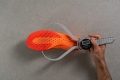
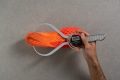
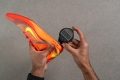
Even with all its energy, this spike surprisingly offers a pleasant ride. Its flexible nature offers lasting comfort. Our bend test shows it’s 60.6% more pliable than average, making it easy to manoeuvre along hills and muddy tracks.
We recommend those with wide feet to look elsewhere since this spike is very narrow. It took us more effort than usual to put our feet in.
Pros
- Some premium materials
- Ultra-light design
- Excels on soft grass
- Lively forefoot
- Exceptional ground sensation
- Great value
- Extreme agility
Cons
- Limited energy return
- Durability concerns
- Requires break-in time
If you’re new to cross country, we recommend assessing your form before purchasing a new pair of spikes. If you’re heel striking heavily, the spikes will be uncomfortable and you should be aware of the longer adjustment period. On the other hand, if the terrain is flat and mostly dry, you can use cross country shoes with no spikes or regular running shoes.
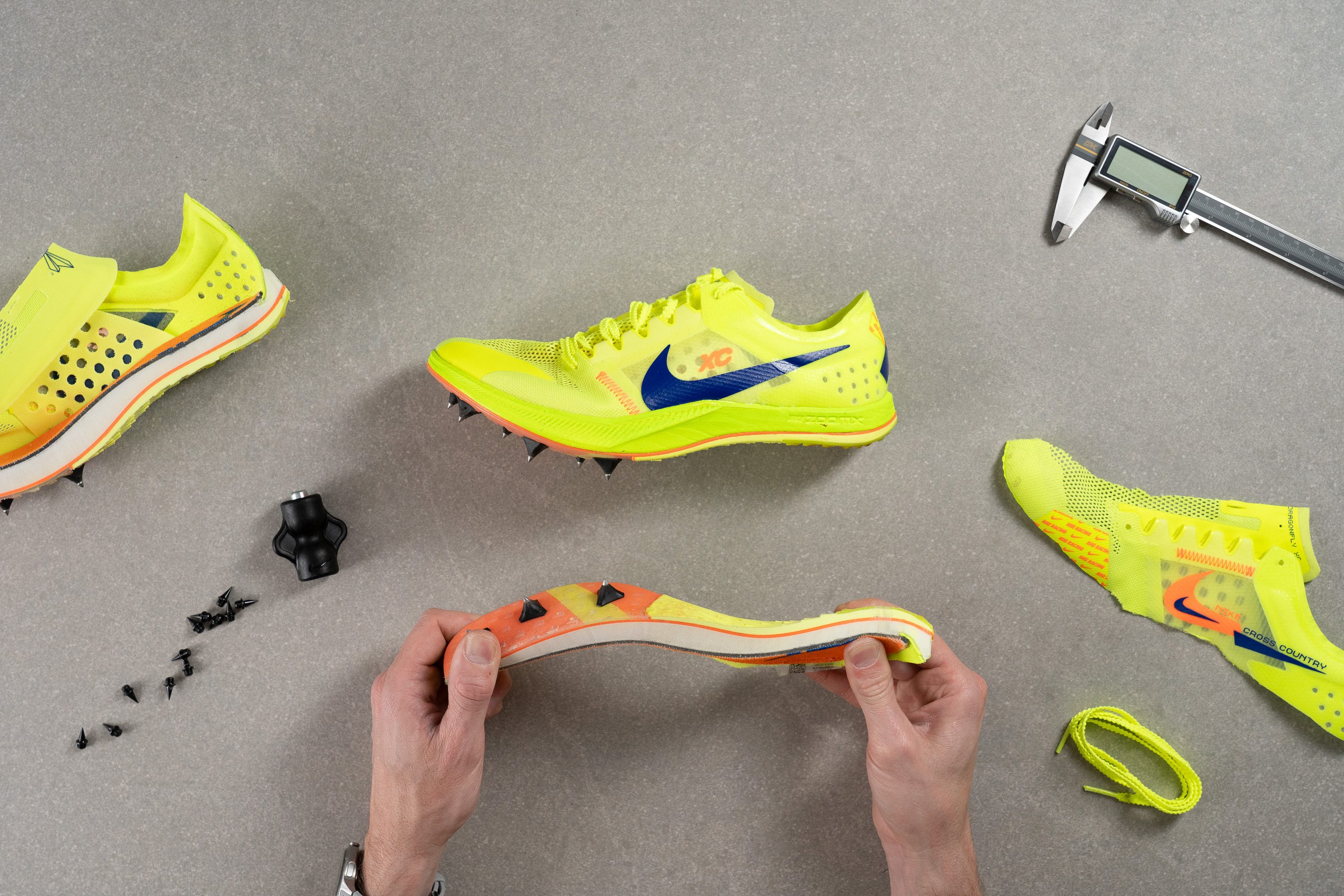
If you’re an experienced athlete chasing PBs, we recommend going for the top-tier running spikes (also called elite/premium). These spikes feature a carbon-fibre plate and a resilient, very lively foam. This combination allows for maximum explosiveness.
Further below, we cover details that better explain XC shoes, their performance, when and where they should be used, and how not to get a bad-fitting pair.
What kind of shoes do you need for cross country?
This is the most important question and it depends on the terrain (where you train and where the races are held) and on your experience (running form, biomechanics). Basically, you have 2 choices:
- Spikes: these shoes, as the name suggests, have spikes, making them excellent for wet grass, steep terrain, and soft ground when grip and every second count.
- No spikes: maybe you remove the spikes, or you use shoes that don’t even have the spikes by design. These shoes are used on flat terrain, with paved sections (asphalt, concrete).
If we’re talking about running shoes with no spikes, you can opt for cross country flats or regular running shoes, road or trail, depending again on the terrain.
When do you actually need the spikes?
When it comes to grip, spikes are as aggressive as it gets. When you run and your shoes bite into the ground, you worry less about staying upright, so you run more confidently and you become more aggressive.
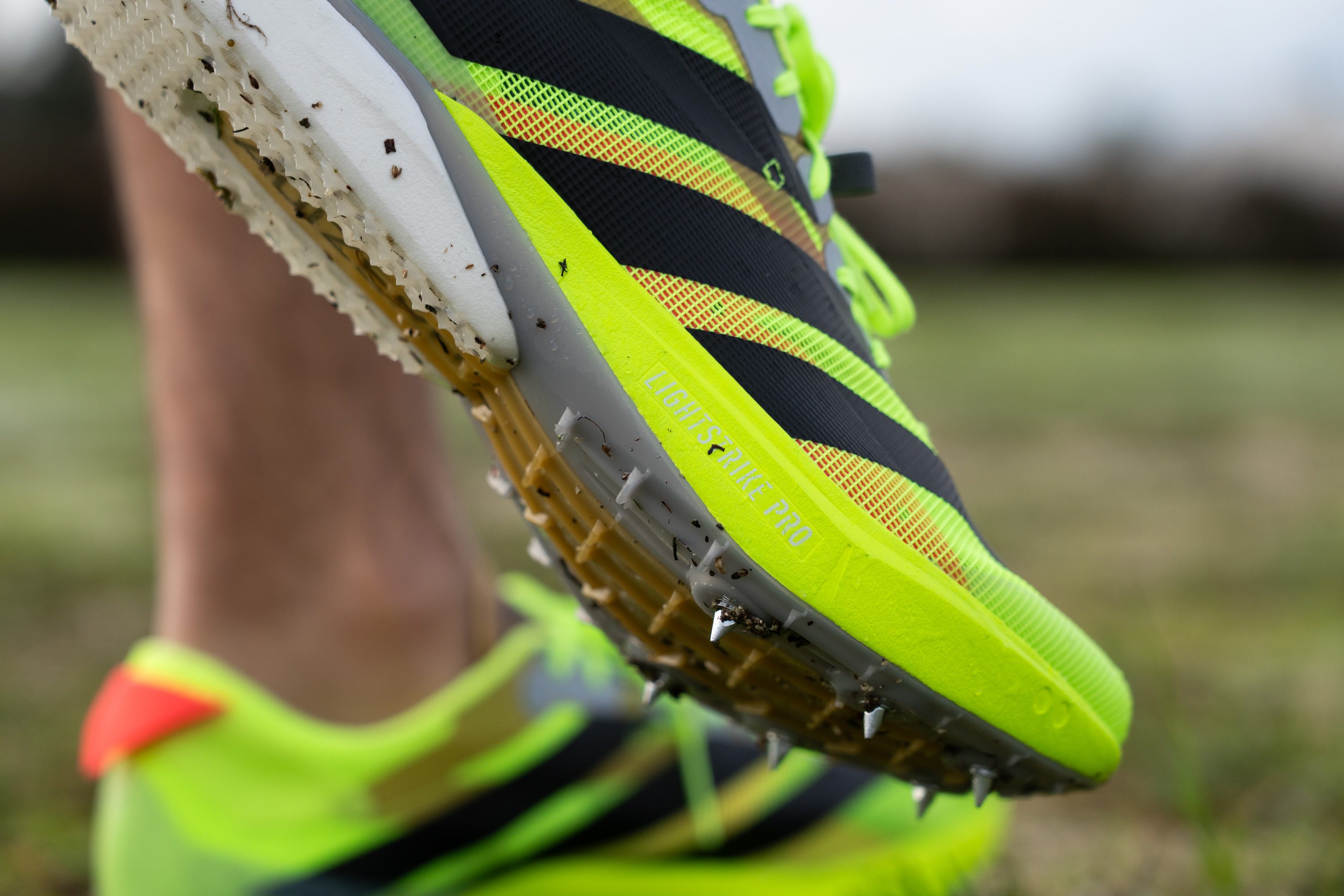
The spikes work wonders when used properly (for intended purposes):
- On hilly terrain
- On wet soft ground: muddy grass, loose dirt, or pure mud
- On fast grass fields
- Sharp cornering on soft ground asks for the most aggressive grip
- If you want to shatter records and, for you, every second counts.
Shorter spikes give you a better grip on gravel and grass, while longer spikes grip better on loose and muddy terrain.
|
Some XC spikes come with 2 sets of spikes, so you can easily adjust to the different terrain. |
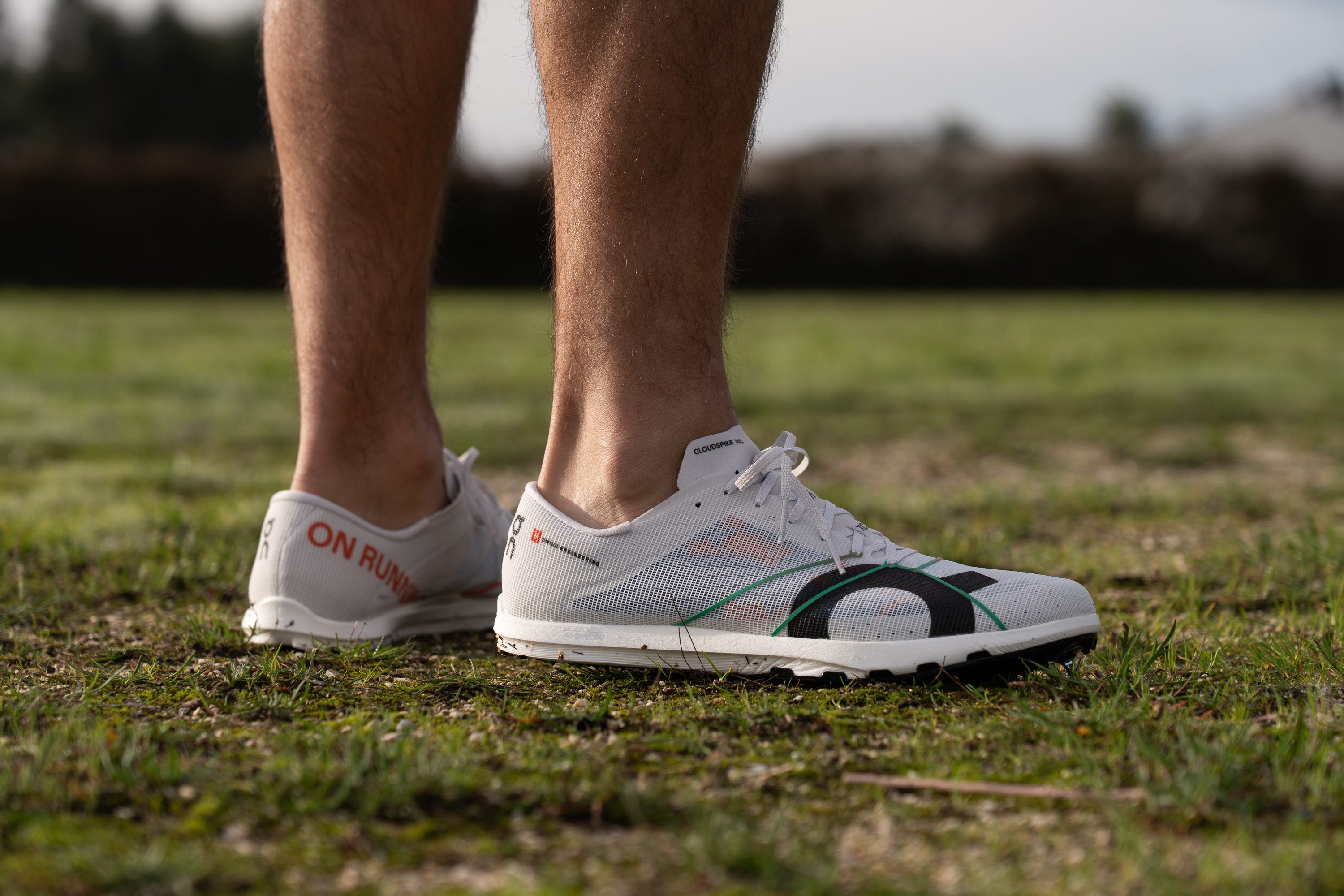
If you’re having doubts whether you should use flats or spikes, go for spikes if it’s muddy and hilly.
When NOT to use the spikes
If the terrain allows you to choose between spikes and flats, and if you’re not very competitive, run in shoes that feel better and make you more confident. This especially applies to you if you’re not used to the spikes yet and haven’t done enough training in them. When the terrain is flat and mostly hard ground, many athletes opt for no spikes.
Also, if you are a heavy heel striker with not enough miles in running spikes, your legs will feel it and, best case scenario, be uncomfortable. Strain and even pain are a possibility. If not familiar with this, do a gait analysis first.
When to use waffles in XC (spikeless)
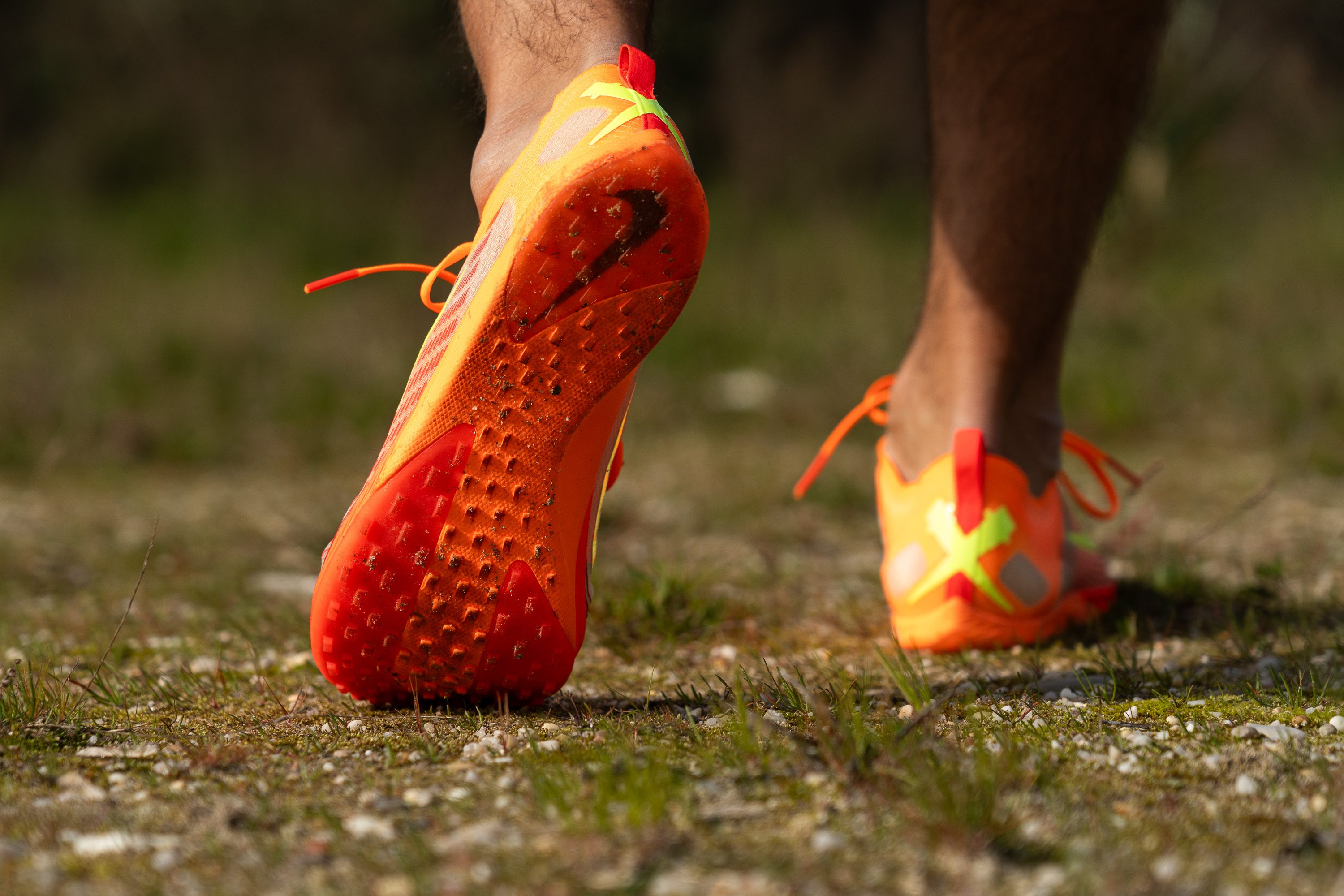
Cross-country shoes without spikes are called spikeless, flats, or waffles. There are many cases when you would not wear spikes in XC:
- They are forbidden by the race organisers. Those in California should pay special attention to this (spikes are not permitted)
- When most of the ground you’re covering is asphalt or other paved paths
- Flat and dry terrain (hard-packed), they can perform even on dry grass (or dry golf courses).
| In some cases, it’s worth removing the spikes and inserting blanks. These dummy spikes or caps will prevent dirt from entering the metal threads and will keep the metal threads undamaged. This way, you can honour the race organisers or simply perform better on concrete patches. |
Nailing the fit in cross country shoes: lab data
The fit in XC shoes is more aggressive than in regular running shoes. It has to be, especially if the shoes have spikes. However, that does not mean that the shoes should fit small or too tight.
By know, you already know the shape of your feet and where you may need extra room in the shoes – where it’s the widest, at the big toe, or maybe you need a higher toebox because your big toe is pointing up. That’s where our lab data chimes in!
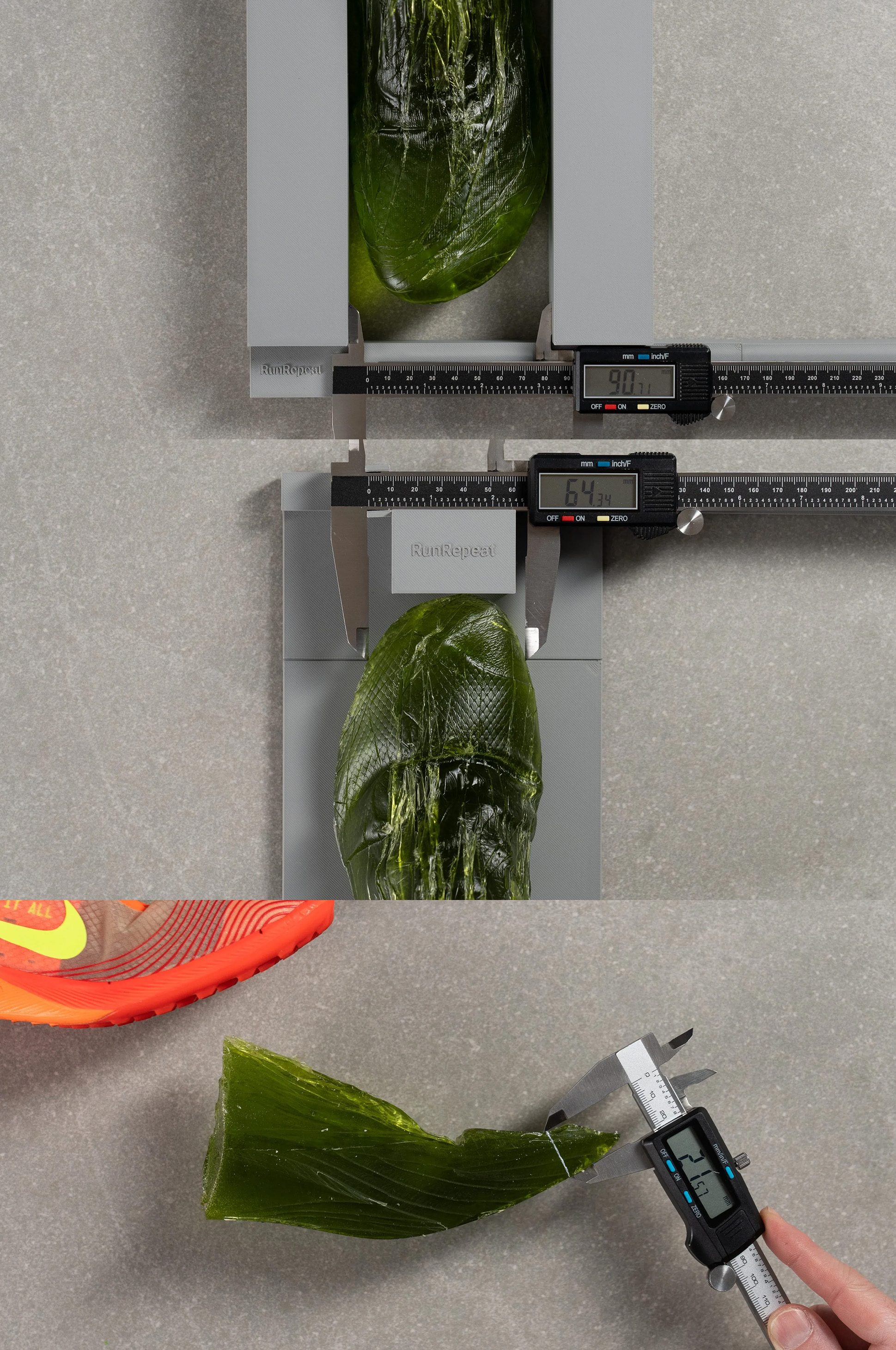
Based on our fit, toebox width, and toebox height measurements, you can find cross country shoes that offer more or less room exactly where your feet need it.
How heavy are cross country shoes?
In racing, every second matters. We can also say that every ounce matters as well! Heavier shoes mean slower performance (Rodrigo-Caranza et al., 2020), so it makes sense if you’re curious about the weight of XC shoes.
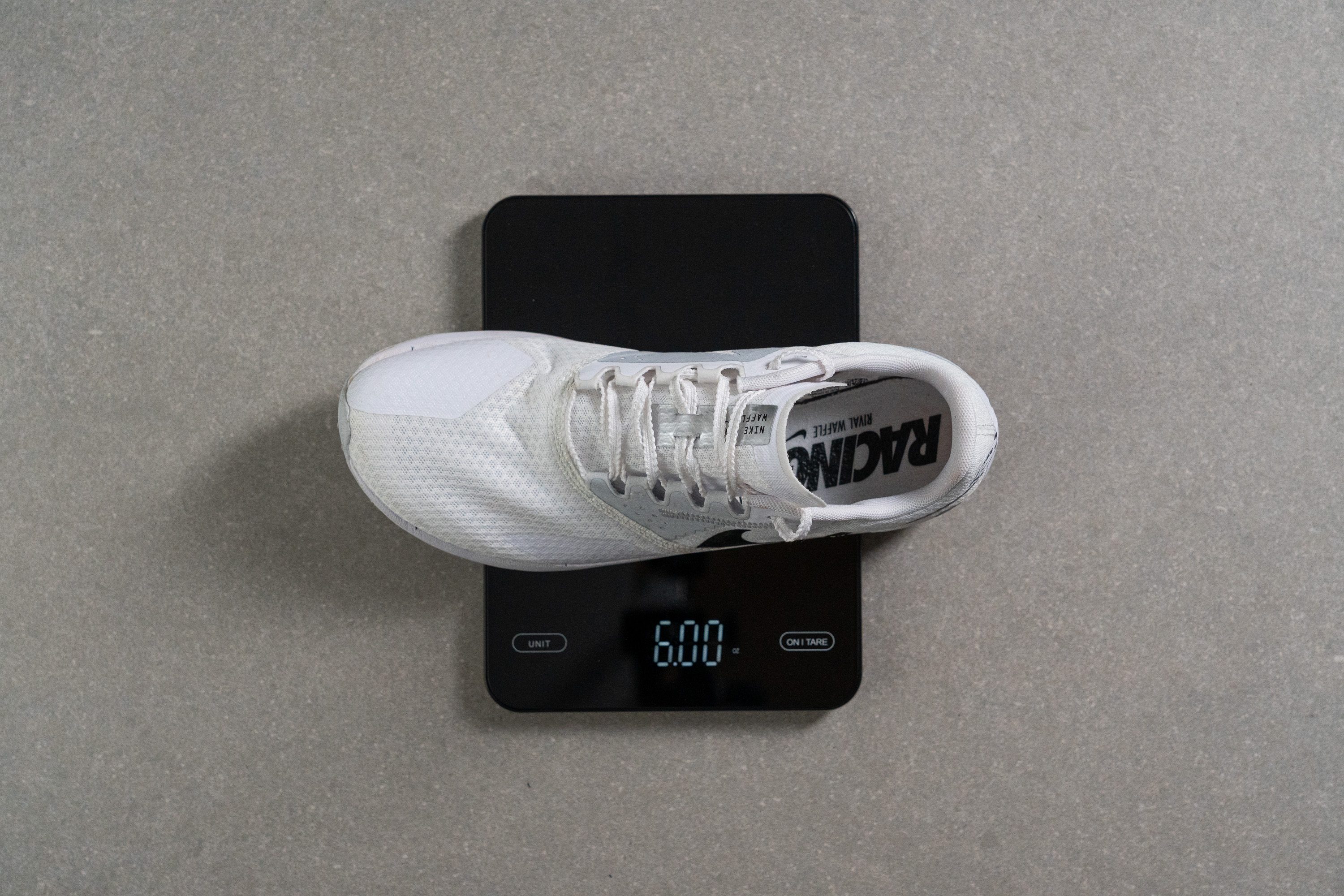
At the moment of writing this guide, the average weight of XC shoes sat at 5.6 oz (158g), while that of trail running shoes is 10.2 oz (289g).
Cushioning in XC shoes
Previously, XC was all about getting as close to the ground, because that meant lighter weight. With next-generation foams, we are fortunately past that. This means that in some XC shoes, you will be able to enjoy some cushioning!
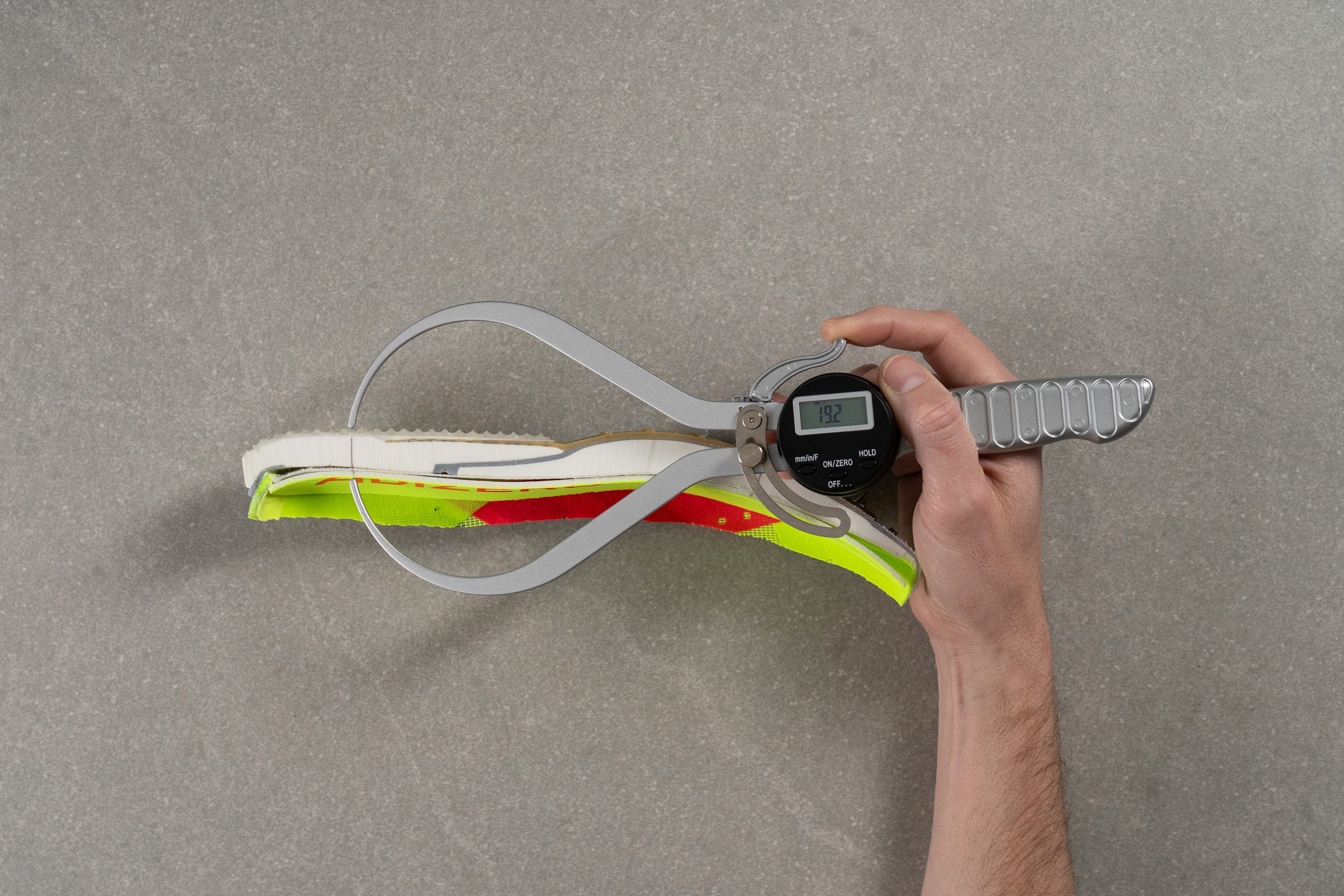
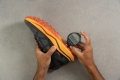
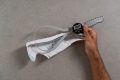
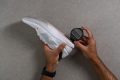
We then use an Asker C durometer to measure the midsole softness. The lower the number on the digital display, the softer the midsole in XC shoes.
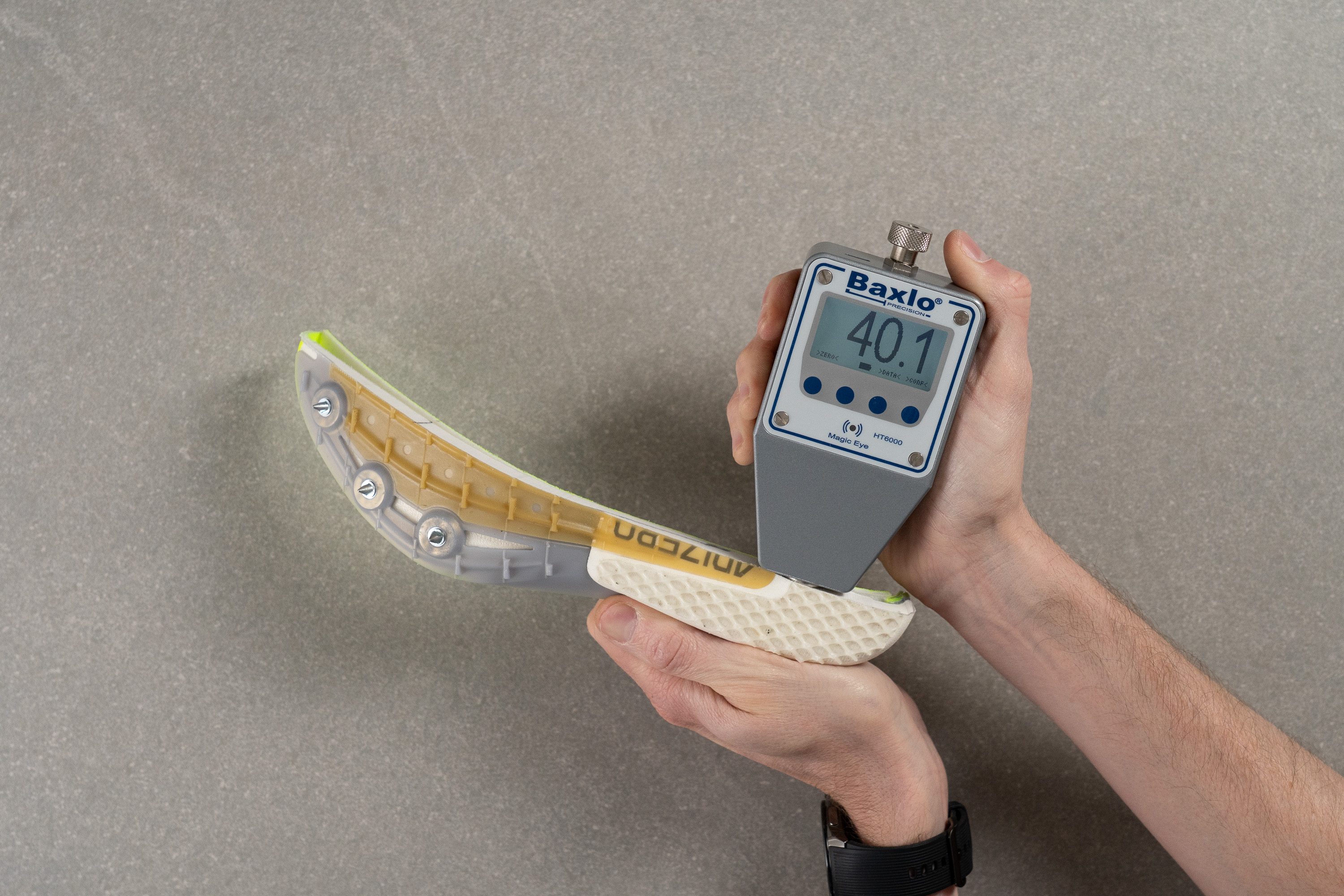
Knowing these numbers can help you find a softer or more balanced midsole.
Toebox durability and breathability in cross country shoes
This is one of the biggest differences between XC shoes and running spikes. Running spikes need to perform well on the track only. XC shoes have to protect you from the debris you will inevitably encounter on the trails, so we expect the toeboxes here to be more durable. Are they? Let’s look at the lab data.
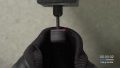
To test the toebox durability, we use a dremel to try to intentionally damage the toebox. This test is completely standardised, which means each XC shoe is treated the same (same force, same duration, same number of rotations per minute). The toebox above scored a perfect 5/5.
The video above shows us what a non-durable toebox (rated with 1/5) looks like.
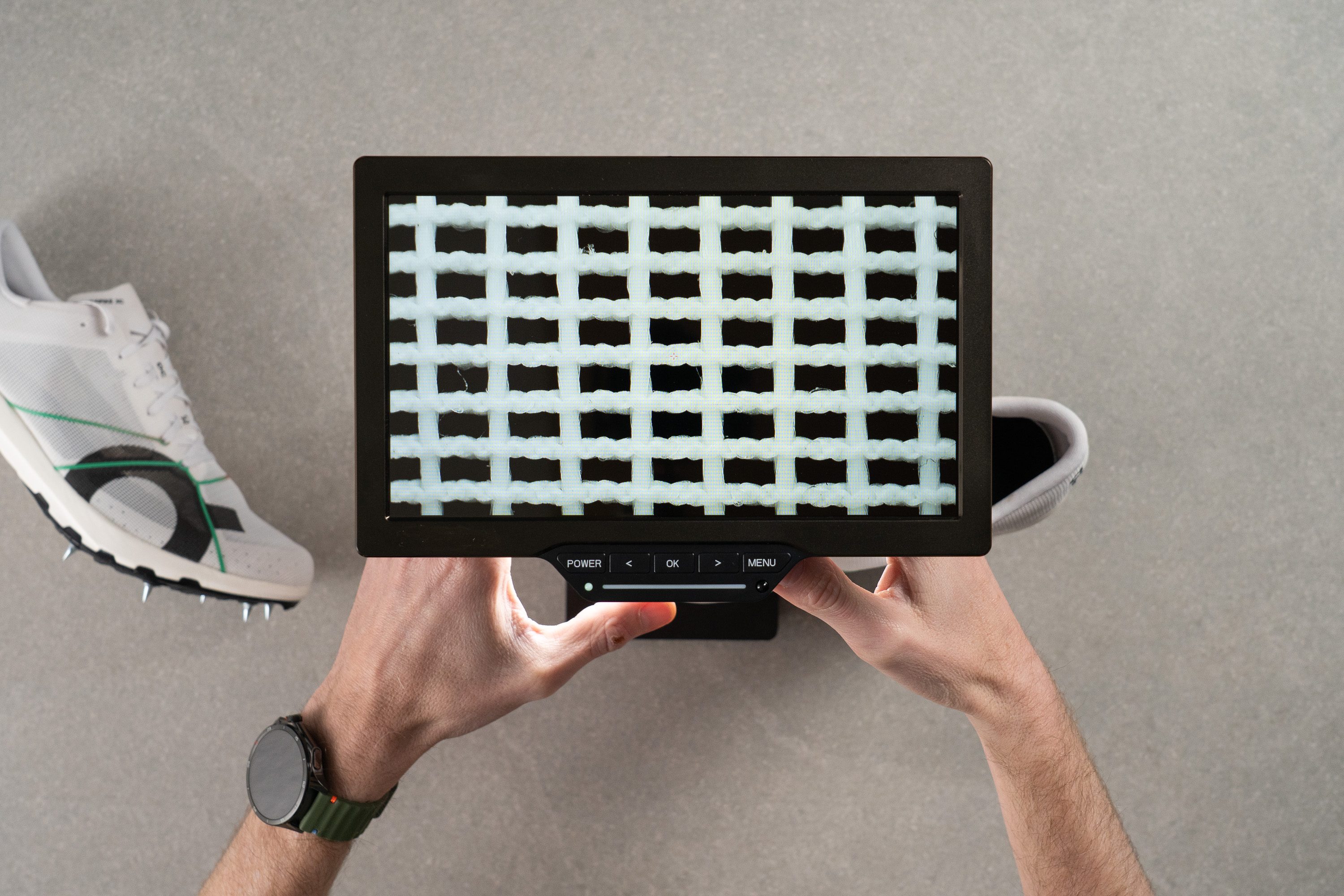
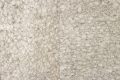
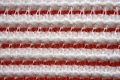
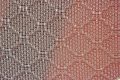
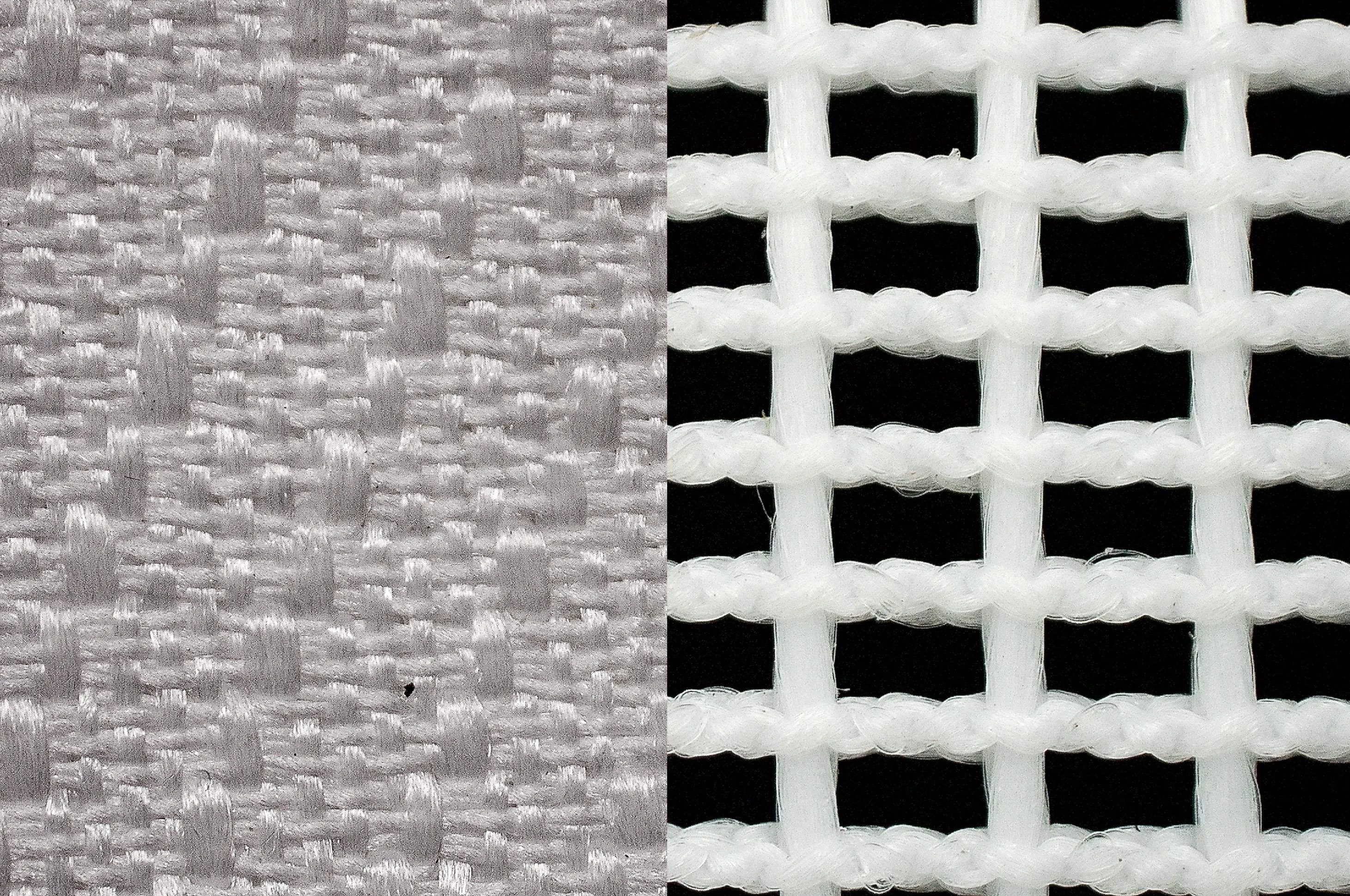
The upper material works best when it’s very breathable and yet very durable. The 2 don’t often go hand in hand. But, if you’re interested in the design of the upper, you can always browse our microscope photos.
We use microscope as part of our breathability assessment. Here, we also assign a 1-5 rating, just like in the durability test. 5/5 is reserved for the most breathable toeboxes.
How to get used to the spikes
If you’re just getting started and experiencing the spikes for the first time, your body will need some time to adapt to the maximal ground feel and crazy good grip. You may experience soreness and discomfort in your feet, shins, calves, and Achilles.
We recommend doing 100-500 metre runs on grass. You may also want to limit your meet distances to 3-5K in the first weeks.
If at any point you experience pain (so, more than fatigue and strain), we recommend seeing a specialist.
What to do when your calves hurt
If you started training in XC spikes, you might be feeling discomfort because you are not used to them. Also, your calves may be hurting. Possible causes are:
- You are still not used to the spikes and you need more time to adjust
- Your running form is not good enough for running in spikes and maybe you’re a heel striker
- You are using spikes on hard ground.
We recommend working on your running form and using spikes for strides. If the discomfort persists, consult a specialist.
What are super spikes?
The trend is clear, we got super shoes in running, so it made sense that we’ll get super spikes track and field. And we did, but the term is connected to the spikes for the track based on what we’ve seen in scientific research (Healey et al., 2022; Bertschy et al., 2025).
Running shoes as spike alternatives
When the terrain is mostly flat and dry, you can use running shoes instead of waffles. The features you will want to consider depend on your needs and the terrain:
- Definitely look for lightweight shoes because heavier shoes will weigh you down
- If you’re prioritising speed, comfort, and performance, look for light carbon-plated trail running shoes
- On rocky terrain, we recommend more cushioned shoes, which can be found as regular road or trail running shoes. The protective midsole will prevent your legs from feeling beaten up
- If the course is mostly made of road, look for lightweight race road running shoes
- If you need stability, don’t skimp on it. These models may be heavier, but will provide the extra stability you need on roads, which will make you run more confidently
Running spikes vs. XC spikes
When not paying too much attention, one may think that running spikes and XC spikes are very similar and, therefore, could be used interchangeably, on track and on trails. One would be wrong.
Running spikes often have shorter spikes than XC spikes, and they are less stable and durable because they are intended for track use only. XC spikes, on the other hand, have longer spikes because they need to grip hard into the mud at various angles (steep terrain), and they are less stiff than XC spikes. Very long spikes found on cross country shoes could easily damage the track.
There are some rare instances that would allow you to use XC spikes on the track: if the spikes are short or closed with dummies, and if the rules allow such use.
Check if spikes are allowed
Before registering for an XC race, you should check whether the spikes are allowed. Race organisers may forbid them so it’s good to be prepared. Your options, given that you want to participate anyway, are: inserting dummies into the spike holes or using regular running shoes.
Similar buying guides